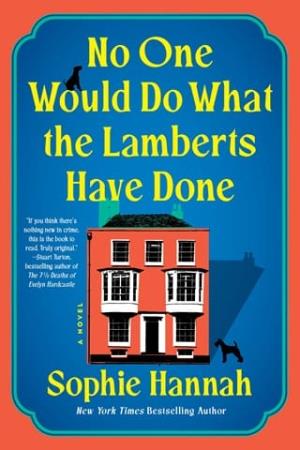
No One Would Do What The Lamberts Have Done
Chapter Monday 16 September 2024 Connor
Connor
Detective Connor Chantree was afraid he’d already ruined everything and was about to be sent abruptly on his way.
He should have explained to Large first and only then handed over the bundle of papers.
He’d done his best to uncrush them, straighten them out, smooth away creases, and brush off what dirt he could.
Then he’d arranged them into a rectangular shape, which had taken far longer than he’d expected it to.
He’d added two red elastic bands, top and bottom.
The result was unimpressive. It sat in the middle of Large’s desk and seemed to drink in the baffled stares of both men; and yes, Connor checked with himself—those battered pages did look thirsty in a way those not in the room would have called impossible.
Somehow, increasing the tidiness of the bundle’s presentation had achieved the opposite of what Connor had wanted.
The document (Was that the right name for a few hundred pages?
Should he think of it as something else?
A book?) looked nothing like the sort of pristine, sharp-cornered contender he’d hoped to create.
Contender? Words were appearing in Connor’s head that he was sure hadn’t been there before he’d read the…
thing. Ideas too. Like this one: The spruced-up, rectangularized heap looked as if it was trying to mock convention, as if it had scuffed itself and kicked itself about a bit in an act of deliberate defiance.
Even to Connor, its curator—curator?—it seemed to be saying, And your point is?
whereas the mess of maimed and defeated pages he’d seen on first opening the box had screamed a different message at him: Pay attention! Help! Put me together!
There was a strong chance, of course, that he was imagining some of this. He wished he’d brought in the soggy box, exactly as he’d received it and without reading any of the contents, and simply handed it over. “Above my pay grade,” he could have said as he’d passed the problem on to Large.
Who was he kidding? He couldn’t have done that; the possibility hadn’t occurred to him because it had never existed.
He’d felt duty bound to drop everything and read the thing from start to finish before doing anything else.
The physical package had been left for him, marked for his attention, and with it had come a powerful sense of duty that couldn’t be shirked.
“What’s this, Chantree?” Large said. “Why is the name Lambert back on my desk?”
“Sir, I think you need to read it,” said Connor. “Fairly urgently.”
Large picked it up and removed the elastic band at the top.
He spent nearly five minutes reading small sections from randomly chosen pages.
“So,” he said eventually, in the voice of one forced to consume many disadvantageous and depressing realities all at once.
“You’ve written a novel about the Lambert family and their recent travails.
I’ll admit it: I’d prefer to live in a world where that hadn’t happened.
And in second place—my runner-up choice—would be not knowing it had happened and never finding out. ”
Connor didn’t think he ought to know what the word travails meant. It alarmed him that he did. “Sir, I didn’t write it—”
“Then who did?”
“—and I’m not sure it’s a novel.”
“It looks like a novel.” Large kept his eyes fixed on the bundle, in the careful way a king might watch someone he suspected of being a treasonous impostor about to stage a coup.
“It has a title—one that’s probably too long to fit on a cover.
Just in case you were thinking of publishing it, which would have all sorts of legal…
” Large broke off, but not before Connor had frightened himself even more by finishing the sentence in his head with the word ramifications, another one he didn’t think he ought to know.
“But you say you didn’t write it.” Large frowned. “Then what is it? Where did it come from?”
“Sir, you need to read it yourself. I can’t—”
“And I’m not going to do that.” Large smiled conspiratorially, as if they had both known all along they would end up here and could now unite in celebration. “Tell me what you hope I’d think or do if I read it. That will move us further forward without undue suffering accruing to me.”
Connor had read the thing twice and still had no idea what he thought ought to happen next. He had even less of a clue what Large’s response might be. He couldn’t say that, though. It was too vague and likely to get him waved out of Large’s office.
He said, “You’d wonder, like I’m wondering, whether the coroner maybe got it wrong. Whether perhaps there’s reason to suspect—”
“I see. That’ll do, Chantree. Thank you.
” Large let the manuscript fall from his hands.
It landed on his desk with a thud. “Take it away, please, whatever and whoever’s it is.
You know as well as I do: The autopsy ruled out any deliberate action.
Suicide, murder—both possibilities were eliminated, happily for all concerned.
Let’s not seek out further trouble, shall we? ”
“But then what killed her?” said Connor.
“Healthy young people don’t just die for no reason.
Look, I’m not saying it wasn’t a natural death.
We know it was. And there’s nothing in those pages to support a murder charge, if that’s what you’re worried about.
The Crown Prosecution Service won’t touch it.
But given that the autopsy found no trace of—”
“Chantree.”
This, Connor recognized, was the point beyond which no more of his unsolicited words would be allowed to pass. “Sir?”
“The Lamberts have been through enough. Don’t you think?”
“Definitely.” He’d heard the unspoken bit at the end too—partly thanks to you, you stupid, gullible git—whether Large had silent said it or not. Connor had been silent saying it to himself every day, at least ten times a day, since the truth had come out.
That was assuming the truth was what they all now believed it to be.
And if it wasn’t, how could it possibly be down to him, Connor, to correct the mistake?
The extent to which he felt chosen was impossible to ignore.
Yet, who in their right mind would choose him?
He was very much an “I do my best” kind of person but not at all an “I’m determined never to give up until I get the result I want” sort.
The difference between the two approaches, and which camp he fell into, was made clear to him soon after he’d gotten married sixteen months ago.
He was the most useless variant of the “I do my best” type—the sort that tended to have a wistful “Oh well!” attached to it.
Whoever had left the box for him had picked the wrong person.
They’d have done better to target his wife, Flo.
Nothing fazed her. She’d have strolled into Large’s office with far less trepidation than Connor had felt as he’d hovered on the threshold, not caring that she didn’t work in the same building or profession.
“I trust you won’t be offended if I point out that the Gaveys suffered too,” said Large.
The Lamberts and the Gaveys. Connor had been transfixed and now felt haunted—no, that wasn’t an exaggeration—by the way the two families had been presented as a sort of entwined pair, predestined to be enemies to the death; that was what the voice in the pages implied over and over again.
Whose voice was it, for God’s sake?
If only Large would read the manuscript…
“Yes, sir,” Connor said. “All things considered, there’s been an incredible amount of suffering on both sides. Lamberts and Gaveys.”
“We agree, then. No need for any more. Good.” Large sounded jollier. “Is there anything else you’d like to say before you leave and take this malodorous clump with you?”
Connor had sprayed the pages with his wife’s strongest perfume—“1996,” it was called—but for some reason the scent hadn’t stuck and the original odor had reasserted itself: a blend of earth and meat, as if the bundle of paper had been buried in the ground alongside a dead body, then dug up a few weeks later.
“Yes, sir.”
“Pardon?” said Large.
“There is something else I’d like to say.
” He had to try. If he didn’t take inspired action now, he never would.
He found it alarming whenever Flo started to rant about her willingness to die on hills, but he knew he wouldn’t be able to rest easy until he’d seen the view from the one he was about to ascend. (Last week, he’d have said climb.)
“Is it about the Lamberts?” asked Large. “The very finished-and-concluded matter of the Lamberts, about which no more needs to be said, ever?”
“No, sir.”
“What’s it about?”
“My sister’s tattoo,” said Connor.
“Are you being serious, Chantree?”
“Yes, sir. You see…” Was he going to take the plunge? Was he a dickhead?
Yes. Probably. “My mum begged her not to do it, but there’s no telling our Danielle.
She’ll always do what she wants, and she enjoys it even more if it pisses you off.
So she got inked up, right, and it’s… Well, I don’t mind tats, but it’s pretty bad.
Covers the whole of her left thigh, and, sir, that’s not a small area.
” Connor made sure not to look at Large’s enormous stomach as he said this.
“And Mum thinks everyone who gets a tattoo’s going to be unemployed forever or end up dead or in prison, which is obviously daft, but she’s right about our Danielle’s tattoo. It looks awful.”
“Chantree—”
“Sir, let me finish.”
“Are you trying to trick me into wondering whether a natural death was a murder, via an analogy involving a bad tattoo? My money’s on yes.”
“It’s meant to be an animal skull, but it looks like a motorbike that’s been tortured to death, Mum says. I’ve never seen her so distraught. Couldn’t stop crying for days. Absolutely gutted, she was. It’s hard to explain if you don’t know her—”
“Don’t try,” Large advised. “Just get on with it, if you must.”