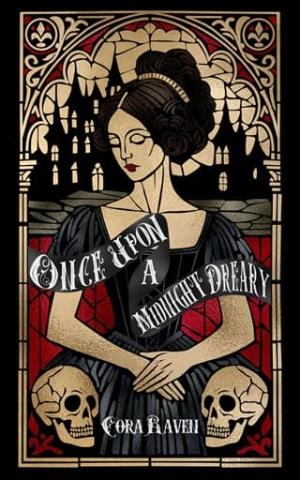
Once Upon a Midnight Dreary
Prologue
Dearest reader,
If this account ever finds its way into your hands, I ask only one thing of you before you continue.
Do not decide too quickly that I am insane.
Madness is an easy verdict and society has always found it convenient—particularly when a woman speaks too much, remembers too well, or dares to insist upon her own version of events.
It is far simpler to say she imagined it all than inquire why so many appeared invested in convincing her of just that.
I write this not as a confession, nor even as a plea, but as a record. These pages are not meant to defend me. They are meant to unburden me from the terror I endured.
You must understand, before I began this tale, that my mind was not always fractured. I was not born delicate, hysterical, or prone to fantasy. If I have become so, it was not without careful encouragement.
I was raised beneath the long shadow of a woman the world decided was broken long ago.
My mother was once beautiful, brilliant, witty, and married well.
Society adored her—until they didn’t. She loved me fiercely, desperately even, but there were moments throughout my childhood when she would seize my wrists with trembling fingers and stare at me with terror clouding her eyes, whispering about the evil trapped in her child.
They took her from me when I was eleven.
I remember the night vividly, though I have been told that memories are treacherous things. Children embellish and grief distorts.
But one does not easily forget terror.
If I close my eyes, I can still feel her fingers digging into my arm as she dragged me from my bed.
I recall the smell of her floral perfume and the stickiness of her sweat-drenched skin.
I remember the way my voice broke when I screamed for my father and I can still see the glint of the knife in her hand as she raised it above my head.
But mostly, I remember the pain.
By the time my father and the servants pried her away, the gash across my cheek had already begun to bleed down my throat. The scar it left remains still—pale, jagged, and merciless—an ever-present reminder of the moment my mother went mad.
As they dragged her away, she twisted back toward me, her eyes wild, her mouth twitching as she whispered, “I only wanted to cut away the evil from her.”
There were moments, later in life, when I found myself wondering if perhaps my mother was not entirely wrong about the evil that lived within me. Whether perhaps she had seen something in me that others did not.
Was it possible that she had not been entirely wrong about the darkness that lives within all of us?
Or perhaps it was simply a nagging seed of fear that took root in my conscience and grew quietly over the years.
Regardless, as I grew older, I noticed how quickly concern turned to discomfort when my name was spoken.
Invitations to balls and soirees quietly stopped arriving.
Conversations faltered when I entered a room.
Eyes would linger just a bit too long on my scar before sliding away with polite horror.
I learned that poverty was not my greatest shame.
Poverty, when accompanied by a titled father, could be forgiven, overlooked, even pitied. Madness, it would seem, could not.
And yet, I wanted what all women are encouraged to crave. Marriage, security, and of course, respectability.
If you have been told that I sought attention, you have been misinformed. I sought only for survival after my father passed away.
What followed—my marriage, the manor, the staff, the whispers, the dreams, the shadows in the halls—I am told cannot possibly have happened.
That no one conspired to break me. That what I saw in that manor were figments of my overactive imagination born of trauma, grief, and one too many morbid books.
Perhaps.
But before you decide how this ends, I ask you only one small thing: Will you read this as the diary of a woman unraveling? Or will you allow for the possibility that perhaps unraveling is sometimes done to us?
I will not promise clarity, only honesty as I experienced it. Whether that proves sufficient is no longer within my control.
So if, after reading what follows, you choose to believe that madness was solely my undoing, I will not fault you. It would be far easier than accepting the alternative.
I set these words down not to beg for sympathy or absolution, but simply to be heard. Whether you trust me or not is a decision only you can make. I can only tell you what I saw. What I felt. What I endured.
As Edgar Allan Poe, himself, once said: “That which you mistake for madness is but an over-accuteness of the senses.” Then again, he also said: “This story is told through the eyes of a madman, who, like all of us, believed he was sane.”
I suppose I’ll let you decide which is true.
And so I begin.
My name is Lucy Deveroux, Duchess of Blackthorn, and this is the story of how I came to be haunted—not by the dead—but perhaps by my own mind.