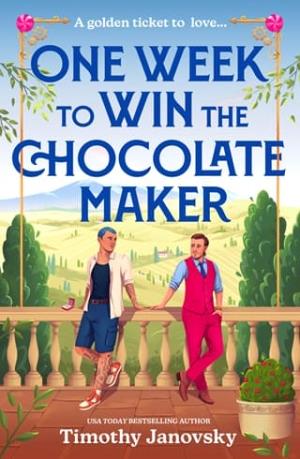
One Week to Win the Chocolate Maker
Chapter One
ONE
DARIO
A chocolate maker, an opera singer and a party boy walk into a reading-of-the-will.
This sounds like the setup for a darkly funny joke, but alas, it is Dario Cotogna’s life, and his effervescent grandfather’s passing is a mirthless affair.
Inside the well-stocked, regal study at Villa Meraviglia on a scenic hilltop in the village of Montecolognola, in the province of Perugia, Italy, a lawyer sits in wait behind an imposing wooden desk. Above her hangs the Cotogna family portrait, painted back when there were six of them.
And then there were three, Dario thinks as he sits in one of the handcrafted, sixteenth-century wooden chairs in front of the desk beside his mother.
His younger brother—taller and wider and hairier, so you’d never guess he was younger—frames her other side.
They are half of what they once were. How can Dario dare to feel whole again?
Dario unbuttons his sharkskin overcoat. His closet is full of creations by Gabriele Vitale, the best tailor in walking distance of his front door.
No matter the weather or occasion, Dario feels most like himself all dressed up.
Today, he broke out his blue power suit with its contrasting yellow polka-dotted pocket square because today is the day he claims his inheritance, steps into his destiny.
The familiar lawyer before him has wide-set, down-turned eyes, black wavy hair that falls well past her padded shoulders, and a hefty sheaf of papers in front of her.
A pair of square-framed, plum-colored reading glasses rest upon her tall stack.
Her name is Violetta Francisco, and she has known the Cotognas as long as she has been alive.
Smiling professionally, she says, “Buon giorno. Allora, cominciamo.”
“In inglese, per favore?” asks April Cotogna, the mother.
She grew up in America, trained in England, and toured all over Europe.
She played the title role in Puccini’s Manon Lescaut when it came to Perugia many, many years prior.
This is how she met Dario’s late father, Cosimo Cotogna Jr. She liked to joke that the way to most men’s hearts is through their stomachs, but Cosimo Jr.’s heart could only be won through his elephant-sized yet bat-like ears.
“Which is good,” she’d say, “because I can carry a tune but I can’t cook!
” The room would guffaw at the gorgeous, lithe diva with golden hair and golden pipes gracing their presence at some party or another.
Despite her vocal training, her years married to a born-and-bred Italian man, and her two multilingual children, she never quite became fluent in the language. The phonetic alphabet was more her friend than any real alphabet ever could be.
“Certo. Yes. Let us begin,” Violetta says switching between the two languages effortlessly. She puts on her glasses. They make her look even more severe.
Dario reaches out for his mother’s hand, which taps on the rounded arm of her chair. She squeezes him, which he takes as a gesture of thanks.
Much like the character of Manon Lescaut, April Cotogna was not thought a suitable match for the heir to a global chocolate empire.
While Emilia and Cosimo Cotogna Sr. grew to accept April the aspiring opera star who couldn’t cook—practically sacrilegious in the Italian culture—there was no guarantee things would stay the same.
When Cosimo Jr. died young in a reckless Vespa accident, she feared she and her sons would be cast out from the world they’d come to know.
Luckily, Cosimo Jr. made plentiful provisions to ensure that did not happen.
Still, that niggling fear must be with her again now that Cosimo Sr. is gone, which is why Dario squeezes her hand back.
Dario is heir apparent. He only needs Violetta to read it aloud from Cosimo Sr.’s last will and testament for it to become a reality. He is keen and ready to take on the massive family business.
Well, mostly ready.
Amorina Chocolates has been his life since he graduated from the University of Perugia.
Cosimo Sr. was his de facto father for most of his fundamental years.
But Dario earned that relationship, unlike his brother, Emilio, who acted out at every minor inconvenience, spent money without a care, and put the Cotogna family in the press for all the wrong reasons.
Dario understood a man as busy and eccentric as Cosimo Cotogna Sr. could not be understood.
That was his power. His hours were erratic, his temperament was calm no matter the blistering amount of work he had to do, and his conversations had a way of veering into riddle if they went on long enough to bore him, which they often did.
However, people liked doing business with Cosimo Cotogna Sr. because you never knew what you were going to get. When you took a meeting with Signor Cotogna, you might luck into a winning deal and become rich, or you might get tricked into testing a truffle made to taste like puke.
Dario acclimated to his flamboyant grandfather and learned by example, becoming useful around the processing factory, the chocolate school and the company’s historical museum.
Until one day, sometime in his late teens, while he was taking dictation for a letter to his business associate—Cosimo Sr. did not mess with email—the infernal nuisance!
—his grandfather looked him in the face and asked, “Ti paghiamo?” Are we paying you?
Surprised, Dario shook his head. Tendrils of his shoulder-length chestnut brown hair swished this way and that across his long face.
Cosimo clicked his tongue, shook his head. “Questo non va bene.” That is not good.
From within his desk, Cosimo Sr. withdrew a small, purple sack.
He tossed it to Dario, who caught it. Inside there were golden coins.
Shock and awe fizzled like popping candies in Dario’s belly, until he reached in and pulled one out.
It smushed between his fingers. Chocolate slimed onto his palms from the cracks in the shiny casing.
Cosimo laughed, and laughed, and laughed.
Days later, in the Amorina offices above the museum, Dario discovered his name had been placed on a company mailbox and inside that mailbox was an envelope. It was his very first official paycheck. The rest, as they say, is history.
History is what Cosimo Cotogna Sr. is now.
History is what Dario Cotogna hopes to make.
Holding hands with his mother, in this room of a thousand stories packed onto built-in shelves, Dario waits for the first page to turn on the story he is destined to star in.
Patiently, he listens as Violetta talks about how she has been named executor of the will, which makes sense given her family law firm’s longstanding relationship with the Cotognas.
Over the next several hours, she details the division of the lucrative, expansive estate including sports cars, art pieces, boats and various heirlooms. It is morbid and mind-boggling, the amount one can accumulate in a lifetime and leave behind for others to sort through and fight over.
“The title of Villa Meraviglia is bequeathed to April Cotogna,” says Violetta.
“The title only,” April is quick to say, looking to her older son. “As you know, Violetta, I’m never here. I’m always touring. This is your home, Dario. You will continue to oversee it. That’s fine, right?”
Violetta nods, which sets Dario at ease.
This is his home. This villa is where he grew up.
This is the study where his father worked before he passed away, severing the line of succession and leaving behind a legacy Dario sometimes feels too young to take on with his two modestly experienced hands.
His eagerness to make impactful change on the family business does not outweigh his ballooning, clinically diagnosed anxiety.
This villa, due to that generalized anxiety and his acute agoraphobia, is also Dario’s fortress.
Which works in a morbid way given the village’s medieval beginnings.
Dario’s world has not extended past the borders of Perugia since the incident he tries not to dwell on.
His therapist keeps reminding him that increased exposure to his triggers is key to treating his agoraphobia, and he’s made small strides.
Outside of the villa, Dario can go to the Amorina factory for work and to Lake Trasimeno for a sail and a stop at Isola Polvese, but ever since his nonno got sick and then passed away, he’s put his mental health on the back burner.
Because if as a child, you touched the stove while it was still hot and came away with a burn, you would know not to touch it again.
Perhaps, like the skin on our fingertips, Dario Cotogna is too sensitive for the scorching stovetop of the unknown, and the incident was the universe’s way of imparting a tough lesson.
Violetta proceeds. “On to the matter of the Amorina company.”
Dario’s heart takes off with the speed of a thousand horses. He grips his mother’s hand again, needing to be grounded in what is both a bittersweet and significant moment.
Violetta’s red lips turn down, and she sets her glasses aside.
The air in the room grows warmer, and it has nothing to do with the bright sun shifting positions through the nearby windowpanes, creating lines of mustard yellow across the tan, lacquered floor.
Dario hitches forward in his chair, which creaks with age beneath him.
“There is a small matter we need to discuss,” she says, going off-script. Dario has known Violetta since he was an infant. She used to babysit him. Judging by the creases between her eyebrows, whatever the matter is, it will not be small, but it almost certainly will be unpleasant.
“What is it?” Dario asks, not sounding the least bit brave.
“According to the will—” Violetta begins, voice professional but eyes brimming with sympathy “—Dario Cotogna is to be the temporary successor of Amorina Chocolates.”
“Temporary?” he asks, confusion bursting out of every syllable in the blasted word.