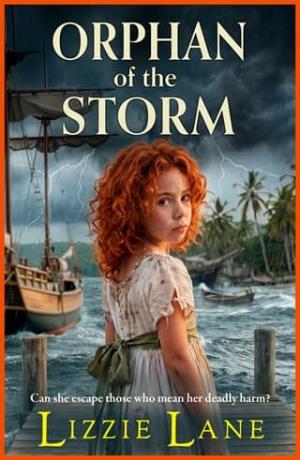
Orphan of the Storm
Chapter 1
Blue eyes, brown eyes and those in between; all were fixed on the lawyer.
He read slowly, pronouncing each word with great deliberation, eyes and spectacles fixed on the portfolio that was the will of a wealthy plantation owner, a pillar of society and also a friend.
The reading of the will was taking place on the spacious veranda running along the front of the Palladian mansion that had been home to the great man.
White folk, house slaves and favoured black women stood or sat at varying lengths from Frederick Gregory of Gregory, Paul and Pitchfield, the family solicitors.
Those who worked the sugar cane or tended the animals of the farm or stables stood in silent rows, their dark eyes dancing in the glow of torchlight.
Children yawned against their mothers’ skirts.
The occasional cry of a baby sounded from the direction of the cabins in the slave quarters that were their homes.
Summoned to attend, they’d come with fear in their hearts in case the estate was likely to be sold and them with it.
Families might be broken up; husbands separated from wives, parents from children.
Eyes accustomed to being downcast searched the faces of Sir Edward Kildare’s children but turned swiftly downcast again should their look be met.
Though this was Jamaica, considered a more civilised island than others in the Greater Antilles or the Windward or Leeward groups, it didn’t do to appear too bold.
They were still chattels and must know their place, though they’d respected a fair man whose main failing in their eyes was his taste for African women; slave women who had no option but to submit.
The bulk of my estate I leave to my sons, Peter and Arthur…
‘He reads like a blasted snail, don’t ya know,’ muttered Peter Kildare, the deceased’s eldest son. His tone was spiced with something of the slave patois, a habit carried on from one generation to another. He threw the lawyer a menacing though unseen look.
Peter, with his corn-coloured hair and sharp blue eyes, might have been handsome if it wasn’t that his sardonic disposition showed in his face.
Prolonged distrust and cynicism twisted the corners of his mouth downwards.
His was a handsome face, the blond Adonis of the family, who was attractive to both men and women.
Beneath that handsome surface lurked a hard disposition, a ruthless man who would stop at nothing to get what he wanted.
He had inherited most of the family holdings and intended holding sway over those parts bequeathed by his father to others. As far as he was concerned, everything should be his.
Arthur, his younger brother, sighed. ‘Our father liked things done properly.’
Like his brother, Arthur was fair, but whereas Peter was handsome, tall and physically attractive, Arthur boasted only a dusting of gingery hair on his head and upper lip.
In private, he sometimes studied the rest of his body with outright dismay; he was so pink; so hairless.
Luckily, few saw his naked body, with the exception of the female slaves he coupled with, though, of course, they wouldn’t dare discuss his physicality, not if they knew what was good for them!
They did see his eyes, which were of that paleness found in northern climes where the sun is weak, and the sky misted.
Out of Arthur’s hearing, the slaves on the vast sugar plantation that was their home called him Lord Lobster.
Indulged and spoilt as much as their brothers, Sir Edward’s daughters, Hermione and Emily, sat stiffly and silently, though Hermione did throw her eldest brother a look of reproachful impatience.
Like him, she wanted to get this over with.
Like him, she wanted to know what ridicule their father’s will was likely to heap on them.
Their father had been so benevolent to his workforce that some had believed him to be of Quakerish persuasion. She fully expected him to have made bequests to his ‘people’, as he’d called them. ‘Like some latter-day Moses,’ as her brother Peter had said.
Her eyes slid sidelong and met those of her sister.
Emily’s face coloured up as the same thought passed between them.
If Hermione was the female equivalent of Peter, then Emily was similar in looks to Arthur, except that her eyes were much darker, almost violet, and her hair was a tumbling mass of wheaten gold that defied the curling iron and regularly escaped from ribbons.
Coupled with that, no matter how much she hid from sunlight, her face was a mass of freckles.
Emily looked down at her hands, aware that her stomach was knotted with nerves. Only once this was over would they know for sure how the estate had been divided, how the ‘other’ Kildare had fared, the one they’d only recently found out about.
Their father’s second wife, Dulcina, had died in childbirth.
They’d assumed the child had never taken its first breath but had also died, which was just as well as far as they were concerned.
Unlike them, she’d been far from fair, her ancestry dubious, at least one quarter African, if not a half!
Whatever had possessed their father. It was Pitchfield, one of the other partners at the firm of lawyers, who had unwittingly given them a preview of their father’s wishes, which in turn had led them to the realisation that the child of Dulcina had not followed her mother into the oblivion of eternity.
The girl child had been whisked away, sequestered with an old family retainer – though not that far away.
Sibling rivalry had been set aside when they’d realised that their father had made a settlement on her.
That in itself was bad enough, but doubly galling was the realisation that Lord Alexander, their father’s brother and inheritor of the family title, was childless.
He was their uncle and by their deduction all his land would be theirs following his death – except for one small fly in the ointment.
The child they’d thought had died was very much alive.
Arthur had rooted through his father’s papers and private letters, a trail of them scattered all around the tall, cool room that had served as his father’s study.
Hands trembling, he had shown his brother Peter what he had found, letters between his father and his uncle betraying a shocking secret.
Second wife Dulcina had been married to their father, the child she’d been carrying sired by his brother.
Brother confided in brother.
Peter had scowled at the contents, whilst Arthur bleated on that any claim they had on their uncle’s estate was null and void. The daughter would inherit – unless Lord Alexander deemed otherwise.
The pits and lines of Peter’s scowl had deepened to demonic anger. His lips had curled like a hound about to rip the throat from a captured doe. ‘Over my dead body!’
The letters – more than one of them – were torn into pieces and thrown out of the window. The breeze from the sea took hold of them. Like the white petals of a plucked bloom, they flew away, tossed into the air and heading seawards.
Arthur had howled like a beaten dog baying at the moon. ‘Cleveland Court should be ours!’
‘It will be,’ Peter had growled, his teeth till bared, lips still curled.
And so, a plan was hatched that, no matter what, there would be no other heirs to their uncle’s estate except for themselves. The plot was not shared with their sisters.
‘They’re just women and will have husbands to look after them.’
If the lawyer noticed that those listening were impatient, he gave it no account as he went on to disclose the main beneficiaries.
The plantation on Jamaica went to Peter, as the eldest son.
A smaller plantation on Nevis went to Arthur.
The two daughters were provided for. They’d never have to dirty their hands doing menial work; in fact, their only work would be finding a fiancé who could further enrich their lives.
And then it came to the bequests to slaves and company servants.
‘To my loyal servant, Captain Joseph O’Neill, I leave a yearly pension of fifty pounds…’
The man with grey running through his beard and his mighty mane of hair standing at the edge of the family gathering gave a single respectful nod.
Many a conversation had been shared with Sir Edward.
So had secrets. When he’d heard of Sir Edward’s death, a man who had been as much a friend as an employer, he had taken ship from Savannah with undue haste. Few knew of the hidden child.
At the time, O’Neill had thought it somewhat cruel that the little girl was destined to be brought up apart from her half-siblings. Only when his old friend had described how he felt, and the likely repercussions when it was found out, did he understand.
Sir Edward had loved his second wife, but following her death found it difficult to look at the little girl growing into a likeness of her mother. Dulcina had been his wife but had broken his heart. Lochranza was his brother’s child. Wife and brother had hurt him deeply.
He’d also known that her life would be endangered when it was discovered that the five-year-old would one day inherit a vast estate. He had no illusions about the selfishness of the children from his first marriage.
‘My own fault,’ he’d exclaimed sadly. ‘I spoilt them. Gave them everything money could buy.’
Except love, thought O’Neill. Edward only had that for Dulcina and even then it was flawed. How easily love can be tarnished with jealousy. Lochranza was the result of that liaison.
O’Neill’s duty was to protect that child.
He stood back following the reading, turning as if to leave the veranda, but remaining in the shadows, a worried frown creasing his high forehead.
Like Edward’s children, he wished to know who had inherited bequests, who had won their freedom and who had been burdened with a responsibility they could not possibly understand. The latter concerned him greatly.