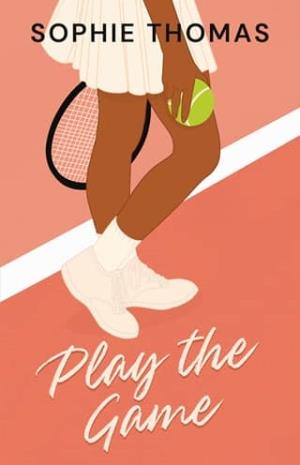
Play the Game (Road to the Olympics #1)
Chapter 1
Chapter One
NAOMI
There aren’t many life-changing moments I’ve been caught off guard by.
Choosing to go to university over becoming a professional tennis player was a conscious decision. As was graduating at twenty-one in early July and making my WTA debut at the Cincinnati Open two weeks later.
I worked hard for my first WTA title, so that didn’t surprise me. I’d earned it and the rise up the rankings it granted me.
I worked even harder for my first Grand Slam title. Which I got at twenty-three. At home (kind of) in Wimbledon.
More hard work on my least favourite surface, clay, paid off when I won the French Open. Followed by a victory at Flushing Meadows the same year. With the title of US Open champion, I also earned the number one spot in the world. A position I held for months.
The final, elusive title of Australian Open champion came when I was twenty-nine. Eight years of hard work finally paid off, adding me to the list of greats who managed to achieve a career Grand Slam.
The life-changing event I didn’t see coming was at the start of clay court season, when I was thirty-one.
A shattered ankle.
An injury that took me out of the game outside of my own terms, and one I wasn’t sure I was going to come back from.
Another unexpected event?
In Rome. When a stray tennis ball flew up and knocked my coffee out of my hand, and all over my outfit, at thirty-two.
Rome, Italy – May
“It never ceases to amaze me how hard they hit. It’s like they have a vendetta against those poor little balls,” Alisha said quietly at the changeover.
“Sometimes you do,” I replied, just as quietly.
When Alisha, my sister, realised we’d be in Rome at the same time as the Italian Open, she floated the idea of us attending.
Ever since my injury, I’d enforced a tennis blackout with my family and friends.
It felt harsh, but in the immediate aftermath of my life as I knew it ending, I didn’t want any reminders of the sport.
I’d never officially lifted the pseudo-embargo, but up until Alisha asked, no one had said the word ‘tennis’ around me for months.
Which was an impressive feat considering my parents ran a tennis training centre where my brother, Wyatt, also worked.
The first thought that came to mind when I heard it again was how much I missed tennis.
Even when I was at uni, tennis was still a part of my life.
I hadn’t let myself think about how there was a hole in my life without it.
In fact, I managed to convince myself that I’d successfully filled it with a post-accidental-retirement business as a physio.
But sitting in Campo Centrale getting gently roasted by the mid-afternoon sun, I realised I hadn’t filled it at all.
Watching Sam Reed, Britain’s number one—and within touching distance of being the world number two—slowly break Italian hearts had me longing to get back out onto the court. To find that part of myself again.
“It’s kind of hot when you think about it. All that power.”
I snorted. “I seem to recall you saying that dating a tennis player could never be for you because you’d never see them.”
She poked my sun-warm arm. “I stand by that. Don’t date one. But I imagine they would be great for a short time.”
I pulled my sunglasses down my nose and levelled a look at Alisha. “As with most sweeping generalisations you make, it really depends on the person.”
The corners of Alisha’s mouth tipped up. “Oh, yes, I forgot you were the expert on these things.”
I rolled my eyes and pushed my glasses back up. “Not an expert, just experienced.”
“Some would call that expertise.”
The umpire called time, saving me from having to carry that conversation any further.
At 30–40, set point for Reed, I remembered the cappuccino—too hot when I bought it two changeovers ago—might finally be an acceptable temperature to drink and bent down to pick it up.
There was a sharp intake of breath around the court—it was held for a beat—and then a surprisingly raucous cheer as game, and first set Reed was called. As I sat back up, coffee already halfway to my mouth, lid off, I realised something was flying at me.
If I’d had just a second more notice that a ball was heading in my direction, I might’ve been able to move out of its path.
But I didn’t.
Instead, I could only watch in slow motion as the ball Reed had clearly smashed onto the court to win the set came hurtling towards me. My sister had the reaction time of a slug. She wasn’t going to catch it.
It made direct contact with the cup and knocked it out of my hand, spilling the contents over my crisp white linen shirt and landing in my lap, where the remaining dregs dribbled onto my matching shorts.
The good news was, the coffee wasn’t boiling hot anymore.
My eyes flicked to the court.
Standing at the net was Sam Reed, racquet hanging loosely in his hand, already looking at me.
Turns out, in the right light, Sam’s eyes looked like two perfect pieces of bronze.