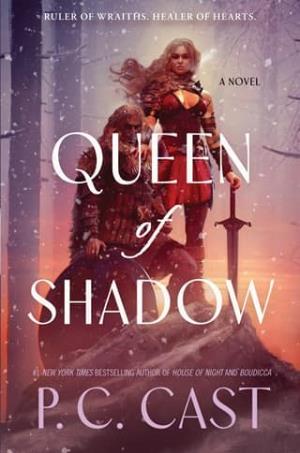
Queen of the Shadow
Chapter 1
Take the bard with you.”
He stared at Lugh, hoping he had misheard.
“Cuchulainn! Take the bard!” the god thundered.
He wanted to shout, My name is Sentanta!
But he could not challenge the God of the Sun, even though the God of the Sun was his father.
He nodded and remained silent, wishing he could speak to his father rationally about his destiny.
Lugh had never been interested in his son’s questions or desires or fears.
Lugh was only interested in what glory Cuchulainn was destined to bring him.
Clueless about his son’s inner turmoil, Lugh smiled and stared off into the distance. “Yes, it will make an excellent story someday . . .”
* * *
The morning was clear, though clouds gathered high in the brilliant blue sky, reminding Scáthach of shaggy Highland sheep clustered together before a shearing.
She double-checked the harness she’d stepped into—heavy braided hemp covered in supple leather—and the iron ring through which was threaded the fifty-foot length of rope that glided within the structure of the harness.
The thick rope snaked a short distance across the stone floor, where it fed into a pulley system, much like the one that lifted and lowered heavy drawbridges.
The rope pooled near the pulleys, waiting to be played out as Scáthach needed it.
Satisfied that all was as it should be, Scáthach put on her thick leather gloves and pulled herself up to stand atop the parapet that circled the rooftop of Dunscáith Castle.
As she gazed westward across the slate-blue water, a flock of seabirds lifted from the whitecapped sea.
Scáthach watched them circle low in the saltwater mist and then turn skyward.
Unbidden, a short poem composed itself—as poems often did—and Scáthach released it into the listening breeze. “Birds’ wings slice the clouds / wounding them / portending change.”
“Are you going to compose poetry or go over the side?” came a voice from behind her.
Scáthach turned, giving her daughter, Uathach, a wry smile. “As you know quite well, Little Fry, I am more than capable of doing both.”
Her daughter’s lips tilted up at the familiar nickname. “But did you remember an offering?”
Scáthach raised one sandy blonde brow. “Do you truly think I would summon my immortal giantess mother without an offering?”
Uathach shrugged. “Normally, no. But . . .” Her voice faded and she shrugged again.
“His death has saddened me, not addled my mind.” She patted the heavy leather pouch she’d attached to her belt beside the sheath that held her knife.
Uathach nodded, opened her mouth to speak, and then closed it again, pressing her lips together into a line.
Scáthach knew her daughter far too well not to prompt her. “Well? What is it?”
“You rarely invoke Béfionn. Usually it is she who summons you.”
When Uathach said no more, Scáthach prompted her again. “Yes, and?”
“Will it not annoy her? Will your mother even care that he’s dead?”
“Béfionn has never admonished me for summoning her. You need not worry about that. As to whether she cares that he is dead—I cannot speak for her, but I remember his sad smile, his kind eyes . . .” Scáthach stared out at the sea, her mind in the past. “I remember his love, and I think she will, too.” She pulled her thoughts up through the years to her daughter.
“You know him from his visits. Why does it seem as if you consider him a stranger?”
“I don’t!” Uathach was quick to say. “I cared for him. I know you did, too. But Grandmother never visited while he was here, even though that would have been the perfect time for the two of them to be together again.”
“Perhaps Mother stayed away out of care, instead of carelessness for his feelings,” Scáthach said.
“Regardless, Béfionn should be told, and who better to tell her than me?” She didn’t add that she’d spent the seven days since the messenger had come with the news considering how to tell her mother.
She’d finally decided there was no good way to tell bad news—it just had to be told.
“But why doesn’t Grandmother already know he died?” Uathach blurted, and before her mother could answer, she continued. “Béfionn is Goddess of the Underworld. I don’t understand why she wouldn’t be aware of the death of the mortal man she loved well enough to father her only child.”
“Béfionn is Goddess of our Underworld—the Summerlands and the realms of Annwn. Father was a Norseman who honored Odin All Father and Freya as his patrons. There is no way for Mother to know when he entered Valhalla.”
“It doesn’t seem right.”
Scáthach lifted one brow. “No one goddess, no matter how powerful, could possibly oversee every Underworld.” She shook her head. “I would not wish that on Mother or any deity.”
“Well, speaking as the daughter of a powerful, fearless mother, I wish you luck in dealing with yours.”
Scáthach’s wide, full lips tilted up in amusement at her daughter. “Oh, Little Fry, I am not fearless. Only an idiot fears nothing.”
Uathach scoffed and muttered, “That’s not what your students say.”
“Which is exactly why they are students and not fully trained warriors. Now, should I call one of those students to aid me, or will you lower me?” She jerked her strong chin in the direction of the pulley system beside which her daughter stood.
“So now you’re in a hurry? I thought you were composing poetry.”
“Like I said, I am more than capable of doing both.” Scáthach winked at the tall, tawny-haired daughter who looked so much like her, grasped the rope in her gloved hands, and leaped backward off the parapet.
As always with the first drop, her stomach lurched, and she gritted her teeth against the vertigo-like sensation.
The rope drew taut and swung her back to the thick stone wall of the castle.
The soles of her leather boots connected firmly with the wall and she settled into the familiar rhythm of rappelling.
As the rope played out and her leaps moved her down the castle wall, the wind whipped against her, and she was glad she’d pulled her hair back into a thick braid so it could not blind her.
She wore her usual uniform of black leather breeches and a form-fitting, short leather tunic that had been dyed bloodred and then painted with images of sturgeons, the huge dragon fish who were familiars of her mother.
Scáthach leaped back and down again, barely breaking a sweat.
The long, lean muscles of her shoulders and arms bunched and released, working hard to keep her descent somewhat under control—but only somewhat.
Rappelling was as close as she could get to flying, and she reveled in the feeling.
Mid-leap, Scáthach tossed back her head and laughed—a loud, full-throated sound that unapologetically took up space and commanded attention.
She bent her knees and pushed against the exterior castle wall, laughing again.
This time her exhilarated cry was caught and amplified by others.
When her feet next met the castle wall, she glanced up to see that several of her students lined the westerly tower parapet, cheering her on.
In the middle of the group, two huge paws appeared, followed by a blue-gray shaggy head.
Standing on her hind legs, the dog poked its head up over the battlement, equal in height to the young warriors.
The deerhound’s dark eyes glittered as they watched her.
Scáthach’s grin was untamed in its ferocity as the student warriors raised their fists in the air and let loose roars of encouragement with the dog’s enthusiastic barks joining them.
Scáthach was pleased that her students had gathered to watch her rappel down the seaward wall of her castle.
She certainly could have walked out of the front entrance, crossed the Bridge of Leaps and the long, raised walkway that traversed the boggy field that surrounded the castle, and climbed down the rock wall to swim the twenty feet that separated the mainland and the stone island on which Dunscáith had been built.
But that would have taken much longer and would not have provided yet another example to her students of the skills she had perfected and they had yet to attempt.
As the cheers and barks were carried away by the wind, Scáthach returned her attention to the rope and the wall she rappelled down.
Scáthach knew better than to divide her attention when performing a feat.
It was something she told her students over and over—cocky arrogance had a time and a place, but neither was during a feat or a battle.
As she continued to make her way down to the base of Dunscáith Castle, Scáthach reordered her thoughts.
As her daughter had said, she did not often summon her mother.
So when she did, she did so with the solemnity appropriate for the invocation of a goddess.
Her leather-booted feet lit lightly on the damp rocks on the strip of narrow beach.
She pulled thrice on the rope, mightily, and in just a few breaths, her daughter’s head appeared far above as she gazed down over the parapet and waved acknowledgment to her mother.
Scáthach waved back before stepping out of her harness and laying it carefully over one of the larger stones.
She took off her thick leather gloves and placed them atop the harness before she turned seaward.
Scáthach strode to the water, stopping when the slate-blue waves washed against her boots.
She smoothed her tunic, feeling the rush of expectant nerves that invoking her mother always caused.
She loved her mother, but Béfionn was Goddess of the Underworld, Mother of the Dead, Fairest One beloved of bears, deerhounds, and the sturgeons that surrounded the Isle of Skye and the northern sea of Alba.
She was as mighty as the great brown bears that ruled the Highlands, fleet as her cherished deerhounds, and fierce as the sturgeons that grew to the size of dragons.