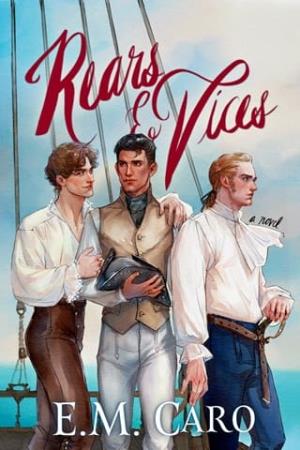
Rears & Vices
Chapter 1
One
HM Schooner Netley
Kingston Harbour, Upper Canada
HIS MAJESTY JOHN BULL AT FORT YORK:
DEADLY SELF-SABOTAGE!
Everard glared down at the Rochester Spy’s front page in disbelief.
“Self-sabotage—? Jesus sainted Christ!”
He threw the thing. But thanks to Upper Canada’s lakeshore humidity, the three-year-old Yankee paper was damp, and heavy, too, so it merely hit the edge of his desk with a pathetic, protesting thump and tumbled down.
Everard stood from his cot to resume pacing his cabin. It served him right, looking for old gossip about pirates.
But the editorialising! It was just as well he was no longer in printing. He had a mind to—
“Sir?” The ship’s boy, from the companionway. “Gig’s ready, cap’n.”
Right. No need for more newspaper hearsay, anyway; he’d soon see this pirate for himself.
“Presently!”
Everard plucked up his hat, shoved it on.
Courts martial were full dress, which meant buttons—eighteen of them—but he had, at least, his own bicorn: satin-trimmed, beaver felt, nonregulation.
He hoped someone might take its notice and that that someone might be admiralty, for it was as close as he’d ever get to giving that institution a certain finger.
Everard opened the door. “Jack?”
The boy jumped. “Yessir?”
“Please return these before you take your liberty ashore.”
Jack eyed the three crates of newsprint with some trepidation, caught himself, and quickly stared ahead to the panelling. “Yessir.”
Everard bit his tongue against a thank-you—it was neither called for nor appropriate, and please had been bad enough of a slip—and went above deck. His most recent lieutenant met him at the gangway, saluted with two hooked fingers. Everard nodded in return.
“She’s yours for the day, Mr. Spicelay.”
The bo’sun piped him off the side with a shrill whistle, and when he’d sat down aft, piped the boat off, too.
Everard cast his focus away from Kingston Harbour and across the sealike Lake Ontario.
It was hot today, unusually so for June, and the water was calm, waves smoothed and set sparkling by an uninhibited sun.
There was a light breeze in from the west, gentle enough that he’d no reason to fear for his favourite hat.
The Lakes Service had few advantages. Water that one could scoop straight into one’s mouth was foremost.
Another was that, compared to his saltwater contemporaries, Everard had judged relatively few courts martial over the past three years.
Today, though, he didn’t have much choice in it.
It was 1816, and the wars with the Yanks and the French had ended.
There was a glut of officers. His twenty-four-year career clung to nothing more than a few bits of unwound rope: courtesy, rank, and his lingering—more like withering—reputation.
As much as he hated passing judgment on his fellow seaman, obliging the admiralty was unavoidable.
Slowly, the little gig pulled up to the shiny black-and-white hull of HMS Brigitte.
Trials were held on the largest deck to be had in-harbour. A fifty-eight-gun, three-masted, fully rigged frigate, the Brigitte certainly qualified; she was the biggest freshwater ship left not laid up in Upper Canada.
Everard stood, hand on his sword, and looked up as he waited to be piped aboard. Captain of a schooner he may have been, but still a captain.
The whistle blew for his ascent. Everard couldn’t keep in grunts of effort as he climbed the unending hull.
His left hand—with the one thumb, two knuckles, and not much else—relied on the strength of his arm below it, and required he wrap his wrist on every pull.
Rope handholds were a bit slow going, a struggle some would call undignified.
He called those someones fucking bastards.
“Everard!” a voice greeted him as he crested the railing. “About time!”
Everard’s two good sea legs were his only saving grace as he stepped down the gangway and untwisted his uniform sleeve.
Preston D’Arcy, Post-Captain, looked precisely the same as Preston D’Arcy, First Lieutenant had: wild, red-brown curls, fashionably cropped and haphazardly greased.
Long dark lashes. Just enough French extraction for a profile too pouty to be truly stern.
Handsome, and far too aware how to leverage that fact.
They’d been great friends, once. More.
D’Arcy came close, clapped him on the arm. “How have you been, Ev?”
“Just fine, D’Arcy.” Everard gave a small, polite nod—D’Arcy and he were not strictly on speaking terms, not anymore—and looked away to eye the line of chairs assembled on the deck.
There weren’t many; three of six officers’ chairs were occupied.
“Am I fifth, then?” he asked, squinting against the sun.
“Yes, at minimum today,” D’Arcy said. “Hardly anyone left in the Lakes Service, you know.”
Everard grunted. He did know. The war was over. “Who’s presiding?”
“Johnson.”
“Hmm. Best and brightest.” Everard swiped his brow with the lace at his wrist. Maybe he ought not to have worn his favourite hat.
The Brigitte’s deck was sweltering; it would make for a positively miserable forenoon of courts martial.
Not that it wouldn’t already have been. “Surely by now he’d have lost the posting? ”
“You know well why not.” D’Arcy brought up his right hand and rubbed thumb and fingers together.
Everard grimaced. “Yes, well, the way of peacetimes, I suppose. We’ll be here past supper, do you think? Unless he has got a quicker secretary.”
The officers’ chairs were situated on the quarterdeck beneath a sheet turned horizontal, which provided shade from the glaring sun. They made their greetings of the other officers, all fellow Lakes Service captains—and sat gratefully.
“Gad, I hope not.” D’Arcy leaned in close, whispering for Everard’s ears only. “Have a look who I’ll miss out on.” He shifted back to tilt his chin unsubtly at the upright, red-breasted Marines lined up against the rail.
Everard, not in the habit of sexualising his ranked inferiors—not usually—glanced over and frowned.
“Er… which?” he asked.
Not usually, because he had made one—one—notable exception to this rule thus far. The result, of course, being that Preston D’Arcy knew him much better than one probably ought to know his fellow captain.
“They can’t be your own Marines?” he admonished.
D’Arcy snorted, though he grinned wide. “You shock me. No, of course they’re not mine. Could you imagine? I’d never sleep.” He waved. “My lobsters are on shore leave. These are admiralty men, special order out of Halifax.”
“Special order,” Everard said, beneath his breath.
D’Arcy’s single right shoulder epaulette sparkled as he shoved Everard good-naturedly. “And when was the last time we sat courts martial together, Ever?”
As though either of them would forget.
“At least you’re not the one gagged this time,” D’Arcy continued.
“Oh, don’t be an ass.” He and D’Arcy—at the time Everard’s first lieutenant—had in fact sat their own inquiries after losing a ship—the Wanderer—in battle to the Americans, Christmas Eve of ’12.
But they’d been acquitted honourably, in spite of the surrender and infamous defeat. D’Arcy had even got promoted after.
And Everard, dear God, had certainly not been gagged.
“They gagged the prisoners?” he asked curiously. It wasn’t usual, even for violent offenders.
“Well, no,” D'Arcy admitted. “Only the one.”
“The pirate.” Everard’s mouth parched suddenly, and he cleared his throat. “I’m surprised the admiralty haven’t already pitched him over, had done with the man. Or left him in the hulks. Fewer witnesses, if he was so much fight that he wanted gagging.”
D'Arcy laughed uneasily. “You haven’t the least idea. As to witnesses…” His voice pitched lower, conspiratorial, and Everard leaned in. God help him, but he did love gossip, and there’d been so little of it on the lakes. “… more charges were brought night ‘’ore last. Barely legal notice.”
Everard’s heart sank. New charges, last minute? That meant one thing: a sodomy charge.
“Ah.” He sighed. “One of those. Any victims?” he asked pointedly. “Statements?”
“None on the docket.”
“Hmm.” Not likely rape, then, thank God.
Most sodomy charges that made it to the courts martial were, though not all.
Everard had attended only one such trial personally, and nothing about the relations between the accuser and officer-accused had been equal nor yet consensual.
An easy conviction. “Multiple offences and piracy aren’t enough for the Lord High? ”
“Apparently not.” D’Arcy sounded resigned, and no wonder. “This is the fourth I’ve heard of this year,” he muttered. “Halifax calls it an epidemic of moral failing.” He sniffed, twitching his fingers over his nose. “I call it a campaign.”
Everard put his right hand on D’Arcy’s knee and squeezed. “As you are not a rapist,” he murmured, very low, “it’s nothing doing with you and me. The charge is probably unfounded, extraneous. And it’s no surprise they want a pirate to hang, is it?”
“Nothing doing thus far. It lacks only their changing the definition to include the consensual.” D’Arcy sighed. “I suppose you’re right. As usual.” A pause. “But how d’you like your Netley?” he asked. “Whenever you like, Ever, I could put a word in, get you something a bit larger…”
Everard scowled. Could he, indeed. D’Arcy made it sound quite easy—whenever you like!—as though Everard hadn’t been petitioning endlessly for that precise thing since the end of the war.
But though he might’ve wanted it, he knew he didn’t deserve a larger posting.
Not after the Wanderer and especially not after the disaster at York.
His Netley had hardly seen any action while in the Lakes Service, and had in fact already been reaching too high.
The admiralty plainly wanted him to retire.
Every week, he waited for the post that would give him notice.
Rightly, he should’ve retired. Should’ve taken his injury and his twenty-four-year pension and gone back to printing, or illustration, or even, God forbid, his father’s textile mill in Catalonia; anything at all other than continue this grasp at meagre authority.
But in his bones he still felt it: the yearning maw of ambition. He was thirty-six, possessed of an eerie premonition that he had only a handful of years left in him. The barest chance left to yet do something worth being written about—something not flames and death and disgrace.
D’Arcy went on. “I know it’s peacetimes, but the Jamaica station—”
The bo’sun’s pipes blew again: a new arrival to the ship.
There came a yell from beyond the rail: “Captains!”
A man pulled himself aboard and stomped over: about fifty years of age, grey-haired, with an uncommonly long, jowled face, wearing double epaulettes and the maximum amount of embroidery possible on his sleeves. Everard and D’Arcy both stood.
“Admiral,” Everard greeted.
“Blackhand!” The admiral turned to Everard. “Good morning, Captain. But is the sun not horrific?”
Christ.
“Sir,” Everard replied coolly.
“Blackhand” was the sobriquet that had caught on three years past, after the battle of York.
It had nothing to do with Everard’s reputation, only to do with the black leather glove he wore over his left hand.
In the rightful stead of his long career, it seemed the thing had encompassed his whole goddamned identity.
If he could be considered to have a legacy, that was it.
“Thank you for making five, Anderson,” the admiral went on.
Anderson de Anglada, Everard corrected mentally, as always. Most Englishmen pretended to forget the Català bit of his surname. Everard pretended to ignore why.
“It was no trouble,” he replied. “I was close at hand.” The Netley had been sailing up and down the Huron, a glorified patrol.
“At hand.” The admiral chuckled, glancing significantly down. “Quite.”
Everard clenched his teeth. Yes, they undoubtedly wanted him to retire.
The admiral turned to D’Arcy. “What a beautiful lady your Brigitte is, D’Arcy! For a lake-goer.”
D’Arcy had flushed red all the way to his hat. He cleared his throat, made a short bow.
“Thank you, sir,” he said. “We’re well aware of the pirate, but who else have they? Surely they’ve a stack.”
“Peacetimes, m’boy,” the admiral replied—though D’Arcy was thirty-five if he was a day.
“We’ve a handful of mutineers. The usual deserters and thieves.
” His eyes gleamed. “Even a murderer, I hear. Shall we get on?” He turned with a flare of blue coat and sat in the chair largest and centremost, just beside Everard.
He pulled out a pocket watch and observed it haughtily.
A moment later, a harried-looking man came scrambling across the railing, hauling a rickety, brass-hinged lap desk.
The admiral sighed. “Good news, men. I have a new secretary.”
D’Arcy coughed. Everard felt his shoulders slump a little in mirth and relief. Anyone would have a quicker hand than the man’s predecessor.
Maybe they wouldn’t be there beyond supper after all.