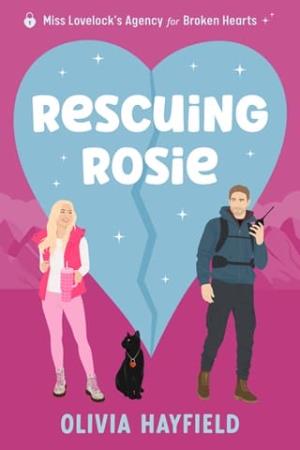
Rescuing Rosie (Miss Lovelock’s Agency for Broken Hearts #4)
Chapter 1
Chapter One
Rosie glanced across the road as she waited at the pedestrian crossing. Those boots were still in the shoe-shop window.
They were cream coloured, with pink roses, blue cornflowers, and feathery green leaves sprinkled across the uppers. The soles were thick and black and stitched in yellow; the laces, criss-crossing their way upwards via a dizzying number of eyelets, were pink.
They were mad. They were beautiful. They were calling to her.
You can’t afford them, said Rosie’s sensible side. And they’re silly.
They’re perfect; I need them, whispered Rosie’s frivolous side, making its voice heard for the first time since Rosie’s heart had been broken.
Oh, are you back?
Definitely not. I’d like to be, but I need a little help here.
As the green man beckoned Rosie across, she considered the arguments for and against. She no longer had a book deal.
Her debut novel, Meet Me on the Champs-Elysées, a tale of love and survival scheduled for publication later this year, had been dropped by the new publisher who’d taken over from the old publisher.
The World War II fiction trend would be over by the time the book was out, the editor had explained.
So Rosie had only her subsistence-level pay as an assistant on Holistic Health magazine.
And now that Reuben had left, there was no one to help pay the bills.
She would need to be super-careful with money.
She did not need another pair of Doc Martens.
But dammit, Rosie was in desperate need of something to pick her up.
A girls’ night out was likely to end in a drunken tirade against men, so she’d ruled that out for the time being.
Whereas … a new pair of boots of such fabulosity might not heal a broken heart, but they’d sure as hell kick against the gloom of a cold, loveless, book-deal-less April.
She’d spent the morning editing a piece called ‘Beat the Blues the Natural Way’ and, noticing a crack in the ceiling of grey cloud that had hung over London for weeks, headed outside for her lunch hour in the hope that, as per that article, a burst of exercise and vitamin D might help her shuck off the colossal feeling of failure that was weighing her down like a backpack full of bricks.
A shaft of sunlight touched the windows above the colourful shop fronts on Camden High Street; they glinted like pairs of eyes blinking after their long winter sleep.
Rosie pushed open the shoe-shop door. A bell tinkled gently.
A pink-haired woman appeared from the back of the shop. She must have seen her staring in the window, as before Rosie had even opened her mouth the woman said yes, she was sure they had her size, and scuttled away to fetch them.
The floral boots were a perfect fit, and it was like walking on air.
‘They’re the very definition of flower power, and so you!’ said the woman, as Rosie gazed at her feet in the full-length mirror.
What does she mean, ‘so you’? The boots were show-stoppers, whereas Rosie’s current look was resolutely dull – a black, knee-length skirt, plain beige shirt, denim jacket; her long blonde hair, unwashed since the weekend, pinned up in an unruly bun. It was a look that said, I no longer care.
In contrast, the shopkeeper was a living rainbow, with her sugar-pink curls, and a frilly blouse and tiered skirt in a chaotic swirl of purple, turquoise and green. She was tiny, and of indeterminate age. Forties? Fifties?
‘I shouldn’t,’ Rosie said, weakly. Her eyes rose to meet the woman’s, and she was struck by their unusual colour – sea green, with dark flecks.
Then she added, ‘But I really need a cheer-up. I’m having the worst week.
My boyfriend left me, my publisher dropped me …
’ Rosie blinked at her reflection in surprise.
She was a private person; she wasn’t in the habit of sharing her woes with complete strangers.
A little black cat hopped down from a seat across the shop and trotted over.
‘Oh – hello, shoe-shop cat,’ said Rosie, bending down to stroke it, glad of a reason to avoid those all-seeing eyes. The cat tentatively sniffed Rosie’s shabby trainers lying nearby, backed away, then hopped up onto the counter where it settled into a tidy loaf position.
‘They’re on sale,’ said the woman. ‘Seventy-five per cent off.’
‘Seventy-five?’ said Rosie. The label in the window had said £170. ‘That’s …’
‘Forty-two pounds fifty,’ finished the woman. She smiled. ‘For today only.’
That was still a week’s-worth of food-for-one, but … ‘In that case, how could I not?’ said Rosie. ‘What a stroke of luck! Thank you. I think I’ll keep them on.’
The woman put Rosie’s trainers into a bag and nodded at the cat as Rosie handed over her credit card. ‘Her name’s Lucky. I expect yours to change. Enjoy your boots!’
Rosie spent the rest of her lunch hour walking them in.
The retail therapy, the burst of spring sun, and a stroll would hopefully generate sufficient endorphins to see her through this afternoon.
The magazine’s editor had asked to see her at 2.
30pm and, given the sense of doom hanging over the office – Holistic Health was struggling, as subscribers and advertisers fled the sinking ship of print media – Rosie had a suspicion this was unlikely to be a pat on the back and a pay rise.
She wove her way through the shoppers and tourists at Camden Lock and onwards along the Regent’s Canal towpath, noticing people’s eyes dipping to her boots.
Sensible Side piped up again: What were you thinking? They’re ridiculous. Everyone’s staring.
Frivolous Side answered back, a little more confidently this time: No – they’re joyous, cool, here-comes-spring boots! Everyone’s jealous.
She turned her face towards the sky, where the gap in the clouds had widened, enjoying the unusual sensation of warmth.
But when her gaze returned to the path ahead, she realised she was approaching a certain canal bridge, and her mood took a dive as she remembered what was attached to those pretty iron railings.
Their lovelock.
It had been Reuben’s little surprise, to mark their one-year anniversary.
They’d first met at a corporate event at London Zoo, escaped the function suite, bonded over the penguins, and finished the evening kissing on that bridge beneath a full moon.
Twelve months later they’d returned and attached the padlock, which was engraved with REUBEN a box of fancy cupcakes. Her father had called him ‘a bit flash’ but her mother thought he was ‘quite a catch’.
When Reuben had produced something from his jacket pocket on that bridge, following dinner at a Michelin-starred Primrose Hill restaurant, Rosie had thought it might be a ring. But it had been the shiny brass padlock.
Now, her new boots seemed determined she should relive that moment. They carried her onto the bridge, and as she approached its centre it came back to her – how she’d felt. She blinked away the tears and frowned.
Well well. I’d forgotten that part.
Maybe it was like they said in detective novels – that revisiting the scene of a significant event enabled buried memories to resurface.
She leaned on the railings, staring at the sluggish, emerald-green waters of the canal below, thinking back.
A brightly painted barge had chugged beneath the bridge, its roof a riot of colourful flowers in tin buckets and planters, its owner giving them a cheery wave.
Rosie remembered Reuben’s look of horror when she’d suggested what fun a narrowboat holiday might be, pootling along the English waterways, tying up at quaint canal-side pubs.
‘Speed limit four miles per hour,’ he’d scoffed.
‘That would not be my boat of choice.’ If there was one thing about Reuben, it was that he never took things slowly.
Then he’d reached inside his Paul Smith jacket …
and there had been a rush of joy, excitement; He’s going to ask me …
! But it had been swiftly followed by a catch in her throat.
Am I ready? Do I want this? Is he really the one?
The surge of relief when it was a padlock, not a ring, had taken her by surprise.
It took her a while to locate their lovelock. On their anniversary it had been the only one, but now there were dozens, as if theirs had seeded a little forest of them.
She’s there. You know what to do, but tread carefully. Her heart was broken only days ago. And twice over.
After months dangling on the bridge exposed to the British winter, the padlock was no longer shiny.
Rosie was bending over, tracing the worn engraving, when a Cockney voice behind her said, ‘Bad news, I’m afraid – I’m ’ere on a mission,’ and she turned to see a man in a London Zoo uniform smiling at her.
‘Nice boots, by the way.’ He was probably in his late twenties, and his eyes were a similar shade of green to the canal.
‘Oh, thanks – I just bought them,’ she said. ‘I’m wearing them in. What do you mean, bad news?’
The man took a pair of long-handled pruners from a wheelbarrow beside him on the bridge.
‘Bad news if you’re a tree?’ said Rosie, looking at the profusion of budding foliage overhanging the towpath.
‘No – they’re bolt-cutters,’ he said. ‘The padlocks are starting to be a problem. They’re spreadin’ across the zoo’s railings like a rash. I said I’d deal with the bridges too, as a favour to the local council.’
‘Are you a zookeeper?’ Surely the best of jobs, second only to being a writer.
‘Gardener.’ He bent down to take a closer look at the padlocks. ‘It’s great timin’ – we can rescue yours and you can keep it. The rest will be recycled.’
Rosie wondered why he’d assume one of the padlocks was hers. The tears in her eyes could have been a sentimental response to this manifestation of deluded wishful thinking.
‘We can’t stop people doin’ this,’ he went on, ‘so we’re putting a special structure by the zoo entrance, as a fundraiser.
It should be cool – a giant ’eart around a sculpture of two lovebirds, with wires for visitors to attach their locks to.
’ His eyes scanned the jumble of padlocks on the railings.
‘Too late for this lot, though. Shall I snap yours first?’
Rosie pulled a face. ‘I don’t want it. My boyfriend just dumped me. I don’t even know why I’m here, prodding the wound.’ She pointed to the dull, brass padlock. ‘It’s that one.’
He took hold of it and tilted it towards him, reading the words. ‘Rosie. Good to meet you, Rosie. And Ben. Well, Ben’s obviously a bleedin’ idiot.’ There was a cheeky twinkle in those magnetic eyes.
‘Reuben,’ she said, feeling herself blush. ‘Not Ben.’
‘Oh?’ He looked again at the engraving. ‘In which case Reuben’s lost his Reu. Serves ’im right.’ He grinned. ‘He’s so going to rue that decision.’
Rosie grimaced, smiled, then peered at the engraving and saw that indeed, the first three letters of Reuben’s name had been worn away.
‘Please feel free to destroy it,’ she said.
‘Mind yourself, then.’ He quickly snapped the padlock’s shank with his bolt cutters. It fell to the ground, and he picked it up and handed it to her. ‘Yours to do with what you will. But please don’t chuck it in the canal.’
She sighed, staring at it. ‘I guess I’ll tuck it away at the very back of a drawer.’ She dropped it into the bag with her trainers. ‘Maybe one day I’ll be able to look at it fondly, instead of wanting to melt it in a furnace wishing it was in fact Reuben’s head.’
The gardener chuckled. ‘Way to go, Rosie. Or maybe keep it ’andy, in case you meet a Ben.’
Her eyes went to the name tag pinned to his chest: Lysander.
‘Nope – it’s the single life for me for the foreseeable,’ she said, squaring her shoulders.
Rosie watched, wincing as the gardener set about the rest of the padlocks, hacking them off then dropping them into his wheelbarrow with a clang.
‘I’m worried you’re messing with Fate,’ she said, feeling uneasy. ‘It’s like you’re an anti-Cupid.’
‘I know, right?’ He read from a heart-shaped padlock: ‘David and Victoria, Viva Forever …’ He looked up. ‘Hey, you don’t think …’
Rosie gasped. ‘God, I hope not – imagine being responsible for ending that!’
He threw the padlock in with the others and lifted the wheelbarrow handles. ‘Well, Rosie, it was nice talking to you. I hope you have a lovely week. At least, I ’ope it improves.’
‘You have a good week too, Lysander.’ Rosie gave him smile and a little wave and set off back the way she’d come.
‘My middle name’s Ben,’ he called.
‘Oh!’ She stopped and swivelled. ‘Is it?’
He grinned. ‘Nah, just joking. See ya!’
She laughed out loud, and it felt like a long time since she’d done that. ‘Goodbye then, and thanks for the cheer-up!’
As she set off back along the towpath, Rosie wondered what it would be like to date someone who wasn’t a lawyer, or something in finance, or an executive. Someone who worked outside, not in an office. (Parental approval was an insidious thing.)
Maybe she’d been doing it all wrong.