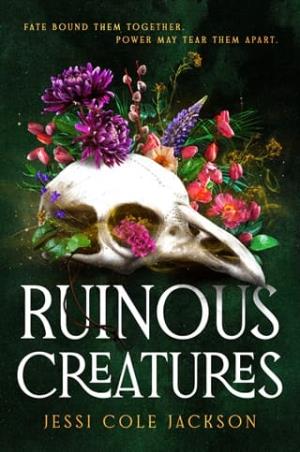
Ruinous Creatures
Chapter One Adela
I polish the bones, rubbing small swipes of scented oils and soothing ointments into the pale, craggy surfaces of the creatures’ skulls. Their insistent whispered wants echo through my head. I repress a shiver of revulsion.
I remind myself of the honor of my position. Communing with the skulls is a sacred calling. I shouldn’t hate the feeling of their wants flowing through me or be relieved that their voices have grown softer over the years.
Behind me, I hear the cruel scoff of my mentor. “Seventeen years in, and squeamish as ever. The Spinner save us. The day you become matcher will be a bleak one for us all.”
“Especially for you,” I mumble in reply as I rub rosemary and safflower oil along the edge of a long-dead jackalope’s empty eye socket.
After all, Bartholomew isn’t yet an old man, and matchers don’t have the luxury of retirement. We die. If we’re both lucky, I’ll have another thirty years as his assistant before I have to take over being head matcher.
If you could call it luck.
“What was that, girl?”
“Do we have more salted lotus wax?” I make my voice light, glad for the matching hut’s muddled light and the solid silver mask hiding my face.
He grunts and points to the jar at my elbow.
“Ah, of course.” I use it on the broad, angular skull of the gryphon with the chipped beak, then move to another jackalope, my hands and mind finding a rhythm in the work as I polish its twisted antlers.
Most jackalopes choose oil imbued with bright cranberries, mint, or lemon verbena.
The sharp-beaked gryphon skulls are finicky, preferring first an earthy, autumnal leaf ointment, then vibrating in quick, harsh bursts halfway through my efforts, only settling back into their pleased rumbles when I switch to spicy peppermint or myrrh and repeat the ministrations.
I take down the three gytrash and polish all their canine-like skulls with the musky scent of oakmoss.
Gytrash always match in triples. And while any skull can match with any of the three orders, gytrash usually pair only with members of the Huntress order.
I wonder if these skulls who assist priestesses with death rites will find their matches during the upcoming ceremony.
On and on I go, trying to sink into the repetition of the work and ignore the scraping murmurs of their voices as well as I can.
Not that the skulls speak with actual voices.
My best friend, Cecelia, is constantly trying to get me to describe the sensation of communing with the skulls while I polish them.
She can hear them too—most keepers can—but they’re faint to her, muffled.
She’s fascinated by the depth of my understanding of their wants and wishes.
But I have no words to explain; for me it’s as undefinable as any other sense.
I just… hear them. Inside my head, or perhaps some deeper part of me. The skulls tell me, without words, their wants, needs, and secret desires. Some are sharp and buzzing; some are gentle and tinkling.
No matter the volume or nature of their voices, I hate hearing them. I oughtn’t. I am a keeper, from a long line of well-respected keepers—with one notable exception. And as assistant matcher, I am destined for greatness.
And yet.
Wishing I were doing almost anything else, I reach up on tiptoe and hook a jaw with my finger, scootching our only dragon skull off one of the top shelves.
“Take care!” Bartholomew snaps, and I nearly drop the skull. His voice softens when he says, “That was Psecilious. One of my first… charges.”
I dust the tips of Psecilious’s horns with a tiny bit of rare golden mica, and gently file away a bump from an otherwise smooth incisor the size of my thumb. Inside me, the dragon sounds raspy, and so much quieter than he ought to be. I twist with guilt for my relief.
To distract myself from the complexity of my feelings, I blurt, “He must’ve been large for a dragon.”
Bartholomew will welcome the chance to expound upon the noble nature of dragons.
He clears his throat. “Dragons once were massive beasts. Large enough to eat a deer in one great gulp. But where they once bred for size and strength, now they make more civilized choices for mates. Females will choose cleverer, more domesticated matches, and over the centuries it has led to a decline.…”
He talks on and on, telling me things I’ve heard a hundred times before. His love for them runs deep—the two he keeps as pets, more wild ones he watches over from afar, even the skulls of dead dragons—all more cherished than his community.
Particularly me.
While he talks, I toil. Grinding herbs and seeds for scents, pressing ingredients for their essence, emulsifying lectin with water and oil for thick, rich lotions. Plus, of course, cleaning all of Bartholomew’s tools.
“It serves them well as a species.”
I chose the wrong strategy. Rather than distracting me, Bartholomew’s high, persistent droning seems to somehow intensify the creatures’ voices until there is a discordant tumult in my head.
At least his golden aspen mask muffles him a bit.
As keepers, we wear masks whenever we work directly with the skulls of the creatures, to protect us from accidentally matching ourselves.
Keepers serve the orders and care for the living creatures; we do not wield magic.
“No more hungering between hunts or nesting in rocks to raise their young. No, dragons are smart. And loyal. The greatest of all creatures.”
When Bartholomew begins to compare dragons to the other types of creatures, I wonder if he’d notice me stuffing bits of my polishing cloth in my ears. Not that it’d help mute the skulls that echo inside me, but at least then their voices wouldn’t be fighting with his for my attention.
I finish working with the horsey skull of a nearly silent pegasus and turn back to the shelves. I place the last skull on the shelf and press my hands into my lower back. I arch, hearing the popping protests of my stiff bones. With that, I believe I am done.
Finally.
My eyes skim over to the rows of skulls that glow in the suns’ rays through the large windows of the matching hut.
Their magic hums with keen anticipation after their polishing, as if they know what’s to come.
And perhaps they do. The depth of a dead creature’s sentience has only been speculated about.
But I believe most of the skulls anticipate the upcoming matching ceremony with something like glee, as if they desire nothing more than to be paired with the novitiates and used for their unique magics.
I shiver at the very idea of having to wear a dead creature on my face every time I stepped into public for the rest of my life; for its wants—its voice—to constantly be in my mind, in my heart. No magic, no matter how powerful or useful, would be worth that.
The sun dips slightly lower, following its inevitable path across the valley, and hits a small shelf that sits above all the others. It’s so high and small I always thought it was practically useless and, therefore, empty. But something must be up there, based on the sharp glint of sunshine.
I step back and go on my tiptoes to see better. There, pushed so far back that I can make out only the edges of two curved yellow beaks, are skulls. Based on the beaks, they must be gryphons. But why would Bartholomew shove them up there?
I count the other gryphons on the shelves.
Six. The exact amount there should be. Have we missed these two in years past?
Or are they new? But no. They’re so discolored they look as if they have begun to fossilize.
Skulls tend to lighten as they age, bleached by the valley sun streaming in through the matching hut’s wide windows.
But that would make them hundreds of years old.
I get the ladder—no amount of stretching on my toes will help me reach these two.
Bartholomew waves me off. “Don’t bother.
We don’t polish the phoenixes. There’s no magic within them to awaken, or match.
They’re just…” He searches for a word, but whatever he’s looking for, he doesn’t find.
With a shrug, he finishes with “decoration.”
“ ‘Decoration’?” I can’t hide the horror of my tone, even when it makes him scowl so hard I can tell despite his mask, just by the tightening of the skin of his eyes. But to call any skull a mere decoration is surely sacrilege, even if they have no magic left in them.
And then the creature he’s named registers in my tired brain. “Wait. Did you say ‘phoenixes’? They’ve been extinct for centuries, at least. We don’t have phoenix skulls.”
“Obviously we do,” he scoffs. “The skulls are there on the shelf. We ought to have the Huntress high priestess burn them when she’s here with her dragon-wearer; return them to the valley. But for now, they sit. Let’s go.”
He turns and leaves without waiting on my response, leaving the door open behind him.
He drops his outer cloak and golden mask immediately outside, where they lie in a pile for me to gather up from frost-gilded grass.
As his assistant, I’m to clean and care for them, then return them to him after the ceremonies are complete.
He could just hand them to me, but that’s not Bartholomew’s way.
I should follow him. Call the day done. While it’s not expressly forbidden, it’s frowned upon to be in the matching hut alone. It can be dangerous, especially so close to a matching.
And besides, it’s creepy.
Even now, the skulls whisper through me, their wants pulling me toward them. Not the phoenixes, but the others. They want me to stay. To pull down the phoenixes. To rub oils and herbs into their ancient bones.
“Do you not hear them?” I call after Bartholomew. “The skulls want us to stay.”
He actually considers. “Of course they do. They are beasts of want.” He shrugs. “In another decade or so, you will learn to ignore their clamoring.”