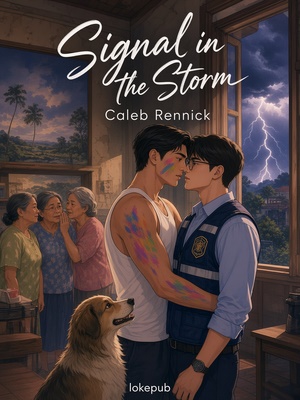
Signal in the Storm
Chapter 1
“What a big cock!”
Allan’s eyes snapped open.
For one confused second, he honestly thought he was back in Manila, trapped in another HR video call that had gone feral.
Then the sound registered properly: not a coworker, but a high-pitched voice from his right, cooing like she was talking to a baby.
He squinted against the bright sunlight blasting through the ferry’s grimy window.
Face-to-beak, a fighter rooster glared at him.
The bird’s wings were half-cocked, its head tilted, its beady eyes full of murder. Its spurs gleamed. Allan, who had encountered many different kinds of cocks up close in his life (thank you, Grindr), had to admit this one deserved the compliment.
The rooster’s owner, a woman in a worn-out campaign shirt with a corrupt politician’s face fading off the front, cradled it proudly in her lap like it was a newborn.
“Ay, sorry, iho,” she said, shifting the bird away from his face. The rooster blinked slowly, unimpressed, and let out a warning cluck.
“It’s okay, Manang,” Allan muttered, inching to the far end of the wooden bench, gripping his battered duffel like a shield as the ferry rolled over the swells of the open Pacific.
Outside the streaked window, the sea heaved under a sky that couldn’t decide if it wanted to be blue or bruised. Typhoon season. Of course his life would fall apart right when the Pacific started rehearsing its annual theatrics.
He checked his phone. No signal. No Wi-Fi. Just 2% battery, a cracked screen, and an email icon with 99+ unread messages that didn’t matter anymore.
Ten hours ago: Conference Room 4B, fluorescent lights, his manager sliding a four-page performance development plan across the table like it was a peace treaty instead of a breakup letter.
“We just want you to stretch, Allan. You’re such a rockstar, but the organization is realigning.”
Translation: we’re using you for three people’s jobs and blaming you when you crack.
By page three, “focus areas for improvement,” a list that basically said please stop bleeding where we can see it, something in him had snapped, quiet and total, like a fuse finally giving up on a bulb that had been flickering for years.
“No,” he’d said. Calmly. “I resign.”
Everyone had stared at him like he’d misread his line. He’d gone back to his desk, typed exactly three short paragraphs, and hit send before he could think of a single reason not to.
By the time he’d reached Tabaco Port, sweat plastering his button-down to his back, necktie stuffed into his bag, his notifications were already full of damage control. Fifty-eight missed calls. A thread titled Re: Reconsidering Your Options, muted on principle.
And above all of it, the message that had knocked the air clean out of his deliberately staged midlife crisis:
Hello Allan. This is Tita Becky. Your mom just had a stroke. Uwi ka na.
For one breathless second, nothing in him moved. Then his lungs clawed for air. His fingers went cold around the phone.
Of course. Now.
Another wave hit the hull, rattling through his bones. The woman beside him cooed at her rooster, oblivious. Somewhere behind him, a toddler was losing an argument with a bag of chips.
I just quit my job. I can’t afford a plane ticket to panic properly. His thoughts slammed into each other, sharp and useless. Static roared in his ears until the rest of the ferry blurred.
If I don’t go now, I will never forgive myself.
His hand had moved on its own after that. Bus ticket. Port. Ferry. His body remembered the route before his brain caught up, just like it always did with things he’d spent a decade trying to forget.
It had been exactly ten years since he’d last set foot on Catanduanes. Ten years, almost to the week. He’d left three days after his high school graduation, and now here he was, twenty-eight years old, going home with 2% battery and zero dignity.
On the night bus from Manila, anxiety had taken the window seat and spent eight hours listing every unfinished dream he’d left behind.
At Tabaco Port, the smell of diesel and grilled fish and someone’s Bluetooth speaker blaring BINI had made him feel like a teenager and an underpaid twenty-something at the same time, which, he supposed, he technically still was, on both counts.
He’d told himself that coming home would be like riding a bike: maybe you wobble, maybe you fall once, but your body remembers. As the ferry chugged closer to Virac, though, his stomach tightened around a quieter truth: he didn’t remember how to ride this particular bike. At all.
“Look. Malapit na tayo,” the woman with the rooster said suddenly, leaning past him to point. “Magayon, ’no? Kita na ‘yung bundok.”
He followed her hand.
Magayon. He hadn’t heard that word out loud in years, not since his lola used to say it about anything she loved: a sunset, a fat mango, him as a baby, apparently.
Viracnon, not Tagalog, the particular local flavor of Bikol that belonged only to this island, half-buried under a decade of Manila English and boardroom small talk.
He was rustier in it than he wanted to admit, but some words, apparently, stayed lodged under the ribs no matter how long you left them unused.
The green spine of Catanduanes rose from the water, steep and coastal, its slopes quilted with coconut trees and rice fields.
To the east, beyond the island’s curve, the Pacific stretched out: bright, endless, the same highway of storms that had made San Andres a regular feature on PAGASA bulletins every June to December.
San Andres sat along that shoreline: a municipality where everyone knew everyone’s middle name, everyone’s high school crush, and everyone’s last flood level. Where NGOs came and went like tricycle drivers on a Friday night. Where disaster drills were almost as routine as Sunday mass.
He let out a long breath. His chest did that stupid little stutter it did when life reminded him no one was actually steering except the wind.
The woman started whisper-complimenting her rooster again, so Allan pulled his phone out of habit and stared at the dead screen.
Under the corporate debris and HR emails, a quieter itch pushed up. One he’d spent a decade tamping down.
His lolo’s hands flashed up in his mind: stained with paint, gripping bamboo scaffolding as he brushed a giant Vilma Santos smile onto the town cinema’s billboard.
His dad, teenage and serious beside his father, filling in the shadows.
A lifetime ago, when every new movie meant a fresh hand-painted poster towering over Cine sa Isla, San Andres’ one and only cinema.
His lolo had called it a noble art. His dad had called it practice. Progress had called it obsolete and traded it in for tarpaulins and a digital printer two towns over.
“Sayang,” his dad used to say when they passed the old cinema, its paint already peeling. “People used to stop right there in the street just to look up, you know. That’s what your lolo did.”
As a kid, Allan had believed it. He’d believed it even more the first time his dad put a brush in his hand and let him fill in a patch of sky.
Somewhere between high school quiz bees and his first year in UP Diliman, that version of himself had been very neatly boxed and shoved to the back of his mother’s storage room.
He’d started college in biology, sprinting toward medicine because that’s what everyone had already written on his future.
Then he’d sat in entire lecture halls of kids who solved problem with their eyes closed, and realized he was no longer the smart one, just one more tired body in a lab coat that didn’t fit right.
A temporary shift to psychology had turned the next few years into a game of degree hopscotch: political science, back to psych, and finally landing in the College of Social Work and Community Development.
After graduation: DSWD. Case folders. Disaster relief reports.
Whole families handed to him like equations he was supposed to solve with a government per diem and a borrowed umbrella.
One bad year (too many cases, one missed follow-up he still thought about at 2 a.m. sometimes) had nudged him out of government and into a private company that paid better and felt worse.
It had been meant to be a detour. It had become the map.
He shoved that whole tangle of memory back where it lived. His sketchpads, his posters, his paint were all literally in a box in his mother’s house, stored the way you’d keep something you loved but couldn’t afford to look at.
“You’re just going home,” he told himself under his breath. “That’s it. No symbolism.”
The ferry bumped the pier with a jolt that seemed to say otherwise.
People surged to their feet, bags and babies and plastic-wrapped boxes of pasalubong pressing in from every direction. The rooster, offended again, let out a strangled crow.
Allan slung his duffel over his shoulder and stepped off the boat into air that smelled like salt, diesel, wet plywood, and the faint sweetness of saba frying in sugar.
Welcome back to Catanduanes, he thought. Population: about 20 storms per year, titas, and every version of yourself you’ve been avoiding.
By the time the tricycle turned into Barangay Espiritu Santo, Allan’s shirt was soaked through and stuck to his back like a second, worse skin.
They rattled past rice fields, sari-sari stores, and a cracked waiting shed carved with initials that made his skin itch with half-remembered crushes. Coconut trees leaned in toward the narrow road like they wanted a better view of the drama.
The changes showed in the damage.
Patches on galvanized roofs, where the last big typhoon had peeled them back like sardine lids. Concrete walls with stubborn brown watermarks that no paint could quite hide. A sari-sari store he remembered by the river, now relocated up the hill, its sign crooked but defiant.
On the ferry, he’d finally called Tita Becky back before his battery died.
“Tita, is Mom at Catanduanes Doctors, or Eastern Bicol?” he’d asked, his voice too high.