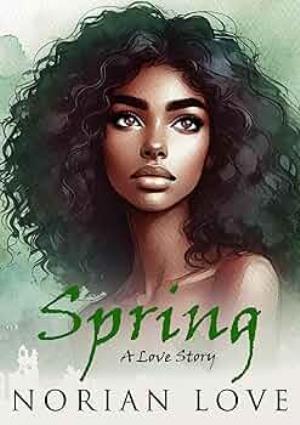
Spring (Seasons of Love #3)
1. Planting seeds
PLANTING SEEDS
T he second pot of burnt-ass Ethiopian roast gurgled behind her in the corner like a petty ex: bitter, messy, and refusing to be ignored.
She sifted through video clips, trying to find the right shot for her latest documentary, The Blacker the Berry , an introspective on soul music across the diaspora.
Right now, none of it felt introspective – in fact, it all felt off, as if she was becoming something she didn’t ever want to be: mainstream.
"You're not gonna make me sit through another quote from that man with the fake accent and the faux-locs in this documentary, right?" quipped her lead documentarian, Rayelle West, who also served as her friend/occasional archangel of good sense.
Rae had been there since the nonprofit days, back when Spring ran grant proposals out of her living room with a broken ceiling fan and more ambition than rent money.
She had a voice like spiced honey – sweet, until it hit the back of your throat.
She was several shades lighter than Spring, her hair cut close in a soft Caesar, cropped neatly around her head, the texture natural and intentional.
The color was a muted blonde – not loud, not brassy – naturally accenting her light brown skin, catching light without demanding it.
It framed her face with quiet confidence, the kind of haircut that didn’t ask permission or explanation, and was accessorized exclusively in controlled chaos: thick red-framed glasses, gold hoops, chunky rings, and an ID badge she wore like jewelry.
She moved like a consigliere – snarky, loyal, and always five steps ahead.
Spring threw a stress ball at her with violent intention as only a best friend who was like a sibling could. On cue, Rae ducked out of the way as Spring barked, “Bitch, hush, I need to concentrate.”
Spring didn’t even look up as Rae approached her. She could hear the irritation in the way Rae smacked her gum as she leaned on the desk examining the man. Spring sighed and preemptively stated, "First, his locs aren’t fake, and second, he’s Afro-British.”
“Girl, nothing about that man says afro anything.”
“Well, luckily for him, being black isn’t monolithic, and you are not the arbiter of all black experiences.”
“Well, luckily for you. I don’t need the last word, so you do you, boo. But if this is what you’re going to present to the board, we’re in trouble.”
Spring sighed. “You’re annoying.”
Rae sucked her teeth. “Okay, sis. I was really trying to let you arrive at this revelation on your own,” she said, checking the time, “but we’re pressed, so I’m about to save us both grief and heartache.
” She pointed at the screen. “Firstly, you’ve got a classically-trained Afro-British actor cosplaying the trenches.
The man does not know the mean streets of London. ”
Rae tilted her head. “And when I say ‘London,’ I don’t mean where the royals wave from balconies. I mean the kind of postcode where folks talk about making their P’s like they on an episode of Top Boy.”
Spring smirked as she continued, “This man is from the kind of London where the espresso machine costs more than my car. You can hear the trust fund in his accent. And coming in a close second,” Rae continued, not missing a beat, “his hair.”
Spring threw her hands up in the air. “You’re being petty, Rae.”
Rae squinted at the screen. “Those locs look like they were installed five minutes before the audition. Like he Googled ‘ How to look deep by Tuesday’ and committed.”
“They’re… not that bad.”
Rae waved a hand. “They don’t look lived in.
They look leased . That’s not diaspora trauma – that’s a hairstyle with a return policy.
Thirdly,” Rae said, counting on her fingers, “he reads like he’s personally offended by the dialogue.
Like the words are happening to him.” She rolled her eyes.
“And did I mention the way he says melanin ? Like a colonizer trying to purchase it at the Negro Emporium.”
Rae huffed, pushed her chest out, and slipped into her best over-enunciated British accent. “‘Now I am not formally – nor informally – suggesting that your audience might take issue with this prim and proper accent lecturing them on the origins of soul music?—’”
“I get it, Rae. He’s not the most-authentic sounding Afro-British man we could’ve found for the role.”
“It’s giving BBC documentary. It’s giving cultural audit. What it’s not giving, is authenticity. There is absolutely nothing authentic sounding or looking about that man. Hell, are we sure Rachel Dolezal doesn’t have a brother? He might be better for the part. In fact, what’s her availability?”
Spring sighed, exasperated. “Rae...”
“Hey, I’m just saying, she fooled the NAACP for years, and her locs look much better. Just trying to help.”
“And what part of this is helping exactly?”
“The part where I save you from waking up at two a.m. to call me crying about a reshoot because you realized this guy makes Carlton Banks look like NBA YoungBoy. If this man starts explaining soul to Black people, we’re going to lose the room in under thirty seconds, and that’s being generous.”
Spring contemplated her best friend’s words. Sensing this in their unspoken bond, Rae backed down, putting her hands up in concession. “You know what? We’ll do it your way. My bad. We don’t have time for me being right.” She leaned back, smirked. “I’m riding with you. Fake locs and all.”
“That’s more like it.”
Rae then nodded toward the board. “Yeah…we’ll throw some kente cloth behind Great Value Shazza Zulu, season him up just enough, and maybe we can take him to the cookout without anybody side-eyeing us.”
It was too late; Rae’s words had already had their impact.
Spring’s lips twitched. She looked at her friend and then back at the screen.
Her instincts had been telling her the same thing, but she hadn’t wanted to listen.
She was tired and behind schedule and needed this to work as is.
Despite knowing in her gut that this was off, the board was waiting for a visual as a sign of good faith.
In a desperate attempt to convince herself one final time, she looked at her best friend. “Seriously… is it really that bad?”
“Nairobi Spring Ellison-Greene, why are you so damn stubborn?”
“It’s that bad you had to use my whole government name?”
Rae nudged her hand to the side and clicked the mouse to navigate to the next slide. Spring almost smiled, thinking maybe she’d somehow won this round with her friend, but the feeling dissolved the second the next frame appeared on the projector.
A Black boy, maybe seventeen or eighteen, stared into the camera like it owed him something. Along the bottom of the screen, the caption read: "Where does soul music come from: My blackness, and knowing that I am more than enough."
But it wasn’t enough. Not for Spring. Not for this pitch. And not for the artistic integrity and cultural importance she was trying to protect from being chewed up by boardrooms and YouTube algorithms.
Her hand drifted to her necklace – a small locket with a compass set inside. On the inside of the compass, was an image of Nubia, the Black Wonder Woman. She opened it and tapped it twice, a silent, anxious tic Rae was familiar with – when Spring was weighing instinct against doubt.
She’d done it once before pitching a million-dollar idea that got them both hired at TLC, and again years later, after deciding to risk everything on a breakout project that carried her into the Creative Director seat.
“The thing about this project is, I care about the way it feels. It’s not just another documentary – I need them to feel it,” Spring grumbled as she watched the dailies from the film she was working on.
“I know babe, the question is do you think that’s what’s going to happen with what you’re looking at?” before she could respond to her partner in crime,
a knock at the door interrupted her progress. "Mrs. Greene, they’re ready for you in conference room three,” the office coordinator said.
“Okay, I’ll be there in a second,” she replied.
For some, going to meet the board of Third Lens Collective – the premier film studio in Atlanta – was a formality, or an execution.
For Spring Greene, the Creative Director of Non-Fiction, it was both.
She sat in her office just off the main corridor with her best friend, realizing time was almost up.
The frosted glass walls provided soft lighting yet kept her privacy intact.
You could see movement from the outside, silhouettes crossing, but intentionally didn’t show detail.
She’d been on a creative streak, and TLC knew it.
Her latest documentary, After the Hashtag , had become an industry sensation.
For eighteen months, she’d followed activists, mothers, and organizers after their justice campaigns had faded from the news cycle, capturing what happened when the cameras moved on.
The film left the industry buzzing – praised for its raw, unflinching honesty, and the intimacy of its lens.
Looking at the footage for her latest effort, Blacker the Berry, she slowly began to realize that she wasn’t moving in the right direction.
What was worse, it was starting to show.
Spring had the kind of presence that made people take notice.
Dark-skinned with full lips that she’d inherited from her Kenyan mother, eyes shaped like almonds, she wore her hair in a soft, sculpted halo, just wild enough to give off an air of carelessness.
Her outfit was clean, tailored –a low-key message that said, “I earned this title and the right to share the air you’re breathing,” which wasn’t easy.
Her athleticism came from her Georgia-bred father, and her body carried heat naturally, quick to warm, quick to sweat, and it was happening at the worst time.