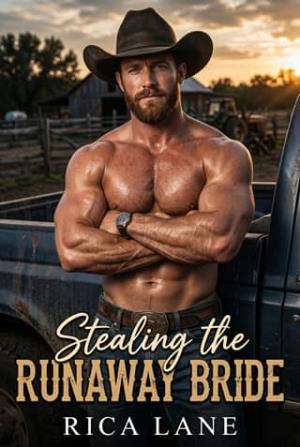
Stealing the Runaway Bride (Filthy Possessive Cowboys #3)
Juliette
The silk screams as it tears, a jagged, visceral sound that should hurt more than it does.
I don’t care about the twelve thousand dollars’ worth of hand-stitched Mikado silk or the delicate Alencon lace I spent six months sourcing from a tiny mill overseas.
Right now, the gown is just a cage, and I’m the bird who finally realized the door was never actually locked.
I stumble across the cracked asphalt of the Pine Valley gas station, my breath coming in short, sharp hitches that burn my throat. The air here doesn't smell like the expensive lilies and cloying incense of the chapel. It smells like diesel, dust, and the promise of a horizon my father can’t buy.
My ballet flats are useless on the gravel.
Every step is a gamble, the heavy train of my dress dragging behind me like dead weight.
I grab a handful of the expensive fabric—the fabric that was supposed to bind me to a banking heir I’ve met exactly four times—and yank.
The seams give way with a satisfying pop.
I cut this gown myself, for my own body, the way I cut for the women the rest of the industry never bothers with.
I’m destroying a masterpiece. My masterpiece.
And God, it feels better than any praise I’ve ever received in a showroom.
He’s waiting. He has to be waiting.
I told the driver to be at the pumps by two o'clock. "Black truck," he’d said over the burner phone. "Look for the dent in the tailgate."
My eyes sweep the lot. It’s midday, and the sun is a relentless hammer beating down on the valley.
A dusty black heavy-duty truck sits idling near the far pump, its engine a low, guttural growl that vibrates through the soles of my shoes.
I don’t look at the driver. I don’t look at the license plate.
I don’t look at anything but the door handle and the safety it represents.
Conrad Marchand thinks he can sell me like a plot of land. He thinks because he paid for my education and my studio, he owns the output of my womb and the direction of my life. He’s about to find out that a designer knows exactly how to take a seam apart when the fit is wrong.
I reach the passenger side, my fingers trembling as I catch the handle. It’s hot, the metal searing my palm, but I don’t let go. I yank it open and haul myself inside, the sheer volume of my shredded skirts spilling across the cab in a ruined white cloud.
"Go," I gasp, slamming the door. The lock clicks—a heavy, mechanical thud that echoes in the cramped space. "Please, just drive. I have the cash. Just get me away from the highway."
The truck doesn't move.
Instead, a scent hits me. It’s not the cheap air freshener or the stale cigarette smoke I expected from a hired getaway driver.
This is something else entirely. It’s the sharp, metallic tang of saddle oil.
It’s the deep, earthy musk of a man who spends his days under the sun and his nights near a fire.
It’s the smell of Pine Ridge.
I freeze, my hand still locked on the door armrest, the bones of my knuckles showing white through the skin. Slowly, I turn my head.
The man behind the wheel isn't the nervous voice I heard over the phone.
This man is a mountain. His shoulders are so broad they seem to swallow the driver's seat, his frame clad in a sweat-stained denim shirt with the sleeves rolled up to reveal forearms corded with thick, functional muscle.
His skin is weathered dark by the sun, seasoned by wind and grit.
And his eyes.
They aren't looking at the road. They’re looking at me.
They’re a deep, turbulent brown, framed by thick lashes and a brow that’s currently furrowed in a mix of confusion and something far more predatory.
There’s a scar cutting through his jawline, a silver jagged line that disappears into a short, dark beard.
He looks like he’s been carved out of the very landscape I’m trying to flee.
"You're in the wrong truck, darlin'."
His voice is a low, gravelly rumble that settles right in the center of my chest. It’s not a question. It’s a statement of fact, delivered with the kind of calm authority that makes my frantic heart stutter.
"I... the black truck," I stammer, my tongue feeling two sizes too big for my mouth. "The dent in the tailgate."
He shifts, his leather work boots creaking against the floorboards.
The movement brings him closer, invading my space with a heat that has nothing to do with the summer weather.
He reaches out, and for a terrifying, exhilarating second, I think he’s going to touch me.
Instead, he picks up a small, whittled cottonwood bird from the dashboard, turning it over in his large, calloused fingers.
"Tailgate’s fine," he says, his gaze dropping to the ruined lace of my bodice. His eyes linger on the curve of my neck, then lower to the place where I’m clutching the torn fabric over my chest. "But you’re sure as hell not."
I swallow hard, my pulse hammering against my ribs.
I should get out. I should apologize and run back into the heat and find my actual driver.
But I can hear the distant, faint wail of a siren from the direction of the chapel.
My father’s security team. They don't use sirens for emergencies; they use them to signal that the asset has been misplaced.
I’m the asset.
"Please," I say, and my voice cracks. I hate that it cracks. I’ve spent twenty-seven years being the perfect, composed Marchand daughter. "I don’t care if it’s the wrong truck. I’ll pay you triple. Just drive. Anywhere but back there."
The man’s grip tightens on the whittled bird.
He looks at the side mirror, then back at me.
The predatory edge in his eyes sharpens, a dark, possessive flicker that makes the hair on my arms stand up.
He isn't looking at me like a stranger. He’s looking at me like I’m something he just found in his pasture and has no intention of giving back.
"You're running," he notes.
"Observant. Is the cowboy hat for show, or do you always state the obvious?" The sass comes out before I can stop it—a defense mechanism I’ve honed in a thousand boardrooms and gala events.
A ghost of a smirk touches his lips, but it doesn't reach his eyes. "I’m Cag," he says, shifting the truck into gear. "And I don't take money from women in shredded dresses."
The truck lurches forward, the powerful engine roaring as he pulls away from the pump. I look back just in time to see a sleek, silver SUV—my father’s lead security detail—screech into the gas station. A man in a dark suit jumps out, looking frantically toward the highway.
Cag doesn't head for the highway. He hangs a sharp right, tires spitting gravel as he guns it toward a rutted dirt track that looks like it leads straight into the heart of the mountains.
"Where are we going?" I demand, gripping the seat as we bounce over a pothole.
"Away," he grunts.
The silence that follows is heavy, filled only with the sound of the wind whistling through the slightly cracked windows and the rhythmic ticking of the whittled bird hitting the dash as we climb.
I should be terrified. I’ve just jumped into a vehicle with a massive, scarred stranger who smells like he could break me in half.
But as I watch his large, steady hands on the steering wheel, I don't feel fear. I feel a strange, terrifying sense of arrival.
My father always told me that every person has a price, and every object has a purpose. He’d looked at me across his mahogany desk two weeks ago, tossing a folder onto the blotter.
“The merger is contingent on stability, Juliette. A wedding provides that. You’ll marry the boy, you’ll produce an heir within two years, and your studio will receive another ten million in funding. It’s a simple transaction.”
A transaction. Not a life. Not a choice. Just a line item on a balance sheet.
I’d bitten the inside of my cheek until I tasted copper, nodding like the dutiful daughter he’d raised.
I’d spent the next fourteen days planning my destruction.
I’d sewn a secret pocket into the lining of this very dress, stuffed with the cash I’d skimmed from my business accounts over the last year.
I’d made the calls. I’d staged the escape.
But I hadn't planned for Cag.
I look at him out of the corner of my eye.
He’s staring straight ahead, his jaw set in a hard line.
He’s a once-burned man; I can see it in the way he carries himself, like he’s waiting for the other shoe to drop.
There’s a weariness in the set of his shoulders that matches the hollow ache in my own chest.
"You're shaking," he says. It’s not soft. It’s a command to stop.
"Adrenaline is a hell of a drug," I snap back, though he’s right. My knees are knocking together under the layers of silk. "I’ve just ruined a multi-million dollar merger and probably gave my father a minor heart attack. Forgive me if I’m not as stoic as a mountain."
"Your father," Cag repeats, the name sounding like a curse in his mouth. "Conrad Marchand."
My blood runs cold. "How do you know who I am?"
He doesn't answer immediately. He wheels the truck onto an even narrower path, the pine trees closing in around us like a green curtain. The scent of needles and damp earth fills the cab, replacing the dust of the gas station.
"Everyone in the valley knows the Marchands," he finally says, his voice dropping an octave. "They're the ones trying to buy the soul out of this place. Black Aspen Holdings. Your old man is the bankroll behind the snakes."
I flinch. The trauma of the last few months—the realization that my father was using me as a pawn to destroy the very land I’ve always found peace in—washes over me.
I’d seen the maps in his office. Red lines drawn through ranches that had been in families for generations.
Names like Pine Ridge circled in black ink.
"I’m not him," I whisper, and for the first time today, the sass is gone. "I didn't know. Not until it was too late."