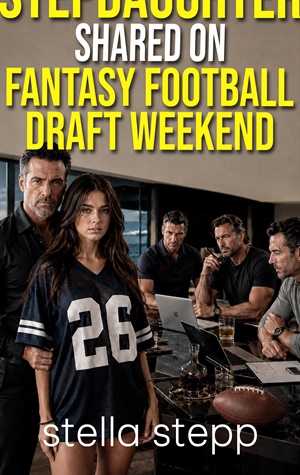
Stepdaughter Shared On Fantasy Football Draft Weekend (Stepdad Shares His Stepdaughter #3)
1. Mia
MIA
Salt air’s already thick through the open kitchen window, the gulf doing its slow morning roll outside, and the front door opens and I drop my coffee mug.
Not dramatically — not a shatter, not a moment.
The handle slips and it hits the counter and tips and sends a brown river across the marble toward the edge and I catch it with my hip and the heel of my hand and still end up with coffee down the front of the jersey I’ve been wearing for three days because I haven’t done laundry and it’s the most comfortable thing in this house.
Eight months since I’ve seen him. Eight months since Aunt Karen’s birthday in Tampa, when he walked in wearing a gray suit with no tie and I realized the man I used to call my stepdad had gotten bigger, harder, quieter in a way that made the room feel like it had less air in it.
I left early that night. Told myself it was the wine.
Drove home with the windows down and didn’t think about his hands, or the way he’d looked at me across the living room like he was solving a problem he couldn’t put down, or the fact that the last time I saw him before that night I was eighteen, and he was just family then — steady, easy, nothing I ever had to think twice about.
I’m not eighteen anymore. I’m twenty-one, between apartments, between boyfriends, between versions of my life, and I’ve been in his beach house for a week pretending I came here for the square footage.
“Mia.” His voice fills the foyer like something structural. Low, unhurried, my name in two syllables that sound like he rehearsed them on the drive here and decided on the simplest possible version.
“Grant.” My voice comes out weird — half surprised, half caught.
Like I didn’t know he’d be coming to his own house.
I did know. I knew when I accepted the key and I knew when I didn’t ask how long I could stay and I know right now, standing in his kitchen in his jersey with coffee on my hands and nothing on my legs, that this is the scene I set without admitting I was setting it.
Behind him: three men. They come through the door carrying coolers, laptop bags, and the loud, easy energy of men who’ve known each other long enough to stop being polite.
One of them has a football under his arm.
Another has a handle of Blanton’s. The third is already looking at me like I’m the most interesting thing that’s happened since they left the highway.
“Shit,” I say. “Draft weekend.”
Grant sets his bag down. His eyes haven’t left me — not the coffee, not the jersey, not my legs. Me. “You forgot.”
“I forgot.” That’s a lie and we both know it. I could have checked the calendar. I could have asked when I called him about the house. I could have been anywhere else this weekend. I didn’t do any of those things, and the truth of why sits in my chest like something with a pulse.
“Well.” The man with the football grins — sharp-featured, dark hair, the kind of face that looks like it’s always one second from saying something that gets him in trouble.
He drops the ball on the couch and extends his hand, bypassing Grant entirely.
“You didn’t mention the beach house came furnished, Commissioner. ”
“Jax.” Grant’s voice. One word. A warning shaped like a name.
Jax Bennett takes my hand anyway. His grip is warm, confident, the handshake of a man who sells things for a living.
“Jax. Sports marketing. Grant’s college roommate.
The reason he drafts third-round quarterbacks and pretends he thought of it himself.
” He hasn’t let go of my hand. His eyes are dark, amused, doing something between a greeting and a once-over. “And you’re the stepdaughter.”
“Former,” I say, and then wonder why I said it. “The divorce was three years ago. I’m just — staying here for a bit.”
“In his jersey.”
“It was in the closet.”
“I bet it was.” He lets go. He’s smiling in a way that makes me feel like I’ve already lost a negotiation I didn’t know I was in.
The second man doesn’t cross the room. He’s standing by the sliding doors, laptop bag over one shoulder, wire-frame glasses catching the light.
Dark hair, neat beard, the kind of posture you see in men who know exactly how much space they’re worth and never take more. He nods at me. “Brooks Callaway.”
Two words. They land with the weight of a full conversation.
His eyes are steady behind the glasses — not scanning, not flirting.
Reading. I feel assessed, filed, and cross-referenced before he even sets his bag down.
If Jax is a man who says too much, Brooks is a man who knows exactly how much silence costs.
“And this—” Grant starts.
“Tate.” A hand swallows mine. I look up — and up.
He’s the biggest man I’ve ever stood next to.
Dark hair, short beard, arms like someone inflated a normal person’s arms by forty percent, a tattoo sleeve I can’t process because his grip has my full attention.
He’s grinning. It’s enormous. “Tate Briggs. Sweetheart, you’re going to need more coffee. ”
He’s not wrong. I’m standing in a kitchen with four men I didn’t expect — three strangers and one man I expected too much — and the coffee is still dripping off the counter and my bare legs are getting goosebumps and the jersey feels like it covers both too much and not nearly enough.
Outside the window, a pelican glides low over the water, unbothered by any of this, and I envy it more than I want to admit.
The house smells different already. Salt air and bourbon and whatever cologne Jax is wearing and the dense warmth of a room filling with men who take up more space than the furniture anticipated. An hour ago this was my quiet borrowed refuge. Now it’s their arena.
I stand in the middle of it, jersey still damp at the collar, trying to remember what my Tuesday looked like a week ago, before any of this was real — before a spilled coffee mug and a text I said yes to without thinking rearranged the whole shape of my summer.
Grant moves through the room. Sets the coolers on the counter.
Opens a laptop on the dining table — the big one, eight seats, glass top, the table I’ve been eating cereal at alone for a week.
He starts arranging: laptops, chargers, a cheat sheet he’s printed and laminated because of course he laminated it.
The football goes on the table. The bourbon goes next to the football. Someone turns on ESPN.
I should leave.
The thought arrives fully formed and completely irrelevant.
My car is in the driveway — a high-mileage Civic with a cracked windshield and a full tank, pointed at the road, keys in my bag upstairs.
My phone is charged. I have three friends within driving distance who would let me crash without asking questions.
I have options. I have legs. I have a door that opens from the inside.
I pull out a chair and sit down at the draft table.
“I have opinions about your first-round strategy,” I tell Grant, and watch his jaw do something I’ve never seen it do before — a micro-flex, not a smile, something underneath a smile, like a crack forming in a wall he’s been maintaining for longer than he’ll admit.
“I’m sure you do.” He doesn’t look at me when he says it. He looks at the laptop screen. But his voice drops half a register and goes somewhere private, somewhere his friends can hear but can’t fully translate, and I feel it in my stomach before I understand it in my head.
Tate is unpacking the cooler — beers, ice, something wrapped in butcher paper.
Jax is already trash-talking Brooks about last year’s draft from across the table.
Brooks is ignoring him, plugging in his laptop with the calm of a man who lets other people talk themselves into mistakes.
The house fills with noise and bourbon and the charged energy of men who’ve been doing this for years — loud, competitive, territorial, relaxed in the way men only get when they’re with the people who’ve seen them lose.
Grant sits at the head of the table. Because of course he does.
His hand finds my lower back as he passes my chair.
Not reaching — arriving. Like his palm knew where I was before his eyes confirmed it.
Five fingers spread across the space between my shoulder blades and my waist, pressing once through the jersey — firm, warm, deliberate. Two seconds. Maybe three. Then gone.
But two seconds is enough. Two seconds of his hand on my back and I know three things:
One — his friends saw it. Jax’s eyebrow went up. Brooks’s expression didn’t change, which means it changed in the places he doesn’t let you see. Tate glanced over from the cooler and then looked away with the careful speed of a man who knows when not to look.
Two — he didn’t do it by accident. Grant Callahan doesn’t do anything by accident. He builds things — buildings, businesses, fantasy football rosters, weekends at a beach house with his stepdaughter already inside it. Everything he does has a blueprint.
Three — I leaned into it. Not much. Not enough for anyone across the table to see.
But I shifted my weight toward his hand instead of away from it, and the difference between those two directions is the difference between a woman visiting her former stepdad’s house and a woman sitting down at a table she has no intention of leaving.
I’m not leaving.
My phone buzzes in the bedroom upstairs — Mom, probably, the third call this week.
I told her I was staying with Emma. I told her the beach house was a girls’ trip.
I haven’t told her anything that rhymes with the truth, which is that I drove four hours to a house that belongs to the man she divorced because he offered me a key and I wanted to be in his space and smell his shampoo and sleep in sheets that held the shape of him, and now he’s here with three friends and a draft board and his hand touched my back like it had every right to, and I chose this.
I chose this on the drive from Tallahassee. I chose it when I took the key. I chose it when I didn’t check the calendar. And I’m choosing it now, sitting at this table in this jersey with coffee drying on my chest and four men looking at me like the weekend got interesting.
Grant’s eyes meet mine across the table. Dark. Steady. The look of a man confirming an answer he already has.
I reach for the bourbon. “Deal me in, Commissioner.”