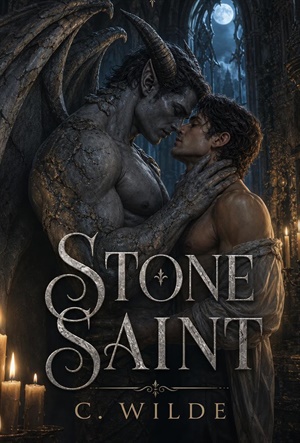
Stone Saint (Monsters of Veilwood #5)
1. Wes
Wes
The scaffolding hums when the wind comes off the lead roof, a low metal note that I’ve started to think of as the cathedral talking back to me.
It’s past ten. I should have stopped an hour ago.
The diocese pays me for daylight and I’m up here burning a headlamp and a tin of beeswax against the cold, picking three centuries of soot out of a stone face the size of a manhole cover.
“You’ve got a chin under all this,” I tell it. “Who knew.”
The face doesn’t answer. None of them do. That’s the deal I’ve made with St. Wracken’s in the eleven days I’ve been sleeping in its rectory, I talk, the building listens, and neither of us mentions how strange it is that I prefer this to people.
I’m an art restorer. That’s the polite word.
The honest word is that I’m a man who gets hired to make beautiful things presentable and then gets sent home before anyone learns my last name.
Six years of it. Manor houses, a war memorial, a collector in Veilwood’s new quarter who wanted his fauns de-mossed and never once looked me in the eye.
I clean. I consolidate. I match the old stone to the new and I leave no trace of myself, which is, I’m told, the whole point of good conservation.
You are not supposed to be visible in your own work.
I’m very good at not being visible.
The carving I’m cleaning tonight isn’t on the list. The list is the apostles in the north transept, the boss carvings in the nave vault, the tomb effigies.
This one is a gargoyle, full-bodied, crouched at the lip of the old gallery where the gargoyles used to throw rainwater clear of the walls before someone bricked in a drainpipe and made them ornamental.
He’s not on my schedule because the diocese has already decided St. Wracken’s is a property, not a building, and properties don’t get their gargoyles cleaned.
But he’s the best thing in here.
I’ve worked on a lot of medieval stone. Most of it is competent.
Some of it is clumsy in a way that’s charming, masons copying masons copying a drawing nobody understood.
This one is neither. Whoever carved him knew the body underneath.
The shoulders are real shoulders. The wings fold down his back with the weight of wings, not the decoration of them.
His hands, he has hands, not paws, grip the ledge with the knuckles up, claws hooked over, and there’s tension in the forearms like he’s about to push off into the dark.
His face is turned three-quarters toward the nave. Toward me.
“You’re overqualified for this gutter,” I tell him, and run my swab along the line of his jaw. The soot lifts. Under it the stone is a paler grey, almost warm-looking in the lamp, with a fine grain like skin under stubble. “I’d have given you a tower. A whole spire. Somewhere people would look up.”
The wind drops. The hum dies out of the scaffold. For a second St. Wracken’s is so quiet I can hear the candle I left burning on the platform behind me, the small wet sound of the flame.
I keep working. I tell him about the diocese, because he’s a good listener and the dead make excellent confidants.
I tell him the survey’s a formality. That the developer’s already drawn his plans, flats, a wine bar in the crypt, the bell tower as a “feature.” That my contract runs to the end of the month and then I go back to my flat across the river and wait for the next thing that needs me and doesn’t want me.
“You’d hate them,” I say. “The new owners. They’ll put a glass floor in. They’ll uplight you in blue.”
I lean back to check my work and my headlamp swings across his eyes.
They’re open. Of course they’re open, they’re carved open, a mason’s deep undercut to catch shadow. But the shadow in them moves. Just slightly. The way a real eye moves when it’s tracking something. The way an eye moves when it follows your hand.
I hold very still.
“…Okay,” I say softly. “That’s the late hour. That’s the wax fumes.”
I reach out, slow, and lay two fingers flat against his stone cheek where I’ve just cleaned it.
It’s warm.
Not the dead warmth of stone that’s held the day’s sun, there’s been no sun, it’s been raining since Tuesday, the whole cathedral is cold as a cellar and I’ve been working in two jumpers.
This is warmth from inside. The warmth of something that has a temperature of its own.
It comes up through my fingertips like the side of a kettle an hour after the kettle’s off, the heat banked deep and giving slowly back.
I should take my hand away. I don’t.
“You’re warm,” I tell him, like an idiot, like he can hear me. “Why are you warm.”
The candle gutters. Far down the nave a pigeon shifts in the triforium and resettles.
And under my two fingers, so faint I feel it more in my own bones than in my skin, there’s a sound.
A low one. Below hearing, almost, a pressure in the air, the kind of note you feel in your sternum when a truck idles outside the window.
It comes from inside the chest of the stone and it goes through my hand and up my arm and stops my breath in my throat.
Stone does not make that sound.
I take my fingers back. I sit on my heels on the cold board of the scaffold with my heart going like I’ve run up the bell tower, and I stare at the gargoyle, and the gargoyle stares at the nave with his carved-open eyes, perfectly still, perfectly stone, and the warmth is already fading off my fingertips into the cathedral cold.
“Right,” I say, to steady myself. “Goodnight, then.”
I gather my swabs and my tin. I climb down off the scaffold one careful rung at a time because my hands won’t quite stop shaking, and the whole way down I can feel him at my back, that turned-three-quarters face, the place between my shoulder blades crawling with the certainty of being watched.
At the bottom I look up.
The headlamp doesn’t reach him from here. He’s just a darker shape in the dark, hunched at the gallery’s edge, wings folded, waiting. He’s been waiting up there for three hundred years.
“I’ll be back tomorrow,” I hear myself say.
And from the dark above me, so quiet it might be the scaffold settling, might be the wind, might be nothing at all, comes the long, low, considering sound of something deciding whether to answer.
I don’t sleep that night. I lie in the rectory’s narrow bed with the rain on the lead and I keep my hand open on top of the blanket, the two fingers that touched him, and I swear I can still feel where the warmth went in.