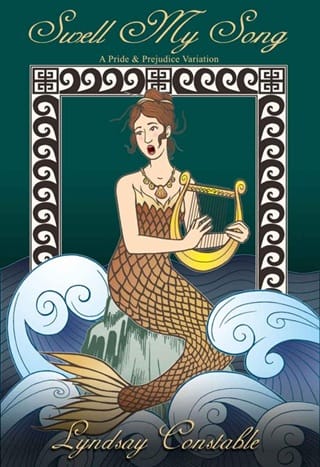
Swell My Song (The Mayhap Myths #1)
1. Chapter One
Chapter One
F rom the tips of Elizabeth’s fingers to the ivories, force would be applied. Then music would swell into the world, entering those who chose to listen through ears that hear, bodies that feel the tremors of each note, and minds that judge what has been performed.
It was no small accomplishment, in Elizabeth’s opinion, as her hands continued to glide along the bones of the instrument. To so overwhelm the sensibilities of another! When viewed in such an all-encompassing way, it was a very intimate act between the performer and the audience. An act that worked on the physical as well as the feelings and intellect of the witness, to the very core of their character. Depending on the discernment and willingness of the receiver to be swayed, music held the power to display a sliver of the artist’s soul, a frank and frightening act that required no small measure of bravery on the part of the performer.
The ivory itself was a sacrifice from a mighty beast from faraway lands. The wood from felled trees and the hours of craftsmanship gave a weighty sense of responsibility to Elizabeth every time she sat before a pianoforte. And never had she had the opportunity to play an instrument this exquisite. Out of the many recitations describing the finery of Rosings from her cousin Mr Collins, this was by far Elizabeth’s favourite. She was surprised to realise that it was one of the few instances, if not the only instance, when her cousin’s excessive praise failed to do the subject justice.
With a small sigh of acceptance, Elizabeth heard the last notes of the song fade away. She sat motionless, hoping that Lady Catherine would forget about her presence for a time—a more frequent occurrence now that both Mr Darcy and Colonel Fitzwilliam were here at Rosings. Elizabeth Bennet and Maria Lucas had fast faded from objects of interest to be moulded and scolded by tart observations, to background ornaments that were nowhere near the importance of the lady’s two nephews. Elizabeth was not sorry for the change.
She glanced up in time to observe both Colonel Fitzwilliam and Mr Darcy rise and make their way from the audience to the pianoforte where she sat. Lady Catherine had been momentarily lured into an appeal on the proper time to release hens from the henhouse by Elizabeth’s lifelong friend, Charlotte Collins. Charlotte probably had no need for advice of any kind on this point, but the parson’s wife was obliging enough to divert Lady Catherine’s focus to herself whenever it seemed that Elizabeth was in need of a respite.
Elizabeth’s back stiffened at the approach of the two gentlemen. Colonel Fitzwilliam was an easy conversationalist, and she had been pleasantly surprised that this single relation of Mr Darcy’s was affable and unassuming. But Mr Darcy himself was not among her favourites when it came to congenial company. In fact, Elizabeth could barely tolerate the man. Her eyes narrowed as his step drew him closer.
Why Mr Darcy even troubled himself to approach her was beyond her fathoming. He could very easily continue to glare at her from the comfort of the small chair next to Lady Catherine’s throne-like seat. Elizabeth had derived a brief flash of merriment from the spectacle of Mr Darcy twisting his rather tall, lean form into the deliberately snug, squat chair. It seemed to Elizabeth that Lady Catherine relished maintaining her superiority in rank even when it came to seating arrangements. It gave her less bold visitors—such as Mr Collins—even more encouragement to fawn from below.
Elizabeth drew a breath sharply and forced a pleasing smile to her lips as she looked up at the gentlemen.
“That was a splendid performance, Miss Bennet. Would you not agree, Darcy?” Colonel Fitzwilliam asked as he stood beside her bench and leaned down to inspect the music more closely. “Lovely! Spirited in all the correct spots, not too bold and assertive on the forte sections, nor too demure during the adagio. Truly, you have a knack for capturing the spirit of the tune without overwhelming it as some may have done.”
Elizabeth smiled up at him as he straightened. “That is a very kind way of saying that, though you admire my interpretation, my skill could use sharpening.”
“No, indeed!” cried the colonel. “Come, Darcy. Support me in my effort to praise Miss Bennet. For I suspect that, much like you, she finds praise of herself rather disconcerting.”
Elizabeth felt her smile falter. To be compared to Mr Darcy in temperament! She could almost scold Colonel Fitzwilliam for what she perceived as an insult. But she knew that the colonel meant no disparagement, as his nature was not one inclined towards slights.
Mr Darcy gave only a brief nod and replied in a level tone that seemed bored, “I could not detect any weakness in the performance.”
“I take it then that you worked awfully hard to discover an imperfection?” she asked with a twist on her lips.
“No more so than is usual for me.”
“You mean to say that I am not alone in this special distinction? Is every lady, who strives for the compliment of being named accomplished by one whose standards are so very lofty, under this sort of scrutiny?”
Colonel Fitzwilliam laughed. “Come now, Darcy! Unless I am mistaken, I heard a gauntlet being thrown down. I believe you are being asked to explain your ideals of a lady. I, for one, would also very much like to know whether every lady whom you encounter is held to the same standards.”
“I do not expect perfection in every accomplishment. It is not possible for even the most educated lady to excel in every single one. That would fly in the face of nature. And, in time, prove to be dull. Each of us find natural inclinations for some pursuits whilst others present us with a challenge. And it can be applied to both sexes. True gentlemen should be able to lay claim to certain accomplishments as well, even if some are easier for them to attain than others.”
“And,” Elizabeth ventured as she again ran her fingertips along the ivories, “would you include conversational skills in the accomplishments of a gentleman? The ability to speak with ease when among strangers? To make himself familiar and friendly to strangers whom he meets at assemblies?”
Mr Darcy swallowed and shifted his weight as he considered. Colonel Fitzwilliam looked on with apparent interest, seemingly amused by the charged air between Elizabeth and Mr Darcy. It chagrined Elizabeth that their mutual dislike was a source of diversion for one so perceptive as Colonel Fitzwilliam. It only added to her desire to take Mr Darcy down a peg in his overblown opinion of himself.
“That is indeed a skill that a gentleman ought to master,” Mr Darcy conceded, “but, as I said earlier, we all have our own natural inclinations that smooth the path towards mastery. I am willing to confess that conversing with strangers has never been something that I find easy.”
“But have you practised? I recall quite clearly the assembly at Meryton where gentlemen were few and you danced with only Mr Bingley’s sisters. Though we were but recently introduced, you could have asked for a turn with me and then our acquaintance could have begun earlier.”
He frowned, perhaps not entirely easy with the remembrances she brought forth. Satisfaction surged through Elizabeth as she pressed her point home. “That would have been an ideal opportunity to practise a skill that does not come easily to you. And yet, there were many young ladies forced to sit due to a lack of partners.”
Colonel Fitzwilliam laughed. “Excellent! I have noticed that too, Darcy. You cannot defend yourself on that point.”
“I can only reply, Miss Bennet, that I do not pretend to be what I am not. There are those in the world who would have you believe that they possess a multitude of honourable qualities that are actually mere illusions. I see no harm in acknowledging what I am accomplished in. I will acknowledge and feel some pride, even. But I am equally honest about that for which I am in need of improvement, and I believe there is no shame in not striving to become skilled in pursuits that are unnatural.”
“But do you not feel compelled to improve yourself? Improvement sometimes needs a force from outside to spark it into growth away from the comfort of what is easy and familiar. Almost an act of violence to bring us to a higher vision of ourselves. Just as when I press down.” Elizabeth pushed the C major key. The solitary note rang out clear and pure. “The hammer strikes the string with aggression, and a thing of beauty is created.”
One corner of Mr Darcy’s mouth moved up as he gave a small nod. “Excellent point, Miss Bennet. But I must also note that being gentle and steady can also produce beauty that pleases.” He inclined his head towards the harp, a neglected, magnificent instrument standing silent in the corner. The petite clawed feet of a rich dark wood peeked out from the base. The head was covered in delicate scrolls of grape leaves, with one carved bunch of the fruit, lush and swollen with sweetness, emerging from the foliage.
A pang of melancholy struck Elizabeth’s heart as the instrument, abandoned for an unknown number of years, sat, waiting patiently, longing to be touched. If her sister Jane had learnt such an instrument, there would be wars fought over who could have her hand in marriage. She would have been the pinnacle of loveliness and art with a harp leaning against her chest and her voice raised in song.
“When the harp makes music,” Mr Darcy continued, “the player tenderly encourages by pulling and drawing the note out, not by the force of a blow. It is a gentle request, not a forceful demand.”
His voice had become so earnest by the end of the sentence, Elizabeth was unaccountably disquieted, her neck warm as her gaze left the harp and returned to his dark eyes.
“Are you discussing accomplishments? I demand to know precisely which ones are being canvassed,” Lady Catherine declared from across the room. “For, I believe I am in the right when I say that I am the foremost authority on the proper forms of accomplishments which young ladies ought to possess.”
“Indeed! You are so very accomplished in accomplishments that I hardly know who could possibly be more accomplished in the knowledge of them,” Mr Collins exclaimed as he leaned in towards Lady Catherine, eagerly dispensing this odd compliment.
Elizabeth bit her lip, attempting to suppress a giggle at the pair of them. Colonel Fitzwilliam shook his head discreetly. She was surprised to note that even Mr Darcy could not restrain compressing his lips tightly. If Elizabeth was not already convinced that he was a man without humour, she would have been inclined to believe that he was attempting to stifle a laugh at the ridiculousness of her cousin’s declaration.
“But,” Lady Catherine continued after waving in the direction of Mr Collins as one does to irksome gnats that pester, “I must point out that, though your playing is tolerable…”
Elizabeth sat straighter as all impulse to giggle faded, not caring for the tone in which the lady was speaking.
“…you will never be deemed truly accomplished unless you can also sing with grace. I know of few ladies who are able to do both admirably. And since I am well aware that you have not had the benefit of London masters, I can hardly expect you to be able to play and sing well. Your playing is passable, I suppose. We cannot expect half as much from your voice. It will most likely lack grace. Grace, Miss Bennet, cannot be falsely forged—you either possess it, or you do not.”
Elizabeth was suddenly furious, her blood scalding as it flowed through her thundering heart. She had submitted to several weeks of questionable distinction by Lady Catherine’s preferment in the form of rude questions, dismissive surmises, and interrupted responses. Just as Elizabeth was about to say something that she was sure to regret, Charlotte leaned towards the great lady.
“I can speak from experience, you will find Elizabeth’s voice has no equal. It is superior to the quality of her playing and is expressive in such an unusual way that I am always gratified when she is kind enough to indulge us with a song.”
“Ah, is that so?” Lady Catherine said, the skin around her eyes tightened. “Miss Bennet, you must sing, though you have declined to do so when previously asked. I am not being unreasonable with this request. Surely you can accommodate us this once. If you would be so kind.” The upper lip of the great lady curled with the last sentence, resembling a small sneer.
Everyone turned their attention back to Elizabeth. Her heart sank. She was grateful to Charlotte for giving her a moment to recover her composure when a pert response was going to leap from her mouth. However, singing was the one skill that she had avoided displaying beyond her small circle of friends and family.
Mrs Jenkinson, the companion to Lady Catherine’s daughter, blinked at her with watery, blue eyes. Miss Anne de Bourgh stilled her fidgeting, nervous hands as she stared at Elizabeth. Charlotte was smiling gently, with an encouraging arch to one eyebrow. Mr Collins appeared bilious, most likely frightened that Elizabeth would humiliate herself and, by association, himself.
Just as suddenly as it had appeared, her fury turned to dread. Elizabeth was being forced to do the one thing she wished not to do—defy her father.