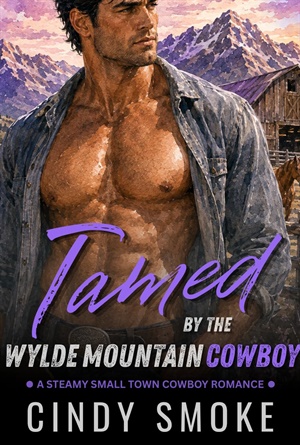
Tamed by the Wylde Mountain Cowboy (Wylde Mountain Ranch #1)
1. Chapter 1
Elise
There are three types of men in the world. Men who open doors. Men who don’t notice doors. And men who are the door.
Raiford Wylde is the door.
I know this within four seconds of meeting him, which is approximately three and a half seconds longer than it should take a reasonable adult woman to assess a stranger, and approximately three and a half seconds less than it actually takes because my body decided before my brain got a vote.
He’s standing at the barn door of the biggest ranch I’ve ever seen (and I grew up on a ranch, so that’s saying something) and he looks like he was built from the same materials as the mountains behind him.
Tall. Dark hair. A jaw that could split firewood.
Eyes that are currently looking at me the way you’d look at a gate you didn’t order and aren’t sure you want to sign for.
“Ma’am,” he says.
Ma’am. He ma’amed me. I’m twenty-seven years old and a man just called me ma’am with the enthusiasm of a toll booth operator and I felt it in my knees.
Because his voice is low and rough and sounds like gravel under boots and he said “ma’am” like it was costing him something and I am not equipped for this.
I’m here because my cousin Jules lost her mind on a mountain and fell in love with a man named Dane Walker and now lives in his cabin recording a podcast and she invited me to visit because, and I quote, “you need to stop moping about the ranch and come see some mountains.” I’m not moping.
I’m processing. There’s a distinction that Jules, for all her narrative skills, refuses to acknowledge.
The ranch. My family’s ranch. Three generations of Carters on two hundred acres in the Shenandoah Valley.
Horses and cattle and a hay barn my grandfather built with his hands and a house my grandmother planted roses around and a life that fit me like a broken-in saddle.
My parents sold it last year. Dad’s back gave out.
Mom wanted to be closer to her sister in Richmond.
They sold the land and the house and the barn and the roses and I stood in the driveway on the last day and watched someone else’s moving truck pull up to a house my grandmother died in and I thought: where do I go now?
The answer, for the last year, has been other people’s ranches.
I pick up work. Seasonal stuff, foaling season, cattle drives, training.
I’m good at it. I’m very good at it. Third-generation good.
But working on someone else’s land is like singing someone else’s song.
You know all the words and none of them are yours.
Now I move from ranch to ranch, never settling down.
Jules says I need a fresh start. Jules says the mountain will fix me. Jules says this while standing in a studio her boyfriend built for her with the confidence of a woman whose life just came together and who assumes proximity to her good fortune is contagious.
I love Jules. Jules is my favorite person and she worries about me the way I worry about foals: with a watchfulness that comes from knowing someone since before they had defenses.
So I’m here. On Wylde Mountain. Standing in front of a barn on a twelve-thousand-acre ranch watching a man who doesn’t want me here pretend that he’s not annoyed that I exist.
“Thank you for letting us ride your property,” I say. Because I have manners. Because my mother raised me to be polite to hostile strangers and large animals and Raiford Wylde currently qualifies as both.
“It’s working land,” he says. Like I might confuse it with a theme park.
“I can see that. Your fencing is excellent. Is that continuous woven wire on the north pasture?”
His eyes change. Not warmer. Sharper. The eyes of a man who was not expecting that sentence from this person.
I know what he sees when he looks at me.
A woman in jeans and boots who arrived in the passenger seat of Dane Walker’s truck with her cousin Jules, who is five-foot-six and sharp and urban and everything Raiford Wylde probably associates with “Dane’s girlfriend’s family.
” He sees a visitor. A tourist. A woman who might know which end of the horse to feed and not much else.
He doesn’t know I can identify his fencing from the driveway or estimate his herd within ten head. He also hasn’t noticed that the mud on my boots came from working cattle three days ago.
I don’t tell him. I don’t correct his assumptions. Let him figure it out.
“Combination,” he says. “Woven wire on the perimeters. High-tensile electric on the interior rotations.”
“Smart. Saves on labor for the interior moves. How often do you rotate?”
He looks at me again. Really looks. For the first time since I got out of the truck. His eyes move across my face and they stop being annoyed and start being something else. Something that makes the air between us feel like the air before a storm, charged and still and waiting.
“Every three weeks,” he says. “Depending on forage.”
“That’s aggressive for this elevation. Your grass must be good.”
“The grass is very good.”
We look at each other. He’s a foot away.
I can see the lines around his eyes (sun lines, not age lines, the face of a man who has spent his life outside looking at land).
I can see a small scar on his jaw. I can see that his hands on the barn door are the hands of a man who does his own work even though he has fifty people who could do it for him.
I can also see that he is, objectively and without any room for debate, the most attractive man I have ever stood within five feet of. And I once worked a cutting horse competition in Fort Worth where the ratio of handsome cowboys to oxygen molecules was medically inadvisable.
This is different. Raiford Wylde isn’t handsome the way cowboys are handsome, sun-weathered and grinning.
He’s handsome the way mountains are handsome.
Unavoidable. Ancient. The kind of thing you look at and think: that was here before me and it’ll be here after me and I am very small in front of it.
I’m having this thought while discussing fencing methodology. I need to get a grip.
He assigns me a horse named Birdie. I know what Birdie is before I touch her. A test. She’s a bay mare with an alert eye and a mouth that’s already working the bit. She’s the horse you give someone when you want to see if they belong on your property or if they should go back to the truck and wait.
The ranch hands exchange glances when Raiford announces the assignment. Two of them. Young guys, lean, the kind of men who have been riding since they could walk. Their glances say: boss gave the guest the spicy one. This should be interesting.
I don’t look at them. I don’t look at Raiford.
I walk to Birdie and I put my hand on her neck and I stand there for a second.
Just standing. Letting her smell me. Letting her feel my hand.
This is the part that most people skip because most people treat horses like equipment.
They’re not equipment. They’re opinions with legs.
Birdie turns her head. She looks at me with one brown eye. I look back. The conversation is short and nonverbal and it goes like this: I know what you are. I know what you can do. We’re going to be fine.
I swing up. Clean. My weight centered, my seat deep, my hands soft on the reins. I don’t adjust the stirrups by looking down. I adjust them by feel, the way you do when you’ve been in a saddle since you were four years old and your body knows the geometry.
Birdie tosses her head. Tests the bit. This is the moment where a nervous rider tightens the reins and a bad rider pulls back and a good rider does what I do: nothing. I sit still. I let her have her moment.
She settles. One small adjustment with my legs, a shift in my center of gravity so subtle it’s more thought than motion, and Birdie plants her feet and blows out through her nose and we’re done negotiating.
I look up. Raiford is on his horse, a big gray, and he’s staring at me.
Not the annoyed look from the barn. Not the sharpened look from the fencing conversation. Something new. The expression of a man who opened a gate expecting a goat and found a thoroughbred.
His jaw tightens. He doesn’t like not knowing what category to file me under.
I can see it. Raiford Wylde is a man who runs a twelve-thousand-acre operation and knows the name of every animal on it and the condition of every fence and the forecast for every field and he just encountered a variable he didn’t plan for and it’s bothering him.
Good. It should bother him. I’ve been underestimated by men on ranches my entire life.
The girl who’s too pretty to know anything.
The woman who’s too soft to do the work.
I have spent twenty-seven years proving assumptions wrong and I’m not stopping for a man with a jaw and a bad attitude, no matter how good his fencing is.
We ride out. The property opens up beyond the barn and my breath catches and I cover it with a cough because I am not going to give Raiford Wylde the satisfaction of seeing me impressed.
But I’m impressed. The land rolls out in waves, green and gold, backed by mountains that look like they were painted by someone who understood grandeur without needing to explain it.
The grass is thick and healthy (he wasn’t lying about the grass).
The cattle in the distance are well-conditioned.
The fences are tight. Everything about this ranch says someone loves this land and has loved it for a long time.
I know that kind of love. I grew up inside it. I lost it when my parents sold. And riding across Raiford Wylde’s ranch on a horse named Birdie, I feel something I haven’t felt in a year. The feeling of being on land that’s cared for by someone who understands what land means. The feeling of home.
Not my home. His home. But the feeling is the same and it hits me in the chest like a gate swinging open.