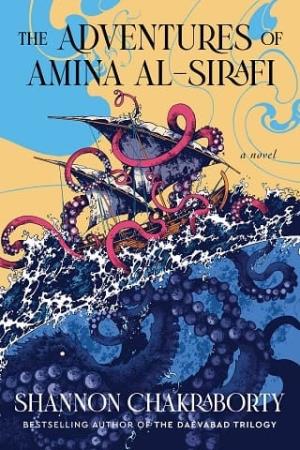
The Adventures of Amina Al-Sirafi (Amina al-Sirafi Adventures #1)
Chapter 1
God as my witness, none of this would have ever happened if it were not for those two fools back in Salalah. Them and their
map.
—What? What do you mean, that is “not how you start a story”? A biography ? You wish for a biography? Who do you think you are chronicling, the Grand Mufti of Mecca? My people do not wax poetic about
lineage like yours do. We are not even true Sirafis. My father’s father—an orphan turned pirate from Oman—simply found the
name romantic.
—Don’t you think so?
As I was saying. The idiots and their map. Now, I understand the appeal of treasure-hunting, I do. After all, we build our
homes upon the ruins of lost cities and sail our ships over the drowned palaces of forgotten kings. Everyone has heard a tale
of how so-and-so dug up a jar of Sasanian coins while sowing his fields or met a pearl diver who glimpsed hordes of emeralds
glittering on the seabed. It was related to me that in Egypt, treasure-hunting is so popular its participants have organized
into professional guilds, each holding their particular tricks close... though for the right price, someone might be willing to give you some advice. They may even offer to sell you a map! A guide to such fortunes you could scarcely imagine.
The maps are—and I cannot emphasize this enough—remarkably easy to forge.
I can even tell you how it is done: You merely need a scrap of parchment and a bit of time.
Tonics are applied to darken and yellow the paper, though regrettably, the majority require urine and the best derive from the bile of a bat.
The map itself should be drawn with care, with enough details that some geographic locations will be recognizable (ideally directing the mark in the opposite direction of which the mapmaker intends to flee).
Symbols can be lifted from any number of alphabets.
Many forgers prefer Hebrew for its mystical connotations, but in my opinion, the text off an old Sabaean tomb makes for more mysterious letters.
Wrinkle the whole thing up; fray the edges, burn a few holes, apply a thin layer of sandarac to fade the script—and that is that.
Your “treasure” map is ready to be sold to the highest bidder.
The map my clients possessed that night did not look like it had been sold to the highest bidder. Though they had been trying
to conceal the document along with their purpose—as though midnight excursions to ancient ruins were a common request—a glimpse
had been enough to reveal the map was of middling work, perhaps the practice manuscript of an earnest criminal youngster.
But I kept such opinions to myself. That they had hired me to row them out here was a blessing, a chance job I had snagged
while fishing. I must have seemed a prime candidate for their mission: a lone local woman a bit long in the tooth and almost
certainly too dim to care what they were doing. I made the appropriate noises, warning them that the ruins were said to be
haunted by ghouls and the surrounding lagoon cursed by djinn, but the young men assured me they could handle themselves. And
as I had spent many a night fishing in the area without encountering even a whiff of the supernatural, I was not truly concerned.
—Excuse me? That “seems sort of na?ve”? Do you not recall how we met, hypocrite? Stop talking and eat your stew. The saltah
is excellent here and you are barely thicker than that pen you are holding. Another interruption, Jamal, and you can find
some other nakhudha to harass for stories.
Anyway . Back to that night. It was an otherwise enchanting evening. The stars were out, a rare sight during the khareef, the summer
monsoon that typically mires us in fog. The moon shone brightly upon the ruined fort across the lagoon, its crumbling bricks
all that remained of a long-abandoned city locals said had once been a bustling trading port. This part of the world has always
been rich; the Romans once called us Arabia Felix, “Blessed Arabia,” for our access to the sea, reliable trade routes, and
lucrative frankincense groves. Locals also say that the lost city’s treasury—still bursting with gold—lays hidden beneath the ruins, buried during an earthquake. It
was that story I assumed had lured out the youths until one of them loudly clucked their tongue at me in the manner of a man
calling a mule to halt while we were still in the lagoon.
“Stop here,” the boy ordered.
I gave the black water surrounding us, the beach still some distance away, a dubious glance. During the day, this was a lovely
place that attracted flamingos and dolphins. When the wind and tide were just right, water would burst from the rocks in geysers
to the delight of children and picnicking families. But during low tide on a calm night such as this, the breakers against
the surf were mild, a steady soothing crash and glittering white spray that did little to differentiate between sea and shore.
If my clients thought they could swim all the way to the barely visible beach, they were even more foolish than I thought.
And I think I’ve been clear how foolish I considered them.
“We are not yet at the ruins,” I pointed out.
“This is far enough.” The pair were huddled together at the other end of my small boat, the map spread across their knees.
One boy held an oil lamp for illumination, the other a burning bunch of dried jasmine.
“I do not understand,” one of the youths muttered.
They had been arguing in hushed whispers all night.
Though their accents sounded Adeni to my ear, I did not know their names.
They had rather dramatically declared that in lieu of offering their names, they would pay me an additional dirham for my discretion, and since I did not actually care, the extra payment was a delightful surprise.
“The map says this is the spot...” He gestured to the heavens above, and my heart went out to him, for what was written on that map had nothing to do with any star chart I have ever seen.
“You said you wished to go to the old city.” I gestured toward the hill—or at least I tried to. But a thick bank of fog had
rolled down from the wadi, the monsoon-swollen stream that fed the lagoon, to surround us, and neither the ruins nor the hill
were visible. Instead, as I watched, the shore entirely vanished so that we appeared to be floating on an endless, mist-shrouded
plain.
The youths ignored me. “We have said the words,” the one holding the oil lamp argued. “We have her payment. She should appear.”
“And yet she has not,” the other boy argued. “I am telling you, we were supposed to...”
But whatever they were supposed to do stopped concerning me. In the space of a breath, the breeze that had been blowing in
from the sea all night abruptly halted, the air turning dead and flat. I stilled, a bead of sweat chasing down my spine. I
am a sailor, and there is little I watch more closely than the weather. I lifted a fraying strand from my cloak, but no wind
stirred the thread. The fog drew closer, accompanied by a smothering quiet that made thunderous every knock of water against
the boat’s hull.
There are places in the world where such signs might herald a vicious, dangerous storm, but the typhoons that occasionally
struck here typically did not manifest so unexpectedly. The water remained gentle, the tide and current unchanged, but even
so... there was an ill feeling in my belly.
I reached for my oars. “I think we should leave.”
“Wait!” One of the young men stood, waving excitedly at the fog. “Do you see that shadow above the sea-foam?”
It was sea-foam, I realized, squinting in the dark.
Years of the sun’s glare upon the ocean had begun to take their toll on my vision, and I struggled to see clearly at night.
But the boy was correct. It wasn’t only fog drifting closer.
It was sea-foam piled high enough to swallow my boat.
As it approached, one could see a reddish-yellow hue to the substance and smell the awful aroma of rotting flesh and gutted fish.
“Give over her payment,” Oil-Lamp Boy urged. “Quickly!”
“Forget my payment and sit back down,” I ordered as the second youth reached into his robe. “We are—”
The boy pulled free his hand, revealing a large chunk of red carnelian, and two things happened very quickly:
One, I realized that was not my payment.
Two, the thing whose payment it was dragged us into the fog.
The boy holding the carnelian barely had time to cry out before the froth rushed to consume him, licking down his neck and
chest and winding around his hips like an eager lover. A howl ripped from his throat, but it was not a scream any mortal mouth
should have been able to let loose. Rather, it was more the roar of a tidal wave and the death cries of gulls.
“Khalid!” The other boy dropped the lamp in shock, extinguishing our only light.
But fortunately—fortunately?—the seemingly alive and possibly malevolent sea-foam was glowing. Its light was faint, but enough
to illuminate Khalid as he bared his teeth like a wolf and threw himself on his companion.
“ You shall not have me ,” he hissed, groping for the other boy’s neck. “We will curse you! We will devour you! We will cast you into the flames!”
The other boy struggled to free himself. “Khalid, please!” he choked as more sea-foam—now the crimson of blood—spread over
them both. Fanged suckers were blossoming across its surface like the tentacles of a monstrous squid.
I would like to say I did not hesitate. That at the sight of two youths in mortal peril, I flew into action and did not briefly wonder if the malevolent sea-foam might be sated with eating them and leave me and my boat alone.
That would be a lie. I did hesitate. But then I cursed them profusely, rose to my feet, and went for my knife.
Now, I am fond of blades. The khanjar that was my grandfather’s and the wickedly beautiful Damascene scimitar I stole off