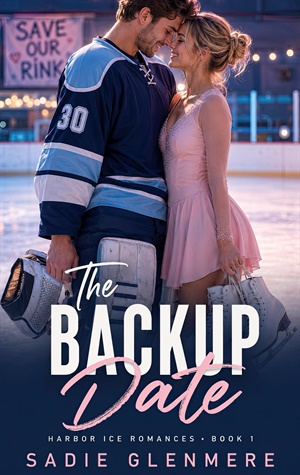
The Backup Date (Harbor Ice Romances #1)
Chapter 1
· · ·
The Barn was always coldest at five-thirty in the morning, which Ada Halloran had decided was useful information.
Cold meant the building was honest. Cold meant the rink wasn’t pretending to be a heated lobby with a Zamboni problem; it was a single sheet of ice in a sixty-year-old box with weatherboard siding and an east wall that everyone called the leak the way other towns named the weather.
She set her tea down on the lobby bench, lowered herself beside it in the careful, eight-second descent her physical therapist had drilled into her hands like a piano scale, and started her warm-up.
Right side first. Always right side first. The hip didn’t get a vote.
Outside, somewhere over the harbor, the sky was thinking about turning silver.
Through the lobby’s tall front window she could see the cobalt edge of the bay and the orange smear of the ferry’s bow lights nudging out toward Tidewater Island.
The lights made the corkboard with the youth-team photos look slightly holy.
She put her hand on her right kneecap and her left hand on the seat of the bench and breathed out. The hip clicked, polite as a doorknob. She let it click. The trick was not to flinch. The trick was never the pain, anyway; the trick was the face you made about the pain.
She’d had a coach in Toronto, once, who used to say a figure skater performed two things at all times: the program and the face about the program. Ada had made a thousand faces about a thousand programs. She knew the muscle group around a smile better than she knew her own ankles.
So: warm-up. Ten slow internal rotations.
Ten slow external. Hip flexor stretch to the count of forty.
A wall sit she counted in lyrics from a song she’d skated to at seventeen, because the rhythm was burned into her like a tattoo.
A few cautious rolls of the ankle, the foot that didn’t remember it was supposed to point. Done.
She stood up. The hip did its small, private conversation with her femur and decided to allow today.
A clatter from somewhere in the back rang through the building, followed by a single soft, unbothered curse.
Wes Berglund. Of course. He was always in the building before her.
By the time she’d unlocked the lobby, he’d already be on the ice in his old practice sweater, running the youth program through skating drills that probably broke labor law for nine-year-olds.
The big body of him in goalie pads always made the kids look smaller than they were, which was probably the point.
She didn’t think about him beyond that. She had a thermos of tea and a class to teach and a list of three song cues to load into the rink speakers before parents started arriving.
She did not think about how Wes Berglund had a way of pacing around a problem like the problem had wronged his mother.
She did not think about how she could hear, faintly, his low voice saying something to himself in the kind of patient tone you used with appliances and dogs and the wiring in old buildings.
She walked up to the AV cubby behind the front desk and queued her playlist. Her opening track for class was a slow waltz the eight-year-olds liked because it sounded like a music box.
After that, two cheerful pop instrumentals — the kind of song Mercer Bay’s children’s-radio rotation served up on a loop.
She filtered her warm-up music into a separate hidden playlist on her phone that no one ever asked about, because that one was an old Russian ballet score she had skated to in juniors, and she could not justify it in any way except that her body still knew it.
She stretched her quad against the bench. Outside, the orange ferry lights slid behind a piling and reappeared on the other side, smaller, like the bay was breathing.
In a different life she would have called what she felt in this hour grace, and made it big.
In this life she just opened her thermos and drank her tea and watched the ferry pull free of the harbor mouth, and that was enough. She had built a small grateful kingdom inside the word enough.
She heard the back door click. Footsteps. A pause that meant Wes had checked the thermostat by the equipment closet, which he checked every morning because it lied. Footsteps again.
“Morning, Halloran,” he said, without quite turning toward her.
He was crossing the lobby with a coil of cable looped around one shoulder and a wrench in his back pocket. The wrench should have been a comedy choice and somehow wasn’t.
“Berglund,” she said.
He raised the wrench an inch without looking up — a wave, possibly, or a refusal to be sincere about a wave — and disappeared through the side door toward the rink.
She stood there a moment longer. The lobby bench was warm where she had been sitting.
She had once, in a different life, performed for ninety seconds at a national championship in a sapphire dress that cost more than her parents’ first car.
She had been a glass thing then, all sharpened edges and applied light.
She missed glass-Ada, sometimes, the way you missed an apartment you couldn’t have afforded.
But she did not miss her in the morning. In the morning, in the orange light, in the lobby of the Barn, she was something simpler. She was the person Mercer Bay paid forty-two dollars an hour to teach beginners how to fall.
Her six-year-olds were death-by-cute.
There were eight of them this morning, helmets too big, gloves too big, skates a half-size too big because their feet were going to grow and a half-size too big was a parenting investment strategy.
A little girl named Mira had glued an orange dinosaur sticker to her left knee pad.
A boy named Beck was eating his own scarf.
“Friends,” Ada said. “Beck. We do not eat the scarf. The scarf is for warmth and dignity.”
Beck released the scarf gravely.
“Thank you,” Ada said.
She had them on the ice in pairs. Mira’s father had explained to Ada at the beginning of the season, with the careful pride of a man who was trying, that Mira had been born with one foot turned slightly inward, and could Ada keep an eye on her.
Ada had kept more than an eye. She had built half the lesson around Mira without ever looking at her differently.
“Today,” she said, “we are going to be falling experts. Falling is a thing that happens to skaters, and the question is: do we want to fall like a librarian, or do we want to fall like a beautiful, soft potato?”
“Soft potato,” said Beck.
“Excellent answer,” said Ada. “Mira, you and I will go first. Hands here.” She tapped her own knees lightly. “Now, when I say down, you go down small. Not big. Not theatrical. Small. We don’t slap the ice. We pour ourselves toward it like soup.”
She gave Mira her hand. Mira gave it back to her, very seriously, with both of her own. Ada laughed.
“Beautiful,” she said. “All right. Down.”
Mira poured herself toward the ice. It was, in fact, a very competent fall. Ada steadied her up.
“That,” she said, “was a perfect soft potato. Beck, you next, but Mira is going to show you how, because Mira is now an expert.”
Mira lit up the way only six-year-olds can. Beck, who was the kind of child who would grow up to either run a hedge fund or rob one, looked at Mira with deep new respect.
Ada had them practicing falls in pairs for ten minutes, and then practicing standing up, and then the older boy in the back named Theo (not that Theo, she did not flinch, she had a six-year-old named Theo and one named Reagan and one named Indigo and she had practiced not flinching on his name in front of a mirror, which was a thing she was going to have to either laugh about with someone someday or take very quietly to her grave) did a fall on purpose and yelled “soft potato!” and the whole class fell, on purpose, like a small, soft, mittened army.
Ada had to wait a full beat before answering, because her throat had done the thing it did when she remembered, suddenly, that she had not stood on a podium in twenty-two months and that she still loved this enough to call it a job.
“All right, potatoes,” she said. “Up.”
She felt rather than saw the lobby door open behind her. The shift of cold air. A different sort of silence on the ice. She knew without turning around that it was Joanna Mendez, because Joanna had a specific way of standing inside a building she owned in every way except on paper.
Ada finished her drill. Spoke softly to Mira. Released the class to the parents waiting in the lobby with hot chocolates that were beginning to leak through the bottoms of paper cups.
When she turned around, Joanna was standing at the boards in her good coat. The good coat was a long, navy, expensive thing she’d had for fifteen years and got dry-cleaned once a year, in February, because by February she had usually wept on it.
It was January. The coat was clean.
“Ada,” Joanna said. “Got a minute?”
“For you,” Ada said, “always.”
“In my office,” Joanna said. “After your warm-down.”
This was unusual. Joanna usually delivered her catastrophes at the lobby bench, leaning on its back rail like a horse. The office was for things that wanted a door.
“Okay,” Ada said.
Joanna’s mouth pulled into a thin line that was not a smile and was not, quite, a frown. It was the face of a woman who had spent a long night doing math.
“Pete’s coming, too,” Joanna said. “And — there’s a folder. I want you to see the folder before he starts talking.”
“Joanna,” Ada said. “Are we okay?”
Joanna considered the question for a beat too long. Then she sighed and pushed her hair back and said, “Define we.”
Ada walked her potatoes out to the lobby, kissed Mira’s helmet at her father’s request, handed Beck his scarf, and headed back toward Joanna’s office with her thermos.