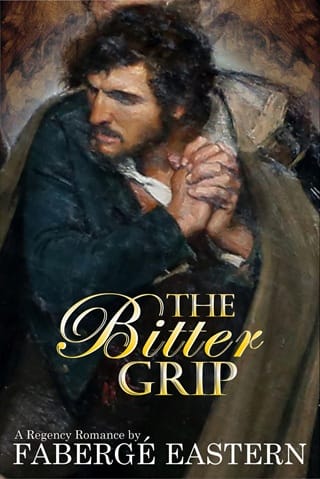
The Bitter Grip
1. Obligations of the Heir
Obligations of the Heir
Alexander Sinclair’s kiss was neither tender nor sought; it was an assault on propriety, not an overture of love.
It left his betrothed reeling, her heart rent by his lack of kindness. The abrupt claim of Lucinda Harrington’s lips shattered the hopeful dreams she had harbored for years. It was a cruel awakening for Lucinda, who had dared to dream of a future with her closest companion.
Children in Alex and Lucinda’s situation, reared on neighboring estates in the English countryside, often found camaraderie in friendship.
In the case of Lucinda Harrington and the Sinclair brothers, their youthful exploits had forged an uncommonly strong bond.
Lucinda’s playful tomboyish ways, though lamented by her governess, endeared her to Alex and his younger brother Miles, who each regarded her as an honorary sibling.
On being widowed, Lucinda’s father, Admiral Sir John Harrington, was left to grieve the loss of his wife with an infant of three years and the child’s self-effacing governess.
Sir John retired from the Admiralty, making the child the center of his world out of a deep love for her mother.
Armed with the booty of several enemy ships, he brought his daughter to Kent, where he was reliably informed he could purchase a castle and fifty acres of the best Kent countryside on offer.
Sir John’s attention was not divided between occupation or a new wife.
If anything claimed his attention away from his little daughter, it was the estate, where several of his less fortunate shipmates were tenanted, or perhaps Lucinda’s governess, demanding that her lessons be attended without distraction.
The fatherly love that Lucinda received ought to have been shared among a brood of brothers.
Had Lady Harrington lived longer, things might have turned out differently.
Still, when the Sinclair brothers, Alex and Miles, were caught trespassing on his land, Admiral Harrington, with his daughter up before him on horseback, welcomed the boys with a friendly “Ahoy there!”
Before long, the Sinclair brothers took to hailing their venerable neighbor as ‘the Admiral’—a title he bore with evident satisfaction—and made liberal use of his large estates, ever hoping to secure a moment of his time.
A man of action and long nautical service, he had weathered more storms than most and possessed an unerring instinct for boyish mischief. With the ease of one seasoned in command, he could steer their exuberance into less hazardous channels, all without so much as raising his voice.
Lucinda, in the company of the Sinclair boys, enjoyed a childhood steeped in joyous escapades, traversing estate boundaries with scant regard for propriety.
Together, the trio built tree houses in Sir John’s woods, fished in Harrington Lake, and grilled their catch over makeshift fires under the admiral’s kindly tutelage.
Many of the pleasures pursued upon the Harrington Estate would have scandalized the patriarch of the Sinclair family, had he been privy to them—a fact the boys knew well as they straightened their collars and prepared to join Lord Sinclair in the library before dinner.
The room’s heavy oak door might as well have been the portal to another world, where tree resin on jackets and the scent of wood smoke were crimes punishable by lecture.
“Alex! Shoulders back,” Lord Sinclair snapped, “must you emulate a sack of potatoes? A future peer does not lounge —he occupies a chair.”
Alex, barely twelve, bristled under his father’s scrutiny and straightened. “Yes, sir.”
The man’s gaze then shifted to his younger son. “And Miles, must I remind you again about ink stains? A gentleman’s cuffs should remain spotless.”
The ten-year-old rubbed at his sleeve in vain. “It was only a small blot, Father.”
“Only a small blot?” Lord Sinclair’s voice dripped with disdain.
“Do you imagine your future tenants will accept ‘only a small’ mismanagement of their rents? Or your future wife ‘only a small’ breach of decorum?” He strode to the fireplace, the portrait of disapproval.
“These are not merely lessons, boys - they are the foundation of your birthright. Alex, recite the five principal duties of the Sinclair heir. Without ,” he added, “the usual creative interpretations.”
As Alex dutifully listed them (“Maintain the estate’s prosperity, uphold the family honor, provide exemplary leadership…”), Miles fidgeted with his cuff again until their father’s glare froze him mid-motion.
“Your brother may inherit the title, Miles, but your behavior reflects equally upon this family. Tomorrow you will both write an essay on the virtues of self-discipline. And for the love of all that’s holy,” he added with a withering look at their boots, “have those polished before you disgrace the pews at Sunday service.”
On route to the dining room, Alex whispered to Miles what they both knew: “Harrington lands by sunset?” His brother’s answering grin spoke volumes.
As neighbors and men of wealth, Lord Sinclair and Admiral Harrington maintained a cordial acquaintance—the sort where the admiral chuckled at sermons on propriety, and his lordship pointedly ignored the Harrington tree house visible from his study window.
Lord Sinclair prioritized education, exacting standards, and at all times, propriety. His endless lectures on “the sacred obligations of the Sinclair name” successfully drove Alex closer to the kindlier admiral with every passing year.
In time, a matchmaking scheme was devised by Lady Arabella Marlstone—Lord Sinclair’s razor-witted sister and Lucinda’s unlikely godmother.
Recognizing her brother’s twin vulnerabilities (pride in his title and balancing the cost of his estates), she proposed merging the estates through marriage.
It was elegantly practical: Alex would gain a wife whose dowry could sustain the coffers, while Lucinda—a motherless heiress—would be spared the indignities of a London season, with no mother to guide her.
“Just think, brother,” Lady Arabella had pronounced with satisfaction, “a tidy solution in an untidy world.”
That Alexander was her favorite nephew and Lucinda, her dearest goddaughter, only added to the felicity of the scheme.
The proposal was framed as a near-divine arrangement, destined to enrich the lesser Sinclair estates, secure Lucinda’s future with a title, and unite the families in harmonious prosperity.
Since the enlargement of his estates was close to his heart, the marriage of their firstborns was a topic that Lord Sinclair would often raise with his genial neighbor, Sir John. Eventually, he gained not only the man’s blessing for the scheme but his daughter’s as well.
It was indeed lamentable that Lord Sinclair had not devoted an equal measure of fireside hours to expounding upon the merits of the proposal to his firstborn before a tragic fall from his horse claimed his life.
Many miles away, in the final year of his studies at Oxford, the news of his father’s death struck the new heir like a thunderclap. The revelation of his betrothal—arranged without consultation—left Alex Sinclair staring at his solicitor as if the man had sprouted antlers.
“Smithers, you cannot be in earnest?” Alex’s voice cracked uncharacteristically. “Lucinda Harrington? That freckled little hoyden? I’d sooner march into battle with her than stand by her at the altar!”
The solicitor adjusted his spectacles. “The agreement is binding, my lord. And Miss Harrington has given her consent.”
“She’s agreed?” Alex’s teacup hit the saucer with a clatter. “Lucinda? The same girl who—” He broke off, unable to reconcile the image of the wild creature who’d once pushed him into a trout stream with the notion of a bride.
“Indeed, sir. It is anticipated that you will formalize the engagement on the occasion of her seventeenth birthday. Which is—” Pages were flicked through in search of a date.
Alex ran a hand through his hair. “Miles and Lucinda share a birth year, Smithers. They’ll both be seventeen in the year ‘23—my brother in March, Miss Harrington in September.”
“I see.” said the lawyer, making notes.
“Do you comprehend, Smithers?” Alex demanded, rising to pace.
The lawyer peered over the rim of his spectacles, wondering what he could have missed.
“My bride would be but a child! And I have scarcely completed my studies—the old devil’s timing remains impeccable.
I have a mind to tour the Continent, to experience London’s delights, cut a dash, so to speak.
To shackle me to a wife isn’t merely tyranny, Smithers - it’s vintage Sinclair strategy.
No, this won’t do at all! I wish to behold Paris and Florence, and perhaps further my education in the arts of the Renaissance.
I don’t want to bury myself in Kent playing nursemaid to the likes of Lucinda! ”
A week later, at his father’s funeral, Sir John Harrington and his daughter filed past in the receiving line with all the other parishioners offering their condolences.
In no mood to think of his nuptials, Lucinda’s shy smile and sympathetic demeanor gave him no more comfort than any other passing acquaintance.
But when he overheard her jest with Miles, prompting a smile from his brother, she caught his attention sufficiently to notice her height had improved.
What figure her cloak concealed was unknown, but a neatly turned wrist and elegant hand held his mother’s when she offered whispered words of comfort.
In that short-lived moment, the scrawny girl with tangled red curls was gone.
Nevertheless, in a short while, the newly titled eighteen-year-old Lord Sinclair asked Smithers for the Sinclair townhouse in Grosvenor Square to be aired.
Henceforth, he desired it for his permanent residence.
Alex then quit Oxford with a flourish, leaving behind a trail of admirers and a few bewildered dons.
As expected, he pursued the diversions of London with reckless abandon, as if the city were his playground. He reveled in larks, but to no man’s disadvantage, for he had a knack for mischief that charmed rather than offended.
He excelled at basset, but never played too deep or dishonored his debts, for he considered such behavior beneath a gentleman of his standing.
He bespoke a Royal Green phaeton, on which he emblazoned the Sinclair crest, and when he acquired an enviable set of grays to set before his vehicle, the whispers of admiration became the talk of the town, much to his satisfaction.
To his friends, he became a capital fellow to have around. Due to his affable manners and loose wallet, he was often claimed by many as a fast friend of whom he would but call a fleeting acquaintance.
To the ton, Lord Sinclair was the very model of a rakish Corinthian: careless in his charm and entirely unburdened by anything resembling earnestness.
Yet behind every jest and languid smile, the echo of his father’s voice persisted—that relentless, clipped baritone, forever enumerating the obligations of blood and title.
Alex had spent years pretending not to hear it.
His family, with the singular exception of his affectionate Aunt Bella, (who alone could coax him into anything resembling filial attention), were endured with distant courtesy.
As for his responsibilities? They were discharged with just enough propriety to avoid outright scandal.
If the world expected him to play the devoted heir, it would have to content itself with a man who did so only when it did not inconveniently interfere with his pleasures.