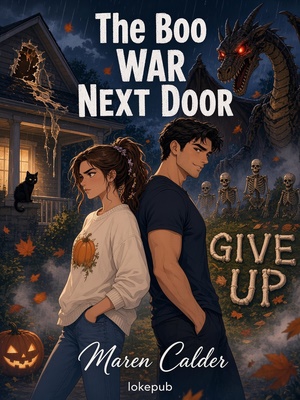
The Boo War Next Door
Chapter 1
Lila
The key won't turn.
I have driven eleven hundred miles with everything I own and a cat who yowled his opinion of me through four states, and the house I inherited is refusing to let me in.
"Okay, Lila." I jiggle the key the way Grandma Bee used to, a little up, a little left, like the lock is a slot machine that owes you. "You grew up picking this lock with a library card. You can do this."
The lock does not care about my history with it.
From inside the carrier at my feet, Beetlejuice makes a sound like a chainsaw giving up. Twenty-two pounds of black cat, zero pounds of patience.
"I hear you," I tell him. "We're both tired. But one of us screamed through Pennsylvania, so one of us doesn't get a vote."
The key turns on the fifth try, the door swings open, and the smell hits me before the light does — lavender and old wood and something underneath that is just Bee, like the house has been holding its breath since March and finally let it out.
I stand on the doormat for a long minute and let it hurt.
Then I carry the cat inside, because grief is a thing you do while carrying something.
The kitchen still has her handwriting in it.
Grocery list on the fridge. Reminder taped to the coffee maker that says FILTERS ARE NOT OPTIONAL, LILA, from the summer I was nineteen and made coffee that could patch a driveway.
Fourteen years that note has survived. The woman archived my failures like they were love letters.
I let Beetlejuice out of the carrier. He flows onto the counter like an oil spill with opinions, sniffs the air once, and then goes still, staring down the hallway toward her bedroom.
"I know, buddy." My throat does something inconvenient. "Me too."
My phone rings. Halverson and Pruitt, Attorneys at Law, which sounds fancy for an office above the hardware store with a window air conditioner older than me.
"Miss Merriweather." Mr. Halverson has the voice of a man who delivers bad news at a volume suitable for funerals. "You made it in. Wonderful. Did the roofer's estimate reach you?"
"It reached me." It reached me the way a piano reaches the sidewalk. "Eighteen thousand dollars. Which is funny, because the estate has, what—"
"Two thousand, one hundred, and change. After the taxes."
"Right." I look up at the kitchen ceiling, where a brown stain in the plaster is shaped exactly like Florida, which feels personal, since Florida is where my job used to be. "And the part where I don't have it either, because my entire division got, and I'm quoting the email, sunsetted."
"There is no shame in selling, Miss Merriweather. Houses like this—"
"I'm not selling." The words come out before I decide to say them, which is how I know they're true. "I'll figure it out. I'm very resourceful. I once built a nineteen-foot animatronic yeti out of pool noodles and a defunct golf cart."
A pause. "I don't know what to do with that information."
"Nobody ever does, Mr. Halverson."
We hang up and I stand there doing math that refuses to add up no matter how nicely I ask, and that's when the dragon rises over my back fence.
I want to be clear about this, because for one full second I question every decision that brought me here, including being born.
A skeletal dragon. Two stories of vertebrae and wing struts, hauled skyward on a winch, its bone jaw swinging open over my grandmother's hydrangeas like it plans to eat the property line.
"What," I say to the kitchen window.
The window does not answer. Beetlejuice, who has watched all twenty-two pounds of dignity leave my body, yawns.
I go out the back door in the October cold in my Florida clothes, and there he is.
The neighbor. Up a ladder in a canvas jacket, bolting a floodlight to a bracket like it's nothing, like his yard isn't turning into the set of a movie I would absolutely pay to see if it weren't happening forty feet from my dead grandmother's garden.
He sees me. Climbs down without hurrying — one of those men who has never once hurried, because the world waits — and walks to the fence.
"You must be with the estate sale," he says. "House stuff goes Saturday. If you're here for the shed, it's not part of it."
I'm sorry. The shed. He has opinions about my grandmother's shed.
"I'm not with the estate sale."
"Appraiser?"
"I'm the granddaughter."
Something moves through his face. Fast, there and gone, like a fish under ice. If I didn't know better I'd call it guilt, but I've been wrong about faces before, which is how I ended up single and eleven hundred miles from a job that no longer exists.
"Lila," he says. Not a question.
"That's unsettling."
"Bee talked about you." He looks at me a beat too long, and then, because apparently we're done with that topic forever, he nods at the dragon. "Winch is loud. Gets louder in the mornings. Figured you should know."
"Gets louder in the mornings," I repeat. "The bone dragon."
"The compressor for the fog runs at six." He says it the way other men say I'll pray for you. "You get used to it."
And then he just — leaves. Walks back to his ladder. Conversation over, apparently, by unanimous vote of one.
"Okay," I tell the fence. "Sure."
Back inside, Beetlejuice is sitting in the exact center of the kitchen table, which was forbidden under Bee's administration, testing the new government.
"Don't get comfortable," I tell him. "We hate the neighbor."
He starts to purr. Traitor.
I mean to unpack the car. What I actually do is open the hall closet looking for towels and find October instead.
The binder is on the middle shelf where it has lived my entire life, fat as a phone book, held together with duct tape and rubber bands and what I can only assume is witchcraft.
THE BUILDS, says the spine, in marker gone brown with age.
Inside: forty years of graph paper. Wiring diagrams in her impatient hand.
Fabric swatches stapled to fog-timing charts.
A pull-out map of the front yard with sight lines drawn in colored pencil, labeled where they scream.
Page after page after page. The floating bride of two thousand nine.
The pirate wreck that leaked real bilge water until the fire marshal got involved.
The moon — the famous one, the paper moon big enough to stand in, with a note in the margin that says face the porch so I can see them from my chair.
I sit down on the hallway floor with the binder in my lap and go through it like a person reading letters from the front.
Here's what nobody tells you about inheriting a house.
It's not the furniture that gets you. It's the systems. The binder.
The filters note. The extension cords in the shed, coiled and labeled by length, because she was a maniac in exactly one direction.
A whole engineering of joy, built and refined for four decades, waiting for somebody to pick it back up.
The last page isn't a build. It's a sticky note, stuck crooked to the inside back cover, in handwriting smaller and shakier than the rest.
Ask Grady before you rewire the porch, it says. He'll act like it's a favor to him.
I read it four times.
"Who," I ask the empty hallway, "is going to explain to me why the enemy is in the binder?"
The hallway declines. Beetlejuice walks across the binder, sits on the floating bride, and begins washing his foot.
"You knew her longer than I knew her," I tell him. "You could contribute."
He does not contribute. Fine. It's fine. It's a note. She was old, he was next door with a ladder, towns work like that. It means nothing except that she knew his name, and knowing this town, he probably hauled her trash cans up the driveway twice and got knighted for it.
Besides. Whatever he was to her, he's the man I have to beat now, and I'd rather not complicate that with information.
I put the sticky note back exactly where it was, which is a thing you do with holy objects, and I go unpack the car for real this time.
The Lighting of the Gourd is the kind of thing you cannot explain to people who aren't from here, and I have tried.
On the first of October, the entire town of Hollow Creek gathers on the green at dusk, and Dottie Pruitt throws a switch, and a pumpkin the size of a Volkswagen — the Great Gourd, fiberglass, older than the fire department — glows orange over the bandstand, and four hundred adults cheer like it's the moon landing.
I grew up on this green. Cider in paper cups, someone's dog wearing a costume, the smell of woodsmoke and fry oil and cold coming down off the hills. Bee used to hold my hand through the whole thing and narrate which of her neighbors were cowards.
Tonight I stand at the back alone with a cider I can't taste, and it's the first time the town has seen me since the funeral, which means I get The Face from everyone.
The tilted head. The soft eyes. Marge Okafor from the hardware store hugs me so hard I hear a rib file a complaint, and says, "Oh, honey," into my hair, twice.
"Hi, Marge."
"You staying? Tell me you're staying. That house needs a Merriweather in it. And you missed everything. We got a coffee place now. Frankie's. Where the video store was. Girl makes a thing with maple foam that would make you fight your family."
"I'm staying," I say, and Marge lights up so hard it's embarrassing, and I don't have the heart to add: if I can find eighteen thousand dollars in a month, anyway.
Up on the bandstand, Dottie Pruitt taps the microphone the way she's tapped it for forty years, three sharp cracks, like the microphone owes her money.
"Founders' Fright registration closes tonight," Dottie announces.
Dottie is eighty pounds of cardigan and authority, and the green goes quiet for her.
"Entry forms at the table. Judging is Halloween night, as always.
And this year." She pauses. Dottie has never in her life rushed a piece of news.
"This year, with thanks to our sponsors at Hollow Creek Savings, the Golden Gourd carries a prize of ten thousand dollars, and the winning home will be featured on the Haunted Homes Tour of New England. "
The green makes a sound like a struck hive.
Ten thousand dollars. I do the math against a roof that costs eighteen and change, and it's not everything — but it's the size of a miracle, and it comes with a tour feature that has commissions written all over it for someone who builds monsters professionally. Or did. Before the sunsetting.
"The prize money's new," says a voice at my shoulder. Marge, materializing the way she does, like town gossip has a teleport function. "You know who's won it three years running? Since Bee passed on the crown?" She points her cider cup across the green.
Of course.
Of course it's the bone dragon guy, standing near the bandstand with a firefighter jacket over his shoulder and half the town orbiting him — someone's kid on his shoulders, someone's dad shaking his hand, everyone's grandmother handing him something baked.
Golden retriever in human form. Big, easy, beloved.
"Grady Ellis," Marge says, with the reverence this town usually saves for hurricane season.
"Contractor. Volunteer fire. Fixed my gutters in the rain once and wouldn't take a dime.
His display last year had a dragon that breathed actual fog, honey.
There were traffic cones. We needed traffic cones. "
"He told me his compressor runs at six a.m."
"That's him being neighborly."
"That's what I was afraid of."
The registration table is manned by a teenager who cannot possibly care less, which I respect. The form is the same form it has always been. Same off-white card stock. Same line at the top.
And there it is. In the box for RETURNING ENTRANT, in the pre-printed list the committee never bothered updating, her name: MERRIWEATHER, B.
— 13 FOXGLOVE LANE. Twelve-time champion.
The reason there's a rule about extension cord gauge.
The woman who once made the front page of the county paper standing inside a papier-maché moon.
They never took her off the form.
My eyes go hot, and I'm not going to cry at a folding table in front of a teenager, I am not, so instead I pick up the pen that's tied to the clipboard with kitchen string, and I cross out the B.
I write LILA above it, in handwriting that only shakes a little.
"You entering?" The teenager looks at the address. Looks over at the crowd around Grady Ellis. Back at me, with the first flicker of interest he's shown in his whole shift. "You know you're next door to—"
"Yeah."
"He has a winch."
"I once made a haunted mine collapse on schedule, twice a night, for four years." I hand back the clipboard. "Tell the committee the Merriweathers are back."
Walking home, I catch my own reflection in the dark window of Frankie's coffee place — a woman in the wrong coat for the weather, carrying a cider she never drank, grinning like she just did something stupid.
Because she did. There's eleven months of savings in my checking account if I'm careful, no job, a roof with a Florida-shaped hole in its future, and I have just declared war on the town saint over a fiberglass pumpkin.
Bee would have loved every single part of this.
That's the thing I can't get around. That's the thing that keeps my feet moving past the green, past the Hendersons' place on the corner — where, I notice, an inflatable graveyard is already installed, eleven sagging tombstones and a reaper listing hard to the left like it's had a long day — all the way to Foxglove Lane, where the porch light of number thirteen is somehow still the warmest light on the street.
Next door, the dragon stands against the stars, huge and patient.
Grady Ellis has no idea what's about to happen to him.
He met a tired woman at a fence this afternoon.
He has not met the woman who is going to take that Gourd off him with her grandmother's name on the form and her grandmother's tools in the shed.
Tomorrow I make an inventory. Tomorrow I find out what's left in that workshop.
Tonight I stand in the yard where I learned every kind of October there is, and I make the same promise out loud that I used to make when I was nine and she'd hand me the good paintbrush.
"We're going to build something, Bee."
From the porch, through the window, Beetlejuice watches me talk to an empty yard, and doesn't judge me for it even a little.
That's a lie. He judges me enormously.
But he stays at the window while I stand out there in the cold, the two of us keeping an eye on the dark together, and honestly, in this family, that's what love looks like.