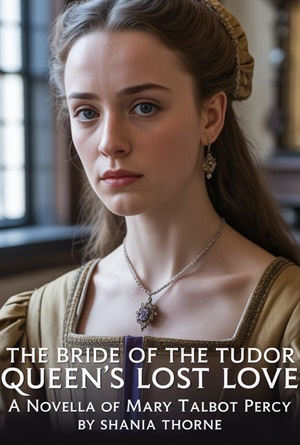
The Bride Of The Tudor Queen's Lost Love (Women of Tudor Scandal #5)
Chapter 1
I did not marry for love. I did not expect to.
But I also did not expect to spend my life as the second choice of a man who never stopped grieving his first. And I certainly did not expect that the woman he loved instead of me would one day lose her head to a king’s temper, while I would lose my heart.
But I’m getting ahead of myself. Before Anne Boleyn had a name that everyone in England would come to learn, I was already promised. I already had a contract signed over my head before anyone thought to ask whether I understood what it meant.
But before Anne, before almost anything else, I remember the smell of beeswax and woodsmoke.
Sheffield Castle held onto its warmth in strange places.
I could feel it in the folds of the tapestries, in the stone beneath the rushes, and in the wool of my nurse’s skirts when she gathered me against her hip.
I remember the sound of my own name called down a corridor before I understood that a name could mean anything beyond the mouth that spoke it.
Even now, as a woman with more years behind me than most of my family found time to live, I can still close my eyes and stand in that hall again, small and unremarkable, waiting to become something my father had already decided I would be.
There were eleven of us children. I was neither first nor last. So I learned early that attention in my father’s house was a resource to be rationed, like fine wax candles or French wine. It was rarely wasted on a girl who had not yet done anything to deserve it.
My father, George Talbot, was the fourth Earl of Shrewsbury. He ruled a household that stretched across Sheffield, Wingfield, and half a dozen lesser manors besides. And he ruled it in the way a general commands a campaign, with an eye always on the next advantageous move.
We were Talbots, and before that Nevilles, and before that Staffords and Hastings. I grew up understanding these names the way other children understood psalms - recited without full comprehension and trusted to matter enormously regardless.
I did not learn my own lineage from a tutor bent over a genealogical roll. I learned it in fragments and overheard through half-open doors. It was the way that most useful knowledge reached a child in a house like mine.
I remember when I was nine. I was crouched behind a hallway door while the women stitched in the next room. I heard my mother’s voice pitched low and urgent, speaking to my aunt about a possible marriage match.
“The Percys,” she said, weighing the name carefully before she let it go. “Northumberland wants the alliance as much as we do. More, perhaps, given what happened with his own inheritance.”
“And the boy?” my aunt asked.
“A stranger to her. He will remain so for years yet. But the terms are sound, and that is what matters.”
I did not know, crouched in the hall with my knees drawn to my chest, that they spoke of me. I only knew that something had shifted in the room beside me. There was a current of importance moving through the adults that had nothing to do with a child’s small concerns.
Later, when my nurse, Alice, dressed me for bed, I asked her what a contract was. She laughed and told me it was a kind of promise that grown men made when they wanted something badly enough to write it down.
I was only a child, and I did not think to ask what my father wanted badly enough to write down about me.
Much later, I would learn that the betrothal itself had been settled in 1516. But the arrangement had been years in the making by the time I overheard it discussed. It was a slow negotiation between two houses, circling toward the day it would finally be official.
Henry Percy, heir to the Earl of Northumberland, was the name attached to the arrangement. It was a name that meant nothing to me and everything to my father.
The north belonged to the Percys. A Talbot daughter married into that house would draw two great families together and stitch the north more firmly to the crown’s interests.
It would win something for my father that I would not understand for years.
It offered security, standing, and deep satisfaction to a man who arranged his children’s lives as carefully as he arranged everything else he owned.
I was nothing more than a line in that ledger. I want to say this bluntly, because I spent decades of my life hoping for some tenderness underneath that accounting that I never found. I was valuable. I was not, in any way that mattered to the men negotiating my future, beloved.
And yet I want to be fair to my father, even now, and even knowing what his ambition eventually cost me.
He did not neglect me. Whatever coldness ran through the marriage he arranged, he did not extend that coldness to my childhood.
I was clothed well, taught my letters, and given a horse of my own by the time I was seven.
And in my own small way, I was included in a household that prided itself on its order.
In those years, Sheffield ran like a court in miniature.
Servants moved through corridors with practiced efficiency.
My mother presided over her ladies with the same brisk authority my father brought to his stewards.
As a child, I did not know that I was watching a display of power.
I only knew that everything around me moved with purpose.
And I slowly came to understand that the purpose extended to me.
I remember one particular evening with a clarity that has outlasted whole years of my later life.
I was perhaps seven, and there had been a supper with guests I did not recognize.
There were men whose cloaks bore badges that I could not read.
My mother had dressed me more carefully than usual that day.
And though no one told me why, I understood enough to stand very straight and speak only when spoken to.
Afterward, when the guests had gone, I found my father alone by the fire.
There was a cup in his hand, and his face was unreadable in the low light.
“Come here, Mary,” he said. I went because a child in my position did not refuse such a summons.
He looked at me for a long moment. I remember foolishly thinking that he might say something about the supper or my dress.
I thought he might ask whether I had enjoyed the company.
Instead he said, “You will make a fine countess one day.” And then he returned his attention to the fire, as though he had remarked on nothing more consequential than the weather.
I did not understand then what he meant by “countess.” I only sensed that the word carried weight, and that he had said it to me the way a man might test the strength of a rope before trusting it to bear a load.
I curtsied, because that seemed the correct response.
I left the hall with the strange, warm pleasure of having pleased him without knowing how.
It was years before I connected that evening to the contract my mother had discussed while I hid in the hall. It would be longer still before I understood that Henry Percy, heir to the earldom of Northumberland, was the husband my father’s ambitions had already carved out for me.
I did not meet him. I did not know what he looked like, or how he spoke, or whether he laughed easily or rarely.
He existed for me only as a name attached to a future, the way a distant country exists on a map - real enough on paper, until you actually arrive and find it’s nothing like you pictured.
What I did know, even as a child, was the pressure of being a Talbot daughter among so many Talbot children.
My brothers would inherit titles and lands outright.
Their futures were secured by birth order rather than negotiation.
My sisters and I existed in a different situation entirely.
We were valued for the alliances we could seal rather than the lands we might hold.
I learned to read this hierarchy in small gestures.
I noticed the attention paid to my eldest brother’s education, the quiet accounting of which daughters had been promised where, and the satisfaction on my father’s face whenever a match was confirmed.
We were currency, all of us, though some coins were more valuable than others.
I understood relatively early on that my own value lay almost entirely in the Percy contract negotiations that began well before I could properly walk.
I did not resent this. Not yet. Resentment requires a comparison or some glimpse of an alternative life that might have been mine.
I had none. Every girl I knew faced the same reality.
My cousins, my sisters, and the daughters of every noble house I visited were promised somewhere.
All of us were waiting for contracts written when we were too young to read them ourselves.
I thought that this was simply what it meant to be born a woman of my rank.
You were precious and unconsulted in equal measure.
You were treasured enough to be fought over, and powerless enough to have no voice in the fight.
It would be years before I understood that Henry Percy’s heart had already been claimed elsewhere. By the time I was old enough to think of him as a real person, he had already lost himself to a woman my father’s negotiations had never accounted for.
I did not know that the word countess my father spoke over me would arrive one day wrapped in bitterness rather than triumph, or that the marriage meant to secure my family’s future would instead become the loneliest chapter of my life.
I only knew that I mattered enormously to the man who had made me, and that this mattering had nothing to do with love.
I eventually carried that lesson north with me into a marriage I did not choose and a household that would never quite belong to me.
But before any of that, I was simply a Talbot daughter, one of eleven, and raised in the smell of beeswax and woodsmoke.
I was taught to curtsy, read, and ride. And I was promised to a stranger who would spend his own youth loving someone else - a girl not yet arrived at court, whose name I would come to know far better than I ever wished to.