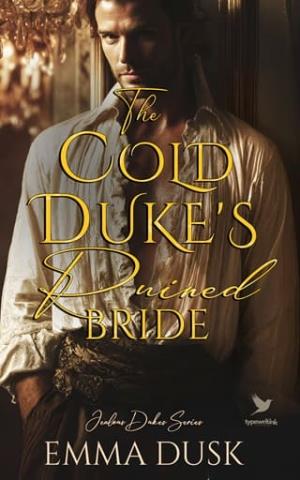
The Cold Duke’s Ruined Bride (Jealous Dukes #2)
Chapter One
“Marriage. Within the year?”
Sebastian’s voice rang out, disbelieving and angry, in the silent room.
Opposite him across the desk, his mother’s gaze widened, her blue eyes lighting briefly before she carefully masked whatever she was actually thinking.
Mr Wilton, the solicitor, swallowed hard, his expression fearful as he looked at Sebastian.
“I am sorry, your Grace. That is what it says in your late father’s will.”
Sebastian glared at him, his blue eyes narrowed, his high-collared shirt and coat seeming suddenly to constrict him. He rolled his broad, muscled shoulders, fighting the constraining fabric. It was just one more thing that made him feel hemmed in and trapped.
“What manner of clause is this?” He demanded icily.
Mr Wilton lifted a shoulder; his broad, square face a picture of fear.
“It is a statement made by the last duke in his will, your Grace. It is as binding as any other statement herein. The sum held in trust for you will not be released until this clause is fulfilled. That is what is written in the will.” The solicitor swallowed hard as Sebastian whirled to face him, his expression flinty.
“I want to see it.”
With trembling hands, the solicitor passed him the document. “It is all there, your Grace. The third article. I—I cannot alter...” he began, but Sebastian interrupted him.
“How much is held in trust?” Sebastian cut in, his voice cracking like a whip.
A stray curl of dark hair fell across his brow; he shoved it back impatiently, hardly noticing the gesture.
This was precisely the sort of petty tyranny his father would contrive—yet another attempt to rule him from beyond the grave.
Rage flared hot in his chest as he searched for any conceivable way around it.
The solicitor twisted his hands together, looking at Sebastian with something close to supplication. “It is the entire sum due to the estate, your Grace. All your late father’s savings.”
Sebastian’s eyes widened, and he let out a breath.
Beside him, his sister Geraldine—Gemma—tucked a strand of coppery brown hair behind her one ear, a habit when she was tense.
She gave Sebastian a hurried, concerned glance.
Sebastian shot her a brief apologetic stare.
He did not wish to distress her, but he could not hide his own strong reaction.
His father had always known how he felt about marriage.
That was probably why he did it, Sebastian thought coldly.
What he had never understood was the cause of Sebastian’s aversion: the cold, loveless union he had endured between his parents.
A marriage of convenience, of silent tempers and careful manipulations.
Sebastian had vowed long ago he would never consign himself to the same.
“So,” Sebastian said briskly, smoothing the edges of his anger as he had learned to do in his father’s presence, “permit me to summarise. The estate has no ready funds unless I marry. The management of Brentfield is expected to continue without any provisions whatsoever until then?” He lifted a brow in cold inquiry.
“Um… no, your Grace,” stammered Mr Wilton. He was shaking outright now, and Sebastian felt a flicker of sympathy. None of this was the man’s doing. “There is money enough for one month’s household expenses, held in a separate account in London.”
“So I have, in effect, a single month before all funds are exhausted should I refuse this… requirement?” Sebastian held the man’s gaze.
“Yes, your Grace.”
Sebastian exhaled sharply. His mother rose from her chair, her face arranged in a mask of concern—though to Sebastian, the spark in her eyes looked far more like triumph.
“Oh, my dear son…” she murmured. “I know it is difficult. But think of the Dukedom of Brentfield. It does require an heir, and—”
As she reached for his arm, Sebastian recoiled before he could stop himself, as though she carried a viper. Her eyes widened, then chilled. Shame pricked him.
“Forgive me,” he muttered. “I must request time to consider this.” He lifted his head, staring first at his mother and then at his siblings—Gemma and Nicholas—who were standing opposite him. Nicholas’ dark eyes held his sympathetically, his narrow shoulders lifting.
“Perhaps we should all—” Nicholas began, but their mother cut him off.
“Sebastian is grieving,” she said, casting a doleful glance toward her eldest. “He does not yet understand what he says. We ought to grant him a moment to absorb the solicitor’s explanation.
Come.” She turned to Gemma, Gemma’s husband William, and Nicholas, all three standing opposite Sebastian.
“We shall retire to the drawing room. Sebastian needs time to think.”
At one-and-thirty, Sebastian found the presumption insufferable. His jaw clenched; his temples pounded. Nicholas shot him a worried look.
“Perhaps we should all go to the drawing room together,” William suggested, his squarish face brightening as he smiled at Sebastian.
With his brown hair and big brown eyes, he looked gentle and friendly, and Sebastian always felt gratitude that Gemma had found such a caring, comforting person who suited her so ideally in marriage.
“I will join you shortly,” Sebastian said, mastering his tone. Still, Gemma’s brown eyes shone with worry at the harshness he could not fully hide. He tried again, more softly: “Truly. I only require a moment. Mother—if you please?”
Her brows rose, as though surprised to be dismissed.
Sebastian felt a small, sharp triumph; even the slightest victory in their lifelong tug-of-war carried its own satisfaction.
His father had used shame as his weapon; his mother preferred guilt and obligation—far more insidious things for a son with a sense of duty.
“Very well,” she said coolly. “You must contemplate.” She fixed him with a hard look before turning away.
Her black mourning gown whispered across the floorboards as she swept into the hall, her back rigid.
Years of disapproval had etched lines into her narrow face; only her firm jaw connected her to Sebastian, whose features were otherwise a truer reflection of his father’s angularity.
His own blue eyes were darker than hers; his frame broader and taller than either parent’s had been.
Gemma followed, her mourning gown shifting gracefully with her steps, copper hair catching the candlelight—a lone point of warmth in the sombre room.
William offered Sebastian an apologetic glance before going after her.
Nicholas lingered last, his long face—so like Sebastian’s—marked with worry.
Only Sebastian had inherited their mother’s blue eyes; otherwise, all three siblings bore the family’s brown hair, Nicholas’s the darkest of the lot.
Mr Wilton made a final, uneasy bow and hurried out. Sebastian granted him a curt nod—unfairly sharp, perhaps, but he could not wholly smother his irritation. Surely the man could have advised his father against so reckless a clause.
The door closed. Silence settled.
Sebastian’s shoulders sagged as he leaned against the desk.
At last, he could drop the mask. He reached for the chair behind the desk, then paused.
His father had always sat there. The memory of that stern face—those hard, assessing eyes—rose so vividly that Sebastian let the chair be.
Instead, he crossed to one of the plain wooden seats by the window and sat heavily, staring out.
The garden lay unusually dark, though it was not yet six o’clock on a summer evening.
Low, leaden clouds pressed over the grounds, casting deep shadows.
The glass reflected a pale version of his own face—hollow-cheeked from lack of sleep, lips—not thin, like his father’s, but fuller—set in a hard line. He looked as haunted as he felt.
“There must be some way out,” he murmured.
He would not—would never—permit his father to govern him from the grave. The man’s tyranny had suffocated him while alive; he would not endure it in death. The mourning coat felt like a shackle around his shoulders.
He rose and paced to the south-facing windows. Long legs, lithe with muscle from hours of riding—one of his favourite pursuits—carried him to the other window. He stared broodingly out as memories of his parents flooded into his mind.
It all came back to him: arguments in whispered tones that he had witnessed, despite their attempt to hide them.
His mother’s cold rage; his father’s anger like a festering wound.
He recalled the continual bickering that had robbed all of them—himself, Gemma, and Nicholas—of ease and peace on every occasion, even Christmas.
“No,” he said softly in the silent study that still smelled of his father—like leather, and the dry, parchment-like smell unique to him. “No. I will not do it. I do not want that for myself.”
Sebastian had resolved early in life that he would not marry, and had kept himself aloof through all the balls and Seasons his mother insisted upon—until he grew old enough that even she could no longer compel his attendance.
After that, he simply remained at the townhouse, reading, while Nicholas was occasionally pressed into attendance.
The memory prompted another thought: a good book was precisely what he needed now.
He moved toward the door, intending to go to the library.
None of the family—save Nicholas—understood why he spent his leisure hours buried in Shakespeare.
But to Sebastian, Shakespeare encompassed every human truth: love and passion, jealousy and obsession, remorse and redemption.
There was no feeling a man could harbour that did not find its echo somewhere within those plays.
As a youth taught to suppress every strong emotion, he had found in Shakespeare a guide to all he felt yet dared not express.
He reached the study door and was about to open it when a knock stayed his hand. He stiffened instinctively, but relaxed as soon as a familiar voice followed.
“Sebastian? It’s me.”
He opened the door at once. Nicholas stood there, his pale face arranged in anxious concern.
“Is something troubling you?” his brother asked before Sebastian could speak.
Nicholas glanced down, then met his gaze again, his dark eyes searching. “Are you quite certain you are well? I did not like leaving you alone.”
Sebastian sighed. “Yes, brother. Truly, I am well. I thought to fetch a book from the library.” He gestured toward the corridor.
Nicholas inclined his head. “I have been thinking… about the matter of the will.” He wetted his lips awkwardly—always hesitant, yet seldom this unsure of offering an opinion.
“Yes?” Sebastian prompted gently.
“I wondered whether you might seek another solicitor. Someone unconnected to the family. Not Wilton.” He paused. “My friend from Cambridge—Alexander Stowe—is an excellent man. You could consult him. Ask for his view of the clause?”
Warm appreciation stirred in Sebastian’s chest. “That is a very good idea,” he said softly. “I may indeed do so.”
It was a good idea, he reflected as he stepped into the hall beside Nicholas. Perhaps Wilton’s insistence that the clause was ironclad stemmed from loyalty—to their father, or to their mother, who had always known how to bend men to her wishes.
“It is worth a try, is it not?” Nicholas said with a small, hopeful smile.
Sebastian nodded. “Yes. It is worth a try.” Already his thoughts turned to the short ride into London from Brentfield Estate, lying only a few miles from the city.
There may be a solution. There must be.