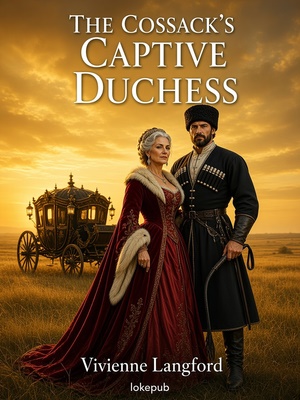
The Cossack's Captive Duchess
The Captive
There are, I have found, two things in this world that cannot be purchased with a widow’s fortune: a good night’s sleep past the age of thirty-five, and a horse who loves you.
The sleep I had given up on. The horses I had bred myself.
Juno stood hipshot in the long grass while I went over her legs, running my palm down each cannon in the fading light, feeling for heat.
She was fifteen and a half hands of Wrentham-bred bay perfection, thin-skinned, opinionated, and unfortunately wasted on the steppe—my guards’ shaggy little Kalmyk ponies had spent a fortnight watching her spook at grouse with what I could only describe as a sort of professional contempt.
Their horses could live on grass and spite. Mine required grain, poultices, and flattery…but they were well worth such pampering, and I would never consider leaving them behind.
I picked up her near fore and dug a small stone from her hoof with my pick. She leaned her great ridiculous head against my back while I worked, and I would not have traded her for the whole of the Russian Empire.
I could not saddle her—no woman alive can heave a sidesaddle onto fifteen and a half hands without assistance, and I had long ago stopped pretending otherwise—but no one else touched her legs, her feed, or her feet.
My grooms in England had learned this, and my hired guards had learned it faster, because I’d learned to say no in Russian before I learned please, which tells you something about me, I suppose.
Hector, my young grey, was picketed beside her, pulling at the grass as though the entire journey had been arranged for his dinner.
I had bred them both. Planned the crosses, sat up through the foalings, argued with my late husband’s stud groom until he retired in protest and then argued with his successor. Had I mentioned I was stubborn?
In twelve years of widowhood I had denied myself very little, but the horses were the indulgence I never even attempted to justify. A duchess’s stables are her husband’s. A dowager’s…are her own.
Everything has been my own.
But when my son came of age this spring—eighteen, invested, and so eager to run Wrentham without his mother’s supervision that he practically packed my trunks himself—I looked at the map, and I looked at my life, and I asked myself where a sensible woman of six-and-thirty ought to go.
Paris, said everyone.
I went to Russia.
I had done Paris already. In the last twelve years of seasonal journeys, I had done Vienna and Florence and the obligatory Alps, had been improved by as many altarpieces as one woman can absorb, and had conducted myself in each city with great discretion and, occasionally, great satisfaction.
But drawing rooms are drawing rooms in any language. I spoke French fluently enough to be bored in it.
I wanted to see…the edge of things. The place where the map-makers began guessing. I was aware this made me eccentric, and I had reached the age where that word had stopped being a warning and become permission.
So: St. Petersburg, which was basically Paris with better furs. Then Moscow, which was not Paris at all, and interested me considerably more.
And then south, week after week, watching civilization thin like a river poured out over too much land—the cities becoming towns, the towns becoming villages, the villages becoming a church and a well and a man holding a rope tied to a cow.
Until the land simply…opened.
I had not known grass could do what the steppe did. It ran to the horizon in every direction and then, I was reliably informed by my guide Semyon, kept going.
The brilliant sky came all the way down to the ground. After a lifetime of parks and hedgerows and prospects designed to please, there was something almost indecent about it—all that space, unfenced, unowned, entirely indifferent to my rank.
I felt more awake than I had in twelve years of widowhood.
Which brings me to that particular evening, golden and enormous, with my little party making camp beside a stream that Semyon swore was sweet.
My men had the tent half up. Hobbs, my maid, was helping with dinner and radiating disapproval at the guards in a way that required no translation—she’d decided in Moscow that they were bandits-in-waiting, on the grounds that Semyon had hired them and she didn’t trust Semyon either.
Semyon was our guide: sixty if a day, grey-mustached, with a seat on a horse that made me privately ashamed of every riding master I’d ever paid.
He spoke Russian at me in long, patient streams. Pyotr Ilyich—a skinny young scholar from Kazan with spectacles and a wardrobe entirely unsuited to weather—turned it into French for me, usually with apologies attached.
That evening’s stream required several.
“He says, madame, that we are entering—the word is difficult—the free lands. Cossack country. He says the tsar’s writ runs thin here.
” Pyotr Ilyich polished his spectacles, which was what he did instead of looking at me when he had to share what he thought was bad news.
“He says there are men in this country who take horses. He wishes me to say that your horses are—visible.”
I didn’t roll my eyes, but only because six years of marriage—and quite a few affaire d’amour in the last twelve—had taught me men did not appreciate it.
Visible? Of course Juno was visible. She was magnificent, was she not? Two weeks of open steppe, and my bright bay mare shining like a new guinea in every mile of it.
“Tell him,” I said, “that I am a wealthy Englishwoman with papers, guards, and a truly formidable quantity of silver, and that I have talked my way past customs men, cardinals, and my own mother-in-law. I shall manage.”
Pyotr Ilyich translated. Semyon looked at me for a long moment—the same enigmatic way he sometimes looked at the weather—and said something short.
“He says the men here do not read papers.”
Well.
This time I did roll my eyes, and was answered with an amused-sounding snort from our native guide.
I should have been frightened, I suppose. I had spent thirty-six years being sensible: a sensible bride at seventeen, a sensible wife, a sensible widow who took sensible lovers and invested sensibly and raised a son so sensible he’d turned me out of my own house with perfect—sensible—courtesy.
Out here, under all that sky, I found I could not locate my alarm.
The fires caught. The horses tore grass in the dark, comfortable sounds.
Hobbs laid out my bedding and my traveling case—which contained, beneath the laudanum and the letter-paper, a certain well-thumbed volume I never traveled without, because a widow’s education ought to be maintained—and the steppe went black and endless in every direction, and I lay awake listening.
Not to anything in anything in particular. Just…listening to the size of all that grass.
Something was out there. I did not know what it was or how it would affect me, but I discovered I was anxious to discover what it was.
Or perhaps I was just anxious in general.
Hobbs—who was a few years older than me—had once tried to explain that sometimes women of our age don’t need a reason to be anxious…we just are.
How perfectly wonderful, right?
Imagine me rolling my eyes.
Well, I’d discovered over the years that there was one tried and true way to turn off my mind—and the anxiety—and fall asleep…and it involved my favorite book and a bit of privacy.
Sure enough, after about an hour, the sounds from outside died down as our guards took to their posts or their bedrolls, and Hobbs’ breathing turned to soft snores from her mattress on the other side of the tent.
My hand slowly burrowed beneath my pillows to remove a set of matches and my favorite volume.
I was not one of those women who traveled with an entire library; usually I needed nothing more than my imagination and a beautiful vista to write my own literature. But I had found, over the years of my adventures, that there was one book I refused to travel without.
A Harlot’s Guide to the Forbidden and Delightful Arts.
It was an old volume, originally written hundreds of years ago, based on the illustration style, by an unnamed noblewoman.
She claimed it was a catalog of her sexual escapades, and I couldn’t deny that she’d been adventurous indeed; it took me years to find a set of partners to attempt The Twin Mountains, and I still hadn’t tried The Hairy Combover.
Perhaps by this point, I’d read the book enough that I had it memorized…but I still lit a candle and opened the pages.
As I flipped through the descriptions and illustrations, the familiar throbbing began between my thighs.
I reached beneath the blankets and inched my nightrail up my legs, scooching higher on the pillows so I could read and touch myself at the same time.
A word caught my eye and I paused my casual perusing.
Oh, yes. The Backwards Donkey.
My fingertip found my clitoris and I began to rub.
With the man in a seated position, the woman straddles his thighs, her back to his chest and her feet upon the floor, and rides him as if he were a stallion, only backwards. Particularly effective if she likes her hair pulled, or her nipples and clitoris stimulated.
The ache in my cunny built as I re-read the description and studied the illustration of the woman, her head thrown back in ecstasy, as the man tugged on her nipples. Soon my breathing was coming faster, and I bit down hard on my lower lip to hold in my moan.
I closed my eyes, and in my imagination, the illustration morphed into me sitting on a stranger’s lap, his beard tickling my naked shoulder as I rode him.
His big, callused fingers found my clitoris, stroking me the way I was doing now, as his cock filled my aching core.
It had been so long—too long—since I’d taken a lover, and none in St. Petersburg or Moscow had intrigued me enough to consider it.
But my mystery lover, my faceless paramour?
The one who now fucked me from beneath as he squeezed my breast, as if he owned me?