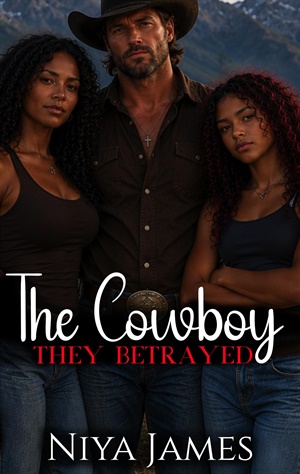
The Cowboy They Betrayed (The Cowboy’s Family Legacy #4)
1. Jessika
ONE
JESSIKA
I know the time because I've been staring at the ceiling for two hours, listening to the rain hammer the old farmhouse roof and waiting for a sleep that refuses to come.
My phone lights up on the nightstand, Briar County Sheriff's Department, and the cold that moves through me has nothing to do with the drafty window above the bed.
I answer before the second ring.
"Ms. Mills?" A woman's voice. Tired, professional. "This is Deputy Hartley with the Briar County Sheriff's Department. We have your daughter here at the station. Nova was detained about forty minutes ago at a property out on Route 9?—"
"Is she hurt?"
"No, ma'am. She's physically fine. But there was a situation at the gathering. We'd like you to come in."
A situation. That's the word they use when they don't want to explain things over the phone.
I'm dressed and in the truck in four minutes flat.
Briar County in October is a thing unto itself, black roads slicked with rain, tree lines pressing in from either side, that particular darkness of rural places that has no comparison in the city.
I spent the last fourteen years in Atlanta.
I forgot how heavy the dark gets out here.
How the sky doesn't glow orange from a thousand different lights but just sits above you, dense and moonless and watching.
I forgot a lot of things about home.
I'm still trying to decide whether that's a mercy or a failure.
The sheriff's station sits at the edge of Calwell, the county seat, in a squat brick building that looks exactly the same as it did when I was seventeen years old and picking up my brother Morgan from a drunk-and-disorderly charge.
Same fluorescent lights bleeding through frosted windows.
Same flag out front that needs replacing.
Same combination of institutional dread and sad vending machine smell that hits you when you push through the door.
The deputy at the front desk, young, probably barely twenty-five, looks up when I walk in.
"Jessika Mills," I say. "Here for my daughter."
He nods toward a hallway. "Back there, ma'am. Room B."
I follow the corridor past a row of plastic chairs, past a bulletin board crowded with missing persons flyers and Community Watch announcements, past a door marked EVIDENCE and another marked INTERVIEW 1.
And stop.
Room B has a window in the door. Through it I can see Nova sitting at a table.
She's wearing the black hoodie she got last Christmas and her expression is the blank, brittle mask she puts on when she's terrified but refusing to show it.
Her dark curls are damp from the rain. There's a streak of something, mud maybe, across her jaw.
She's fine. She's physically fine. The relief hits me so hard my knees actually soften.
Then I see the other person in the room.
A man sits across from Nova. His back is to the window so I can't see his face, just the breadth of his shoulders filling a dark work jacket, the dark hair at his collar, the way his big hands rest on the table, one of them wrapped in a paper towel that's gone brownish-red with old blood.
He's talking to Nova quietly. I can't hear the words through the door.
Nova, who hasn't talked to me with anything other than defensive fury in three months, is listening. Actually listening, her chin propped in her hand, watching him with an expression I haven't seen on her face since before the divorce. Something cautious. Something almost soft.
I push through the door.
Two pairs of eyes come up.
Nova went immediately defensive. "Mom?—"
The man turns.
And everything I thought I left behind in Briar County comes crashing into the present like a truck through a guardrail.
Grant Vance looks like the years happened to him the hard way.
He's always been big, I knew that even at nineteen, but somewhere between then and now the lean edges hardened into something more deliberate, more formidable.
Six foot four of solid working muscle in a dark gray thermal and jeans, forearms visible where he's pushed up his sleeves, both arms a map of black-and-gray ink I don't remember from before.
The beard is new. So is the scar cutting through his left eyebrow.
So is the quality of his stillness, the way he goes completely precisely quiet when he sees me, the way I can watch him process something and decide something and lock everything else behind his eyes in the span of a single second.
He was twenty-three when I last saw him.
Standing in a courtroom.
Those brown eyes, whiskey-colored, always too intelligent, find my face and just hold there.
"Ms. Mills," he says. Not like we're strangers. Not like we're not, either. Like the word itself is doing a lot of careful work.
"Grant." My voice comes out steadier than I feel. Fourteen years of attorney training. "What are you doing in here?"
"Waiting with your daughter until you arrived."
"Why are you—" I stop. Look at Nova. "Are you going to tell me what happened?"
Nova's jaw sets. That chin-up, eyes-flat expression I know means she's preparing to be difficult. "It was just a party."
"On Route 9 at midnight."
"It wasn't midnight when I left."
"Nova—"
"She left the ranch around nine," Grant says quietly. No judgment in it. Just information. "I found her out by the old Colter property around ten-thirty."
Something about the way he says found her makes my stomach drop. "Found her."
He looks at me then, really looks, the way he used to, like he's reading something in the air between us that nobody else can see, and says: "Your daughter almost disappeared tonight."
The room goes very quiet.
Nova's expression changes for just a moment, that hard blankness cracking open to show something younger and more frightened underneath before she closes it up again.
I look at Grant's hand. At the paper towel wrapped around his knuckles. At the dark stain spreading through it.
"What happened to your hand?"
"Nothing that matters."
"That's blood."
"I'm aware."
"Grant—"
"There was a man," he says carefully, "who had decided he wanted company he hadn't been offered. I helped him change his mind."
The phrasing is very precise. Very deliberate. The kind of precision that tells me the actual event was not precise at all.
I pull out the chair beside Nova and sit down, and I take my daughter's face between my hands and turn it toward me, gently, the way I used to when she was small and had nightmares, and look at her.
Really look. The mud on her jaw. The way her eyes are slightly too bright.
The faint tremor in her shoulders that she's working hard to hold still.
"Nova." My voice drops quiet. "Are you okay?"
Something flickers. For just a second, the thirteen-year-old who used to crawl into my bed during thunderstorms is right there behind her eyes.
"Yeah," she says. Her voice is almost steady. "I'm okay."
I pull her in and hold on. She goes rigid for exactly two seconds, fighting it, fighting everything the way she fights everything now, and then folds against my shoulder with a breath that's halfway to a sob.
I look up over her head.
Grant is watching us. There's something in his expression I can't read, something complicated and old and deliberately contained. When he sees me looking, he cuts his eyes away to the wall.
His knuckles, I notice, are torn up badly. Not just one punch. Not two.
He beat someone badly out there tonight.
Protecting my daughter.
I don't know what to do with that. I don't know what to do with any of this, Grant Vance in the fluorescent light of the Briar County Sheriff's station, looking like weathered danger, waiting quietly until I arrived.
I testified against this man. Stood in a courtroom and gave evidence that helped send him to prison.
And he sat here for forty minutes keeping my daughter company.
"Thank you," I say finally.
He looks back. Nods once. Short, contained.
"Do you need medical attention for that hand?"
A corner of his mouth moves. Not quite a smile. "No."
Nova pulls back from my shoulder and wipes her face quickly, embarrassed by the crack in her armor. "He wouldn't even let them look at it," she mutters. "I told him he was being stubborn."
"He is," I say.
Grant raises an eyebrow at that. At the casual familiarity of it. At the fact that I said it without thinking, the way you only say things about people you knew once.
The door opens behind us and Deputy Hartley comes in with papers for me to sign, a release form, something about the incident report, a note that the property owner has declined to press trespassing charges given the circumstances.
I sign everything and help Nova into her jacket and we move toward the hallway.
At the door, I stop.
Grant is still at the table.
"Aren't you leaving?" Nova asks him, turning back.
"In a minute."
"Why?"
He looks at her with the patient, uncomplicated honesty I noticed him using when I watched through the window. "Couple more things to sort out with the deputy."
Nova studies him for a second the way she studies everything, quick, suspicious, looking for the lie. Then she nods like she decided something.
"Okay," she says. And then, quietly enough that I almost miss it: "Thanks for, you know."
"Yeah," Grant says. "I know."
We step out into the rain.
In the truck, Nova is silent for a long time. The wipers work back and forth across the windshield. The dark trees press close on either side of the road.
Then: "You know him."
Not a question.
"We grew up here," I say carefully. "I knew him a long time ago."
"He said he knew our ranch."
Something tightens in my chest. "He said that."
"Yeah. He said—" She pauses, picking the words. "He said he knew horses. He said if any of them were still nervous from the storm you could put a radio on low in the barn. Country music."
I stare at the road.
That's exactly right. That's exactly what works. My father taught me that trick when I was eight years old, and I've used it my whole life, and I have never told a single person outside the family.
"Mom?" Nova's voice shifts. Younger. Uncertain. "What almost happened to me tonight?"
I reach over and put my hand over hers on the seat between us.
"Something that didn't happen," I say. "Because someone made sure it didn't."
She's quiet for a moment.
"He's scary," she says. Not like it's a complaint. More like she's identifying something factual and trying to figure out what to do with it. “Like, people-move-out-of-his-way scary. I watched it happen in the parking lot."
"Yeah."
"But he wasn't scary with me."
I don't answer that.
We pull down the long gravel drive toward the dark farmhouse, and I help Nova inside and up to her room, and I don't tell her that Grant Vance has been described as many things in Briar County. Violent. Dangerous. The county's particular brand of ghost story. The devil that haunts the back roads.
I don't tell her that I played a part in making him that.
I don't tell her that when I looked at his bloody knuckles in that fluorescent light, my first thought was not fear.
It was gratitude so fierce it scared me worse than anything else about tonight.
Back in my room, I sit on the edge of the bed in my wet jacket and don't turn the light on.
Outside, the rain has softened to something steadier. The old farmhouse settles and creaks around me. Down the hall, I can hear Nova's music starting low, she always sleeps to music when she's unsettled, has since she was four, and I let myself breathe for the first time since the phone rang.
My father is asleep in the room beside mine. Three weeks out of the hospital, eight weeks after the stroke that started all of this, this return, this retreat, this failure to be anywhere other than exactly where I swore I wouldn't be.
The ranch is bleeding money. The horses need more than we can give them right now. My father's medical bills are a particular kind of quiet catastrophe that hides behind his stubbornness and his refusal to discuss finances with me.
And now Grant Vance is in Briar County.
I haven't thought about him in, that’s a lie.
I've thought about him. Not constantly, not the way I used to when I was young and stupid and convinced that I understood something about the situation that I didn't. But he surfaces.
The way certain memories surface. The particular specific weight of something you wish you'd done differently.
I should sleep.
Instead I take out my phone and open the browser and search his name.
The results come back fast. A few local news articles from five years ago.
One from seven. A Briar County Gazette piece titled brIAR AUTO MECHANIC FACES ASSAULT CHARGES, the charges, the article notes further down, were eventually dropped.
A mention in a county commissioner meeting regarding a nuisance complaint about the salvage yard on Route 12.
An NA community bulletin from three years back listing Grant Vance as a volunteer coordinator.
I read that last one twice.
Then I put my phone down and stare at the dark ceiling.
Grant Vance.
Years ago, I sat in Briar County's courtroom in a gray blazer I bought specifically for the occasion, I was twenty-eight, freshly barred, convinced I understood what justice looked like, and I told the truth. About what I saw. About what Morgan told me. About the night everything came apart.
I told the truth.
I just didn't know, at twenty-eight, that the truth could be incomplete enough to be almost the same as a lie.
I don't sleep for a long time.
The rain keeps falling.
Somewhere on the other side of the county, I imagine Grant driving home to wherever Grant lives now, his bloody knuckles on the steering wheel, the same night on his side of the glass.
I wonder what he thinks about.
I wonder if he thinks about the courtroom.
I wonder if he's ever going to stop being the thing in this county I can't fix.