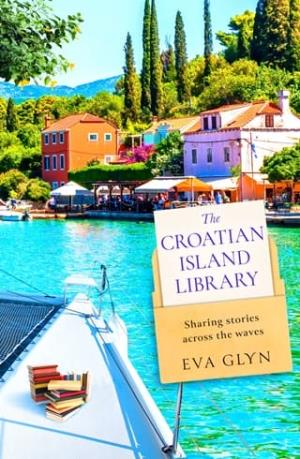
The Croatian Island Library
Dubrovnik
Ana Me?trovi? flung herself into a canvas chair outside the jazz café and glared at her friend Meri.
“You’ll never, ever, not until grapes grow on willow trees, guess what they’ve done.”
Meri sat back, the orange tiger streaks in her hair reflecting the late afternoon sunlight. “That rather depends on who ‘they’ are.”
“Those idiots at the county education department, that’s who. Most especially, sodding Ivana Leva?i?.”
“The woman in charge of the library project?”
Ana nodded. She was about to say more when Meri flagged down the waiter, Toni, and ordered a carafe of wine.
“I’m assuming something stronger than coffee?” It was more of a statement than a question, and Ana nodded.
“The catamaran’s in the old harbour, ready for tomorrow. I’m not driving anywhere.”
Meri whistled. “They let you moor up in there? They can’t be all bad.”
Ana glowered at her. “Don’t joke. They’ve only gone and appointed a male librarian.”
“So?”
What did Meri mean, ‘so’?
“You know why I got out of chartering. You know how much I hated being hit on by some leery, oversexed holidaymaker every other week.”
“Not to mention how much you hated their spoilt wives and girlfriends talking down to you too.”
Ana folded her arms. “At least the wives kept their hands to themselves.”
Toni returned with their wine and a terracotta dish of olives, rolling his eyes theatrically. “Unlike those ladies over there!” He tossed his head in the direction of a group of Englishwomen. “They’ve ordered a second bottle and I’m not sure I feel safe to take it.”
“Don’t worry, draga, we’ve got your back … or whichever part of your anatomy you’re most worried about,” Meri laughed. “Now shoo! Ana and I are talking.”
“All the same,” she said, once he’d stalked away, “you need to be logical about this and not make assumptions. Who is this man anyway? On the vague chance you were actually listening when Ivana told you.”
Sranje! Meri knew her too well. Still, she didn’t want to prove her entirely right.
“He’s fifty-three and English, and until recently was teaching German in a London high school.
He also speaks fluent French, some Italian, and even a little Croatian, which is why he got the job.
The bastard’s done a bit of sailing too, damn him. ”
“So in other words, if he were a woman, he’d be perfect.”
Ana folded her arms. “But he’s not.”
“And he’s probably not a misogynist either.
For all you know he might be celibate. He may not even be straight.
You can’t just assume he’s going to be trouble.
And anyway, being this grumpy isn’t like my lovely Ana.
Are you going to tell me what’s really wrong?
” Typical of Meri to see through her blustering and get straight to the heart of the matter.
Ana sighed. “I just don’t want any aggro, that’s all. I need this to work – you know I do. Financially it underpins … everything.”
“And you can’t lose the catamaran.”
“Like I’d ever let that happen. I’d rather starve than lose Dida Krila.”
“Oh, Ana. Like your parents would let that happen!”
“I won’t take their money again.” She bit her lip. If this didn’t work out she might have to. The money and everything else that went with it. Sod it, sod it.
Meri put her hand over Ana’s. “This is so not like you.”
Meri was right. She didn’t normally get this wound up about stuff.
“I think … I think it’s because I’m nervous about having to manage people, especially people I’m going to be living in close quarters with for ten whole weeks.
I’ve never done it before, and if I don’t set the right tone from the beginning …
If we don’t get on, this summer could be hell. ”
Meri looked up at her and grinned. “I suppose at least with charters you could have any troublemakers off the boat in a week or two.”
Ana put her head in her hands. “Oh god, don’t make me regret this. It was a hard enough decision to make as it was.”
Meri wrapped her arm around Ana’s shoulder.
“I hope I didn’t push you into it. It’s just, when I was asked to write the press release about the project I thought it was perfect for you.
Especially as it’s a pilot. You know how much emphasis the government’s putting on foreign language proficiency.
If it works, their grant money’s there for another four years. ”
“And four more years will pay off the loan on the catamaran, so I won’t have to worry anymore and I’ll be free; free to sail where I want, do what I want.
It’s perfect, honestly it is. It’s just so much responsibility and I’m not used to it.
All I’ve had to do for the last few years is run my boat. ”
“Don’t underestimate yourself. You’ve always skippered, you’ve always had crew, you’ve always completed logs. The only difference this time is you have a librarian and a ton of books on board, and the logs are now weekly reports to Ivana. Any stroppy customers will be down to this bloke.”
“When you put it like that, perhaps it isn’t quite so daunting.” Ana tried to smile.
“I know you can do it. It’s well within your capabilities,” said Meri, giving her a peck on the cheek.
“How come you always make me feel better about myself?” Ana asked, even though she knew in her heart that this time it wasn’t quite true.
“Because I’m your very best friend. Hell, Ana, aren’t you the lucky one?”
At this Ana really did laugh, the knot of tension easing a little in her belly. What would she do without Meri? Knowing she had her back this summer – albeit from a distance – meant the world.
She’d met Meri almost fifteen years before, while she was studying for her degree.
New to the city, she hadn’t realised the jazz café was where the gay community gathered, but the crowd had been so friendly, Meri in particular, that she had felt she, too, belonged.
A bond had grown between them; the combat-wearing, streetwise, single mother and the green-as-grass student.
With Meri, more than anyone else, Ana could be herself.
An hour or so later, Ana circumnavigated the tourists thronging the bright square between the Rector’s Palace and the cathedral on her way back to the boat.
The old stones were tinged a soft golden grey by the early evening sun, highlighting the palace’s elegant colonnade, and a black and white cat strolled languidly in front of her, repelling the attempts of a Japanese visitor to stroke it with a contemptuous flick of its tail.
Dubrovnik would never be home, but Ana certainly appreciated why so many people came here and fell in love with the city.
Heading for the harbour, she passed into the shadows under the medieval arch of Vrata od Ponte.
The fish stall beneath it was closed, leaving behind the faintest tang of the sea, but tomorrow she would buy everything she needed to make brudet, a traditional fish stew.
It would be a good way to welcome her crew.
Set that friendly tone. The youngster Natali, who she’d recruited herself and …
what was his name? Lloyd? If she was honest, she was still miffed with Ivana’s choice, although she knew it wasn’t fair to take it out on the guy.
He’d better behave himself, that was all.
And given he was almost twenty years older than her, he’d better not play on her inexperience as a manager – or try to tell her what to do.
Dida Krila’s sleek form was an elegant contrast to the blue and white painted fishing boats nestling beneath the grey bulk of Sveti Ivan Fortress.
Dubrovnik’s old harbour was wrapped in the arms of the city walls, and it was indeed a privilege to be allowed to moor here, even for just a couple of nights.
Normally only craft belonging to inhabitants of the old town and a handful of tourist trip boats were permitted, so perhaps she should stop worrying about everything and enjoy it while she could.
Ana jumped onto the wooden transom, the feeling of home wrapping itself around her.
She paused in the dip of the wheel helm station, swinging the seat back and forth as she gazed at the banquettes which edged the indoor–outdoor part of the salon.
The whole area was sheltered by the fly deck above and long, smoked-glass windows which gave protection against wind and sun.
Now she slid them open, letting in the glorious evening light that danced across the harbour and glinted from the polished dining table.
Finally she unlocked the door to the galley, which as well as containing the navigation station, led downstairs to the four en suite cabins, two in each hull.
The catamaran’s spec was the best she’d been able to afford: soft, squishy seating, teak finishes; even a full-sized oven and fridge.
Not that she was much of a cook, but the generous galley had proved a popular feature with her charter guests, and the charter business was why she had bought the boat in the first place.
When her grandfather had left her enough money for the down payment, buying a boat had been a no-brainer, just as it had been to name it after him.
Dida Krila. Grandad’s Wings. He’d taught her to sail and had always been happier on water than on land – a trait she’d definitely inherited.
Now she liked to imagine he was still beside her on the seas.
And he’d certainly be chuffed to see her moored in the old harbour.
Too right he would. She wrapped her arms tightly around her chest; god, she still missed him.