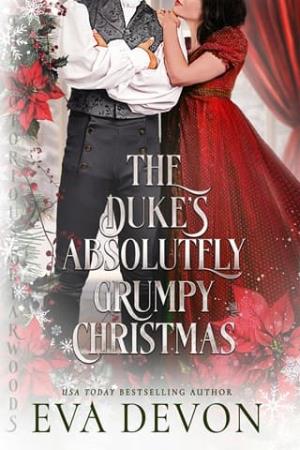
The Duke’s Absolutely Grumpy Christmas (The Notorious Briarwoods #17)
Chapter 1
England
Christmas Day
Many years ago
Oliver Lansford, Earl of Bexton, only son of the Duke of Crestfield, loved everything about Christmas Day. As a nine-year-old boy, it was his favorite day of the whole year. How could it not be?
All boys loved Christmas Day, did they not?
And without question, Oliver was more fortunate than most boys. His Christmases were full of more excitement than other children’s. As the son of a duke, the festivities that occurred on his father’s estates were grander, brighter, fuller, and more exciting than anyone else’s.
And he, joy of joys, was a part of it! Every year, much to his great pride, he got to help choose which plays would be performed and argued strongly for which sweetmeats would be passed out to the children.
True, he was a child himself, and some might have argued he should have simply been allowed to enjoy the festivities without orchestrating them.
But his father and mother believed in intense dedication and devotion to the people on their estates, which they believed was necessary to upholding a constitutional monarchy.
In his father’s often-declared opinion, the people needed to love their rulers, and if they did not, they might rebel, and quite rightly, as had happened in France.
Oliver’s very intelligent and good-hearted father, who was also quite pragmatic about the best way to keep power, was determined that they would be excellent rulers.
And so, every year, the festivity planning began quite early.
The family would make certain that all of the children in his father’s dukedom received some sort of little toy, and that every family received a basket of goods and foodstuffs from the estates.
It took copious amounts of planning and tracking which families needed what, the ages of their children, and the sorts of things that those children might need the most.
Oliver loved watching his mother make list upon list of what jams and jellies would be put into the baskets, as well as which breads would be made in the weeks leading up to the holiday.
For his mother, who grew quite fiery about the subject, would not allow a single family on the estates of the Duke of Crestfield to go wanting on Christmas Day.
No, unlike so many of the other lords that his father despised, his father and mother ensured that there would be no crying child on Christmas Day. No family would sit in their little home with nothing to heat their fires and nothing to grace their plates.
There would be no heart-wrenching cry of a mother who could not feed her babes on the day meant to celebrate the coming of light and love. She would not stand for it any day, but especially not that day. Mothers would have enough for their children and treats besides.
Oliver’s father was a great man, and Oliver knew deep in his bones that, one day, he too would be just like his father. Was that not the duty of every duke’s heir, to be like their father and even to surpass them in goodness?
Yes, when he grew up, for all children must, Christmases under his care would be wonderful, a shining beacon of hope in the darkest of winter days. And he would be just like his father, ensuring that every child upon his estates received joy.
And Oliver’s great joy? It was not in the receiving of presents, though he certainly did receive many, and it was not in the eating of ginger nuts and spiced drinks and hot chocolate, or in ice skating or snowball fighting or listening to carolers or the antics of the tenants enacting centuries-old rituals.
No, his great joy was in the pageantry of the stage. How he loved when the plays came and the performers insisted that his father judge who was the best and give out a prize.
How Oliver loved the plays, the actors’ shining costumes, and the dancers who looked as if they were flying about and not bound to the earth as mere mortals were.
Now, Oliver’s father was quite a good judge of such performances and enjoyed them heartily.
Even so, he would not allow any singular group of players to win all the laurels.
He always ensured that there was a good amount of money given out to every troupe.
And of course, there was a prize bit of ham too.
Yes, how Oliver loved the dances and shows!
And when Christmas Day finally arrived this particular year, and they were able to go down to the village and see the plays put on upon a stage swathed with greenery and backed by painted set pieces, built quickly in the town square, Oliver’s heart was filled to the brim with joy.
Oliver’s little sister, Seraphine, stood by him, holding his hand. She was a little thing with a great angelic name. And she seemed to have a heart worthy of such a thing!
How he did love her! How she did love him! How he loved his parents!
There was no more joy in any family, in Oliver’s opinion. And as the players took to the stage in their brightly colored costumes, decked with bells and make-up upon their faces, and danced brightly and joyfully to music that fell over an awe-filled crowd, he felt a wave of realization…
He wanted to be just like those dancers and players.
He wanted to dance about the stage. Not just like the Morris dancers they sometimes saw. No! He wanted this grand passion of movement! He wanted to hop and sing and make merry and be, well, beautiful, because that’s what they were.
All the lads in their finery with their strength were…beautiful, magnificent, captivating.
His father watched, pleased, but still above it all. And when it finally came time to give out prizes, he gave a prize to the most colorful group.
Yes, yes, being the brightest and the most beautiful and the most colorful, dancing the most energetically? That clearly pleased his father, and it would please Oliver too.
His sister cheered brightly and his mother applauded graciously. And drink and good food flowed as the square exploded with music and song.
That night, when the family went back up to the great house and began to ready themselves for the elaborate dinner that his mother and father hosted every year, for a table of at least forty guests, Oliver found himself in his mother’s chamber looking for silks and satins and jewels.
And he decked himself from head to toe like a tree in Austria that he had read about.
He festooned himself with beautiful things, and then he began to dance.
He leapt about the room and twirled and jumped, marveling at the feel of the silks and ribbons swirling about him, marveling at the sound of the jewels and bells clinking.
How wonderful he felt, how excellent, how like the players upon the stage!
And he, in that moment, felt completely and utterly transformed.
How joyful, how alive! And in a flash, he knew that he loved dancing as much as he loved Christmas.
He loved everything about it, the way it made him feel, the way it made his heart sing.
Yes, he would be a great duke, but he would be a great dancer too.
Why not?
Why couldn’t he be both? Surely, a great man could be great at many things. And he would show his father, and his father would be pleased. His father loved performances, so a performance would only garner Oliver more love.
And just as Oliver turned in a great leaping twirl, ready to go and find his father, his father found him.
But it was not pleasure that he saw upon his father’s face. It was a stern sort of resignation. “My son,” his father said, his voice a deep reverberating dismay, “what are you doing?”
Oliver stilled, the joy suddenly slipping out of his heart, replaced by something far colder, far grimmer, far more frightening. It was as if he now had to pay for the joy he had felt, and the debt of it was gutting.
“Dancing, Papa,” he said softly.
“What are you wearing?” his father asked.
He hesitated, then gestured to his ribbons and jewels.
“Don’t I look wonderful? I look like the dancers from the play.
” But with each word that Oliver spoke, he saw his father’s dismay grow.
Each word was like a shovelful of dirt, digging a deeper and deeper hole, and his voice began to pitch up with indecision.
“You judged it. You thought it the best.”
His father stared at him for a very long time, then said with a calm so soft it was almost frightening, “You are a future duke, my boy. You cannot look like a dancer or a player. You are not a dancer. You are not a player. You are going to be one of the greatest men that England has known. You are my son. And you will judge actors, and you will judge dancers, and you will give them money so that they can do their work and try to please their betters a little bit. But you, my boy, can never be one of them.”
A muscle tightened in his father’s cheek and his lip curled with a touch of disdain, but there was more than a touch in his gaze. A gaze usually filled with approval when looking at his son. But that approval was gone in that moment.
“Nor would I wish you to be,” his father continued without malice, but his intent was clear.
There would be no tolerance of such things.
“You are so much more than that, Oliver. I love you, my son. It is for your own good that I say these things to you. You must take off all of those things, your mother’s things.
And you must understand that a duke’s place in this world is to shine, but from afar, and to be worshiped, distantly like a star.
You cannot bow and scrape and jump about for the approval of the masses.
And dancing, my boy? No, that is not fit for you.
You are fit for the sword, for the pen, for Parliament.
I don’t ever want to see this again. Do you understand? ”
The words swirled through Oliver and he felt sick. He was never to feel such joy again? Such freedom? He couldn’t understand what he had done that was so very wrong. But clearly it had been wrong. Still, he had to try one last time. “But, Papa—”