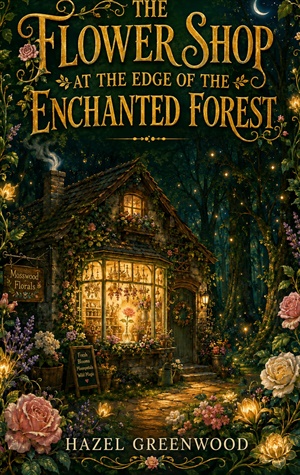
The Flower Shop at the Edge of the Enchanted Forest (The Enchanted Forest Chronicles #4)
Chapter 1 The Inheritance of Petals
The ferry cut through the drizzle like a knife through gray silk, and Flora Mosswood stood at the rail with her hands in her pockets and her future in a single battered suitcase at her feet.
She had been standing there for the entire crossing.
Twenty-three minutes according to the whistle that had just sounded.
Twenty-three minutes of watching the shoreline of Thornhaven take shape through the mist, watching the trees grow from smudges into individuals with bark and branches and roots that held them in place, watching the single stone pier resolve into something solid enough to hold her weight.
She had not sat down. She had not gone inside the cabin where the other passengers huddled over cups of tea, their breaths fogging the windows.
She had stood at the rail because standing at the rail meant she could leave at any moment.
She could step off this ferry the way she had stepped onto it.
Nothing was holding her here. Nothing ever did.
The ferry bumped against the pier with a hollow thud that echoed off the stone.
The gangplank lowered with a groan of wet wood.
Flora picked up her suitcase, nodded at the ferryman who did not nod back, and stepped onto Thornhaven for the first time in her life.
The stone was slick under her boots. The air was cold but not biting, the kind of cold that promised frost by morning.
The village was smaller than she had expected.
Smaller and quieter and wrapped in a stillness that felt less like emptiness and more like waiting.
A single road wound up from the pier, flanked by stone cottages with smoke rising from their chimneys, the smoke hanging low in the damp air, refusing to rise.
The smell hit her before she had taken three steps.
Woodsmoke and wet stone and something green that she could not immediately identify.
Moss, maybe. Or the forest that pressed against the village's edge, its trees visible at the end of every side street, dark and Patient with a capital P.
She had never seen trees that looked so purposeful.
They stood like sentinels, their branches interlaced above the road as if they had agreed to meet there.
She had visited forty-seven towns in the past nine years.
She knew the smell of a place within seconds of arriving.
She knew whether she would stay a week or a month.
She knew whether the people would be warm or cold, whether the work would be plentiful or scarce, whether she would leave satisfied or just tired.
She knew the quality of the light, the sound of the birds, the way the locals looked at strangers.
Thornhaven smelled like rain and endings.
The kind of place where people stayed because they had always stayed.
The kind of place where a traveling flower arranger with no roots and no plans would stick out like a weed in a formal garden.
She would stay a week. Maybe two. Long enough to assess the property, sign whatever papers needed signing, and arrange for the sale.
Then she would be on the road again, and Thornhaven would become another name on a list she kept in her head.
She had received the letter six days ago.
A solicitor in a town she had never heard of, written on paper that smelled faintly of lavender, informing her that she had inherited a property from a grandmother she had never met.
Violet Mosswood. Her mother's mother. Dead, apparently, for some time.
The property was a flower shop at the edge of the enchanted forest. The solicitor's letter had been brief and professional.
It had not mentioned why a grandmother who had never contacted her in life would leave her a shop in death.
It had not mentioned what kind of shop kept running when its owner had been gone for over a year.
Flora had come to assess, to sign, to sell. That was the plan. Assess, sign, sell, leave. The same plan she had executed in forty-six other towns across as many seasons. The plan had never failed her.
She walked up the road past a bakery that spilled heat and the scent of bread into the street.
Past a pub with a wooden sign that creaked in the damp air, a painted tankard swinging gently.
Past a huddle of cottages with gardens that were browning at the edges, the last of the autumn roses hanging their heads, the lavender gone to seed.
Late autumn. The growing season was over.
The village was tucking itself in for winter, pulling its blankets up to its chin.
Flora pulled her coat tighter and kept walking.
The shop was at the very edge of the village, where the cottages stopped and the forest began.
She knew it before she saw the sign because the road ended there, because the trees on the other side were older and darker and somehow taller than trees had any right to be, and because the air changed.
It was warmer. Just slightly. The kind of warmth that comes from something living and breathing nearby, something with a pulse you could feel if you stood still long enough.
The sign hung above the door, faded by sun and rain but still legible.
Mosswood Florals
Flora stopped. Her mother's maiden name.
Her own name, though she had never thought of it that way.
Mosswood. Flora Mosswood, traveling flower arranger, and she had never owned anything in her life.
Not a house. Not a piece of land. Not a plant that required watering past the duration of a contract.
She owned a suitcase and a set of pruning shears and the clothes on her back.
She owned a pair of boots that had walked through forty-seven towns and were starting to wear thin at the soles.
She liked it that way. Ownership meant roots.
Roots meant staying. Staying meant watching people leave until you were the one who should have left first.
The door was unlocked.
She pushed it open.
The smell hit her before the light did. Dried petals and dust and something older, something that had been closed up too long, something that had been waiting.
The shop was dim, the windows coated with grime, the shelves lined with empty vases and dried flowers that had been dry for so long they crumbled at a glance.
A counter ran along the left wall, buried under papers and dead leaves and a ledger that had not been touched in months.
A workbench sat in the center of the room, scattered with stems and ribbons and the desiccated remains of arrangements that had been beautiful once.
The floorboards creaked under her weight. The air was still but not empty.
And on the counter, in a simple glass bud vase, a single fresh rose.
Flora stared at it.
It should not have been alive. The shop had been closed for over a year.
No water. No light. No care. The rose was deep red, full petaled, and so fresh that a bead of water still clung to the curve of one of the outer petals, catching what little light there was and holding it.
Flora set down her suitcase. She approached the counter slowly, the way she might approach a skittish animal.
She touched the rose with the back of her finger.
It was warm. Not sun warm. Alive warm. The warmth of blood and breath and a heartbeat you could not hear but could feel.
She pulled her hand back.
The shop hummed.
Not a sound, exactly. A vibration. Like a tuning fork had been struck somewhere deep in the walls and the air was still carrying the note, still resonating.
Flora pressed her palm flat against the counter.
The hum traveled up her arm, settled in her chest, sat there like a second heartbeat.
She had felt something like this once before, years ago, in a greenhouse in a town she could not remember the name of.
The owner had told her that greenhouses have heartbeats if you listen long enough.
She had thought he was eccentric. She still thought he was eccentric.
But this felt like a heartbeat. There was no other word for it.
Something rustled behind her.
Flora turned.
It was sitting on the workbench. Watching her.
It was small, the size of a cat, and it was made of petals and leaves and light.
Its body was a living arrangement, constantly shifting, petals opening and closing, leaves rustling against each other with a sound like wind through dry grass.
Two tiny points of golden light where its eyes should have been.
It was white. Not the white of paper or snow.
The white of magnolia blooms. Calm. Watching. Waiting.
Flora did not scream. Screaming accomplished nothing, and she had learned that lesson early. She did not run. Running required knowing which direction was safe, and she had no idea what safe looked like in a shop that hummed like a living thing and grew fresh roses in the dark.
She stared at the creature. It stared back. The silence stretched between them, filled only by the rain on the roof and the low hum that seemed to come from everywhere at once.
"You are not a cat," she said.
The creature rustled. Its color did not change. If anything, it seemed to settle more firmly into its white, as if to say it had been called worse things and would not dignify this with a response.
"You are not a bird. You are not anything I have a name for."
It tilted its head. The motion was plantlike, slow and deliberate, as if it had to consider each degree of movement before committing to it. Its golden eyes never left her face.