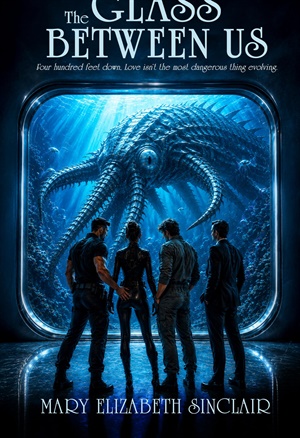
The Glass Between Us
Chapter 1
Chapter One
MAREN
Kevin is four minutes and thirteen seconds off pattern.
It isn’t a deviation worth logging in the official incident system, which has a drop-down menu for “large fauna behavioral anomaly” and no drop-down menu for “your favorite apex predator is being a dick about geometry.”
Still.
I watch him cross the north basin feed with both hands wrapped around my coffee.
The cameras never capture the reef the way it exists.
They flatten it into green-black movement and particulate drift, softening the scale.
The Hadal Luxe paid a criminal amount of money for a viewing system that can show a guest the ridges on a trilobite’s thorax from sixty meters away, but Kevin always defeats the lens.
He’s too much animal for a rectangle.
On screen, he slips between two columns of reconstructed sponge reef, his body long and jointed and absurdly elegant.
His lateral fins move in coordinated waves.
Each stroke is old design made new muscle.
The kind of efficiency that makes my teeth ache if I let myself look at it as anything but data.
I don’t let myself.
Length: 10.8 meters by last clean scan, possibly 11.1 if he’s grown again and the sonar scatter wasn’t an artifact.
Estimated mass: north of eight metric tons.
Speed: 2.3 meters per second, slowing to 1.6 near the sonic boundary.
Caloric expenditure for this patrol route: increased by twelve percent if the loop continues through the eastern shelf.
Distance from submersible bay: not relevant.
I take a sip of coffee. It tastes like I insulted a vending machine and it decided to seek revenge through chemistry.
Kevin turns before the eastern shelf.
I lean forward.
Behind me, the research wing is quiet. My lab hums to itself.
Filtration data scrolls on the secondary display.
A half-erased equation from last Thursday ghosts across the whiteboard behind me.
Someone’s written CHECK SPONGE COLONY BETA in block letters and underlined it twice.
Beneath it, in Dutch’s handwriting, KEVIN REMAINS A PROBLEMATIC ROOMMATE.
I haven’t erased it. It’s survived two full whiteboard purges and one equation I actually needed.
Kevin drifts toward the perimeter again.
The sonic barrier pulses on schedule. I can’t hear it from here, but the system marks the event with a green line across the tracking feed.
Low frequency. Harmless. Unpleasant enough to deter continued approach.
Calibrated against eleven years of behavioral modeling, seventeen peer-reviewed papers, and one hearing in Singapore where a man with a yacht watch asked me whether a Cambrian apex predator could “develop a taste for billionaires.”
I told him there was no evidence Kevin had a preference for class-based predation.
The room laughed.
I didn’t add that Kevin had never been given the opportunity.
On the monitor, he reaches the invisible edge of the world I built for him.
He stops. Doesn’t retreat. No signs he’s startled or confused.
Just stops.
The grasping appendages at the front of his head open slightly, flexing into the water with a delicacy that would disgust half the guests and make the other half reach for their phones.
His compound eyes catch a glimmer from the basin lights.
Thousands of lenses, each holding a different version of the facility’s glow.
He’s looking past the wall.
“Kevin,” I say softly, because the lab’s empty and I’ve apparently reached the stage of my career where I address bus-sized prehistoric murder invertebrates by the name chosen by an ex-Marine with a trilobite habit.
Kevin hangs there for eleven seconds. Then he turns and glides away.
I sit back.
Eleven seconds at boundary. Previous average: 3.2. Last week: 5.8. Yesterday: 7.4.
I should flag it.
At least mark it as a yellow observation, which isn’t an incident, not a warning, not a flare fired into the clean corporate sky. Just a small note. A bureaucratic cough.
I open the raw tracking log and add a private annotation.
A1 boundary hesitation increased. Observe.
Annoyingly vague, but only because the data’s still annoyingly vague.
Kevin disappears behind a shelf of calcified sponge and fronding algae engineered from fossil morphology.
I finish the coffee because I’m a scientist and accustomed to suffering for insufficient reward.
The lab lights brighten automatically at five.
Slowly. The Hadal Luxe does nothing all at once unless there’s a waiver involved.
The ceiling strips warm, revealing benches, sample trays, two unopened protein bars, a stack of reports I’ve been aggressively not reading, and the cot in the corner with yesterday’s sweater folded on it in a way that suggests a woman who doesn’t sleep here.
I absolutely sleep here. Enough nights that the cot’s learned my spine.
I check the basin dashboard one more time. Kevin’s tracker resumes a recognizable loop along the western trench, returning to a pattern close enough to predicted that my body relaxes.
Good.
Good enough.
There’s a difference.
I take my tablet from the charging dock, slide into my shoes without untying them, and leave the research wing before the silence starts asking for rent.
The Hadal Luxe wakes like something expensive pretending not to be mechanical.
First comes the shift in air temperature. Then the scent system engages. Salt, rain, green leaves. Not too much ocean. The actual ocean smells like rot and metal and living things processing other living things. The guest version smells like a spa with a marine biology minor.
I approved the blend. I regret nothing except the word “immersive” in the brochure copy.
By the time I reach the atrium, the facility’s decided to become gorgeous. The central spine rises three levels in curved steel and pressure glass, the living wall spilling green down one side.
I press my fingertips to the glass as I pass. A bad habit. Unsanitary. Sentimental. Mine. The glass gives nothing back but cold.
The bar is dark at this hour, its bottles arranged in backlit rows of amber and green. I catch sight of the day’s featured drink on the chalkboard.
THE KEVIN
BOLD. COMPLEX. SURPRISINGLY AGGRESSIVE.
I stare at it. “Absolutely not,” I say.
“No?” Lina peeks around a spray of white orchids. “I thought you liked that one.”
“I tolerate that one because I respect the democratic process and the bar staff scare me.”
“They scare everyone.”
“They should. They put squid ink in mezcal and called it The Soft Tissue Problem.”
“That sold out.”
“Of course it did. Wealthy people love ingesting a concept.”
Lina laughs, which is satisfying because she’s been here since four and deserves workplace enrichment.
She taps something into her console. “New rotation descends at ten. Two honeymoon couples, one senator’s son and entourage, the Ellery party, and the documentary people who aren’t documentary people because you said no to documentary people. ”
“They’re philanthropic science patrons.”
“They brought three cameras.”
“They can philanthropically keep them in their luggage.”
The atrium lights catch in her eyes when she smiles. Behind her, through the glass, a school of small armored swimmers darts past the reef wall in synchronized panic, then settles again. My attention shifts.
Lina notices. “What was that?”
“Feeding response. The auto-dispensers trigger along the lower shelf at five-fifteen.”
“It’s five-oh-seven.”
I look at the display on the wall. It is five-oh-seven. “Huh,” I say.
“Huh?”
“Tiny huh. Decorative huh. Not operational huh.”
She studies me for one extra second. Front desk staff know people. Better than scientists, mostly, because we’re too busy pretending human behavior isn’t also an ecosystem. Then her headset chirps, and she returns to the safer world of suite readiness and dietary preferences.
I continue across the atrium, tablet against my ribs. The petting tank isn’t visible from here, but I glance down that corridor anyway.
No Dutch. Not surprising. He appears where needed, says something flat, and vanishes before anyone can ask if he named another arthropod.
He thinks I don’t know about Pebble, Tank, Lady Susan, and the small scarred trilobite he calls Lieutenant Dan.
I’ve never once corrected the belief, because watching a man built like a pressure door pretend he doesn’t have favorites is the best free entertainment in the facility, and I’m hoarding it.
I cross into the lower atrium and take the stairs down instead of the lift. The stairs curve beside the main pressure glass, close enough that the reef fills my peripheral vision.
Halfway down, I stop.
Wonder should be easier to manage when you’ve seen the invoices.
But there it is. The basin spread beyond the glass, the old shapes moving in a world I wrote first in equations, then in grant proposals, then in systems and tanks and arguments and sleepless years.
Every living thing out there began as a refusal.
No, it can’t be done. No, the behavioral models are too speculative. No, the legal exposure is obscene. No, the public won’t understand the distinction between dinosaur and Paleozoic fauna, and yes, apparently that matters to branding.
No, Dr. Vale, you’re thinking too large.
I’d been twenty-seven the first time a man said that to me in a boardroom. I remember his cuff links more clearly than his name. Little gold anchors. I wonder if he appreciated the poetry of telling me to stay small while wearing tiny decorative restraints.
I keep walking.
I make it three more steps before my tablet pings.
Maintenance summary. From Reyes, sent at 03:12. Of course. Reyes works hours that imply either dedication, vampirism, or a private war with sleep. I open the note as I walk.
North access conduit vibration increased 0.7 percent from weekly baseline. Not urgent. Recalibrated sensor 4B. Recommend review of EM boundary draw on east grid before guest submersible tours.
Kevin’s eleven seconds at boundary sit up in my mind like an animal that heard its name.
I read the message again.
Not urgent, he wrote. But he sent it at 03:12.
I type Good catch. I’ll review before the tours and send it before I can start second-guessing the number of vowels.
The operations hub is already active when I arrive, its basin-facing glass washed in engineered dawn.
Three technicians at the central table, two aquarists reviewing feed distribution, one hospitality manager quietly panicking over the senator’s son requesting a more authentic suite, which I hope means darker lighting and not blood sacrifice.
“Morning,” I say.
Faces lift. Bodies straighten.
“Dr. Vale,” says Imran from life support. “Dissolved oxygen stable across all public zones. Slight turbidity increase in lower west basin.”
“Pull samples after first distribution.”
He nods and makes the note.
“Guest subs?” I ask.
“Three and four polished, pressure checked, and staged. Two has a cosmetic scratch on the interior panel. Engineering cleared it. We’re swapping it with one of the maintenance vessels for the morning tour.”
“Good. Make it look intentional. Guest rotation at ten. I want submersible tours delayed until I review east grid draw and Reyes stops pretending not to be awake.”
No one reacts. Reyes pretending not to be awake is part of the facility’s operating rhythm.
“Petting tank?”
“Normal chemistry,” says Nia, one of the aquarists. “Behavior looked a little clustered on the five a.m. glance, but I haven’t done full notes.”
My attention sharpens. “How clustered?”
She considers. “Just tucked near the far wall. Could be light change. Could be pressure microshift after cleaning.”
I make a note to check the petting tank myself, then immediately make another note not to overreact to petting tank trilobites arranging themselves in a way that offends my personal sense of normal distribution. Animals cluster. Systems fluctuate. The reef is living, not obedient.
My tablet pings again. Board packet uploaded.
I consider throwing it into the nearest decorative fern. Instead, I open it, because maturity is mostly choosing the least satisfying option in front of witnesses.
The oversight board’s seal appears first: polished, blue, governmental in the way money gets when it wants a badge. Today’s evaluation has been on the schedule for six months. Routine review, they called it.
I scroll past the agenda.
Opening remarks. Safety walkthrough. Containment review. Guest experience audit. Submersible operations. Research wing inspection. Closing discussion.
Evaluator: Dr. Holden Armitage.
The hub noise recedes. The room stays itself. Consoles beep. Staff talk. Water moves through pipes. Someone asks whether the senator’s son is allergic to shellfish or just conceptually opposed. The reef glows beyond the glass, ancient and busy and mine.
I read the name again.
Dr. Holden Armitage.
The letters don’t rearrange into someone else.
My first thought is absurdly practical: He hates confined submersibles.
My second is worse: He’ll love the reef.
Then there’s nothing.
A clean, white gap where my mind should have supplied numbers, objections, jokes, oxygen percentages, anything useful. My thumb goes still on the tablet screen. The facility hum passes through the floor into my bones, familiar as pulse, but for one suspended second I can’t match it to any system.
Holden.
Of course he has a doctorate now. Of course he’s being sent by the board. Of course the universe has decided to lower my ex into my life inside a luxury submersible.
“Maren?” Nia asks.
I look up.
Three people are watching me.
“Yes,” I say. My voice sounds exactly like mine.
“Evaluator?” Imran asks.
“Yes.”
“Problem?”
I look down at the name. Holden, who once told me my mind made the room brighter. Holden, who stopped standing in the light when it was no longer flattering. Holden, whose leaving had been so quiet I almost missed the moment it became permanent.
I tap the tablet dark. “No,” I say. “Routine.”
Beyond the glass, something large moves through the reef where nothing large should be moving yet. Just a shadow at the edge of the basin lights. A suggestion of fins, plates, appendages, old hunger sliding through engineered dawn.
The tracking screen in the lab will know what it is. The system will label it. The system labels everything eventually.
I stand in the center of the facility I built, surrounded by steel and glass and living time, and for the first time all morning, I don’t calculate a single thing.