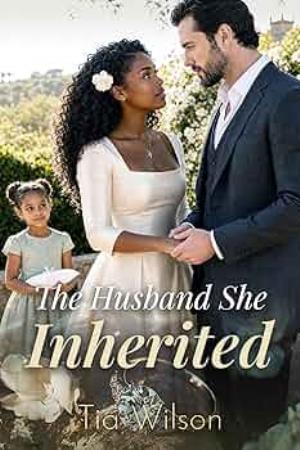
The Husband She Inherited (Forever, Ever After #3)
Chapter 1
The Houston summer pressed against the window screen, thick and slow and smelling faintly of pavement and magnolias from the courtyard three floors down.
Aurora Akande sat cross-legged on her studio floor in her Third Ward apartment; a half-empty mug of coffee gone cold beside her left knee, a fine-tipped brush balanced between two fingers, and her phone face-down on the floorboards because she always worked better when the world wasn't allowed in.
The illustration in front of her was almost finished.
A little Black girl with two thick puffs of natural hair stood on the back of a paper crane, sailing across a sky the color of grape soda.
It was the climactic spread of the fourth book in a series that had earned Aurora a name in publishing, and just enough money to keep her in her own apartment with no roommate and no second job.
She had been working on this single page for six days.
The wing on the left still wasn't right.
She pushed her own curls back from her face with the back of her wrist, careful not to smudge the wet paint.
Her hair was twisted up in a loose pile on the crown of her head, a tortoiseshell claw clip barely able to hold the volume of it.
Spirals coiled at her temples where she had given up trying to keep them contained.
She was thirty-three years old, slim with a runner's build from the four-mile loop she ran around MacGregor Park every morning.
She had the kind of brown skin her mother had always called gold pulled out of warm earth.
She wore an oversized denim shirt with the sleeves rolled to the elbow, paint on the cuffs and a small dried smudge of cerulean on her cheek she did not know about.
She added a single white highlight to the underside of the crane's wing and let out a slow breath.
Her phone buzzed against the wood.
She glanced at it without picking it up. The screen lit with a name that almost never appeared there.
Maeve's Mom.
Aurora's stomach turned over before her brain had time to make sense of it. Mrs. Whitlow did not call her. Birthday cards, sometimes. A Christmas text Aurora suspected was sent en masse to every contact in the woman's phone.
But never a call.
She set the brush down and picked up the phone.
“Mrs. Whitlow?”
“Aurora.” The woman's voice was wrong. Shredded. Wet. “Aurora, are you sitting down?”
The brush rolled off the page and onto the floorboards. Aurora did not pick it up.
“Tell me,” she said. She did not recognize her own voice.
“There's been an accident. A plane. In Italy. Aurora, it was Maeve and Cyrus. They were over Lake Como when something happened to the engine. They're saying it was the engine. Aurora, they're gone. They're both gone.”
The world did not collapse. The world did something worse. It stayed exactly where it was. The cicadas in the courtyard kept screaming. The fan in the corner kept turning. The little girl on the paper crane kept sailing across her grape-soda sky.
Only Aurora went somewhere else, a place several feet behind her own body, watching herself sit on a paint-spattered drop cloth and listen to a woman she barely knew tell her that her best friend was dead.
Maeve was dead.
Maeve Larkin, who at thirteen had climbed onto Errol Akande's workbench in the backyard, planted both small hands on her hips, and announced to the entire neighborhood that she had decided she was now Aurora's second sister and the matter was no longer up for discussion.
Maeve, who had cried harder at Aurora's high school graduation than Aurora's actual mother.
Maeve, who had flown to New York for Aurora's first New York gallery show early in her career and stood in front of every watercolor for so long the gallery owner had asked if she wanted to buy one.
Maeve, who at her own wedding had whispered into Aurora's ear, Listen, if anything ever happens to us, you take her. You hear me? You take my baby and you raise her, and don't argue with me about it, I already had the lawyers write it down.
Aurora had laughed at her then. They had been twenty-five years old and full of champagne and immortal.
“Aurora?” Mrs. Whitlow said. “Are you still there?”
“Imari.” Aurora's voice came out flat as river stone. “Where is Imari?”
“She was at the house in Pinewood Hollow with the sitter, thank God.
She wasn't on the plane. But Cyrus's parents got the call before any of us did and they drove straight down to the coast. They've already taken charge of her.
Aurora, she's asking for her mother. She doesn't understand. She just keeps asking when her mother is coming back.”
“I'm coming,” Aurora said. “Tell her Aunt Rory is coming. Tell her right now.”
“I will.”
“Tell her now, Mrs. Whitlow.”
“I will. I will tell her.”
Aurora hung up. She did not remember deciding to hang up.
She sat staring at the fan for what felt like an hour. It might have been thirty seconds. The grape-soda sky on the floor in front of her had developed a small dark blot where the brush had landed.
Maeve had bought her that brush as a graduation gift. Sable hair. A hundred and eighty dollars. Don't you dare use the cheap stuff anymore, A. You're a real artist now.
Her hand shook so hard she could barely scroll to her father's name. She pressed the green button.
“Hey, baby girl.” Errol's voice came through low and warm, tobacco-rough at the edges. He always answered the phone like she had just walked through the front door. “Your mother's about to put the chicken on. You want me to set you a plate? She's making the gravy you like.”
“Daddy.” She could not get the rest out.
The line went still. Her father had a stillness in him she had only ever heard one other person achieve, and that person was Halston Iverson the morning he had broken her heart.
“Tell me,” Errol said.
“Daddy, it's Maeve. She's gone. Maeve and Cyrus. A plane. They, Daddy, they're gone.”
She heard a soft, terrible sound. Her father, who had built houses with his hands for thirty-five years and never once in her life raised his voice at her, made a noise like a man who had been kicked in the chest.
“Oh, no,” he whispered. “Oh, no, no, no, baby. Oh, sweetheart.”
“I have to go to Imari. I have to get her. I have to get to Pinewood Hollow.”
“Listen to me.” He had pulled himself together already, but she could hear that his voice was wet.
“Listen, baby. You are not driving anywhere tonight.
You're going to put that brush down and you're going to sit on your couch, and your mother and I are coming over right now. I am driving you out there at first light. You hear me?”
“Daddy, I can drive.”
“Aurora Yetunde Akande. You are not driving an hour out to that coast in the dark in the state you are in, and I am not telling you twice. Sit down, we're coming.”
He must have already gone into the kitchen, because she heard the slide of the back door. Her father's voice said Ayanna, honey, sit down, you need to sit down, in the careful, terrible voice he reserved for catastrophes. Then her mother came on, alarmed and sharp.
“Aurora? Aurora, what is it?”
“Mama.”
The dam broke. She said her best friend's name out loud, and the entire room turned the color of nothing. Her mother on the other end of the line was already crying, already saying oh my baby, oh my poor baby, oh that sweet child Imari, oh Aurora, oh Lord. Aurora cried into the phone.
*****
Six thousand miles away, in a top-floor suite at the H?tel des Bergues, Halston Iverson was standing at a window that overlooked the Rh?ne.
He had been awake since four because the company's banking partners in Zurich kept European hours, and his quarterly review was at seven.
His circle beard was freshly shaped, shirt was pressed, cufflinks were silver and plain.
His black hair was combed back from his forehead the same way he had worn it since he was nineteen.
He was thirty-four years old, five eleven, lean and pale from spending more time in boardrooms than under the Texas sun and had gray-blue eyes.
He was the CEO of Iverson Aerospace and Defense, a company his late father had built into the third-largest private defense contractor in the United States, and which Halston, in the five years since he had inherited it at twenty-nine, had taken from comfortably wealthy to obscenely so.
Forbes had put his net worth at $4.2 billion the previous spring.
He had not bothered to read the article.
The hotel suite was very quiet. He had ordered coffee at five and had not touched it. A single Patek Philippe sat on the dresser, ticking gently. The river outside was the color of slate.
His phone rang. Mason Whitcroft. The family attorney.
Halston accepted the call without looking at it. “Whitcroft. It's ten past five in the morning here. This had better be…”
“Halston. Son, I need you to sit down.”
Halston had been called son by Mason exactly four times in his life. The first had been the day his mother died. The second, the day his father had cosigned for his first house. The third, the day his father had died.
He did not need to be told this was the fourth.
He did not sit down.
“Who is it,” he said.
“It's Maeve and Cyrus. There was a plane crash over Lake Como. I just got off the phone with the Italian authorities and with Geraldine Larkin. Halston, there were no survivors. I am so sorry, son. I know what how much they meant to you.”
The river outside did not stop moving. The Patek did not stop ticking. The grew colder.
Halston, who had not cried in front of another human being since he was sixteen years old at his mother's funeral, did not cry now. His face did not change at all. He nodded once, even though no one could see him.
“Imari,” he said.
“She wasn't on the plane. She was at the bayfront house in Pinewood Hollow with the sitter when it happened. Geraldine and her husband drove down from Houston before anyone could stop them. She's safe, but she's with them at the Larkin place now.”
“Geraldine has her.”
“Yes.”
Halston's free hand closed on the windowsill. The marble was cold. “Get her out.”
“Halston—”
“Get her out of that woman's house tonight. Tonight, Mason. I do not care what it costs or who you have to wake up. The sitter takes her back to her own house and stays with her until I get there. I will be there by tomorrow night.”
“I'll handle it.”
“Don't handle it, Mason. Do it. I want her out of Geraldine Larkin's hands before sunrise tomorrow, Houston time. Are we clear?”
“We're clear. Halston. Are you all right?”
“I have to go,” Halston said. “Cancel everything in Switzerland. Have the plane ready at Cointrin in two hours. Call Rhett at the office and tell him he is acting CEO until I tell him otherwise. And Mason. The will.”
“It's in my safe in Houston. I'll need both parties present for the reading.”
“Both parties.”
There was the slightest pause on the line. Mason had been the Iverson family attorney for thirty-one years, and there was very little he did not know about Halston's life.
“Aurora Akande is the other party,” he said.
Halston did not say anything.
“Halston?”
“I heard you.”
He hung up. He set the phone very gently on the dresser beside the watch.
Then he picked up the crystal tumbler he had not used the night before.
He closed his fist around it and squeezed until something gave.
Glass bit into his palm. Blood welled up between his knuckles and pooled in the lifeline of his hand, then dripped, two slow drops, onto the cream carpet of a Geneva hotel suite that cost eight thousand francs a night.
He stood at the window like that for a long time, watching the river. He did not move until the bleeding slowed.
Then he washed his hand in the sink, wrapped it in a hand towel from the bathroom, and called the front desk to send up a maid for the carpet.
She was alive, somewhere on the other side of the world. She was alive and Maeve was not. In approximately twenty hours, he was going to walk into a hospital corridor in Pinewood Hollow, Texas, and see her face for the first time in fifteen years.
He was not ready.
He would never be ready.
He picked up the phone again and started making the calls.
*****
By the time the small turboprop from Houston Hobby touched down at the airstrip near Pinewood Hollow Medical Center the next morning, the sun over Galveston Bay was the color of a peeled blood orange.
Three miles up the coast road, Errol was helping his daughter out of the passenger seat of his old Ford truck.
They walked through the sliding doors of the small coastal hospital at exactly the moment a black SUV with tinted windows pulled into the visitor lot on the opposite side of the building.
A tall man in an expensive black suit with a bandaged right hand stepped out onto the asphalt, without a single member of the press knowing he had come.
Inside, on the pediatric wing, an eight-year-old girl with her mother's hazel eyes and her father's brown skin sat on a hospital bed in a too-large hoodie someone had given her, hugging a pink stuffed Squishmallow, asking the kind nurse at her side, for the fourteenth time, when somebody was going to come and tell her where her mother was.
She was about to get her answer.
She just did not know it yet.