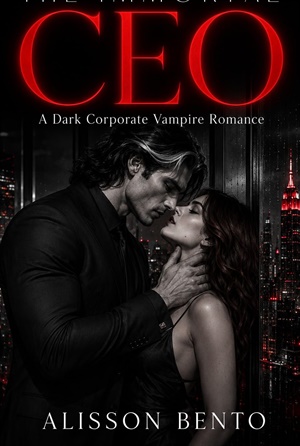
The Immortal CEO (Bound by Blood #11)
CHAPTER 1
Eliza
◆
I sit up. The brick wall of the bedroom is still cold from the night.
I walk barefoot across the bleached oak floor to the galley kitchen.
The kettle. The coffee press. Black coffee, two raw sugars, the way I have taken it since I was twenty-one and decided adulthood was a series of small chosen rituals defended against the chaos.
The bowl on the counter was my mother's.
The brass mechanical pencil is on the writing desk under the window where I left it last night.
Half a millimeter point, gunmetal cap, the leather memo cover beneath it monogrammed EQ in gold lettering rubbed pale by my thumb.
She gave it to me in the kitchen of a hospital five years ago.
She handed it to me with both hands, the way you would hand someone a relic, and she said, You are going to write the world down with this, Eliza, and the world is going to do what you write.
She was already sick. She did not yet know. I clip it now to the leather cover by feel and bring the cover with me back to the bed.
The three Vance Rail Group quarterlies are queued on my phone. I read them with the coffee balanced on my sternum. Q1, Q2, Q3. The third pass is when the variance begins to grin.
Four hundred and twelve refrigerated rail cars in service.
Two-point-one billion in annual revenue.
Eighteen hundred and forty employees. The variance grins from the gap between the reported logistics cost per revenue ton-mile and the computed fleet utilization.
Two-point-two percent baseline over Q1 to Q3, rolling out to seven-point-four percent on the six-month trail, which on the revenue ton-mile baseline produces a number on the order of a hundred and fifty million dollars unaccounted.
The number is the kind of number that, in our line of work, is what we technically call a screaming red flag.
I drink the coffee. I do not yet trust the number.
The trust is what tomorrow is for.
---
The 7:18 commuter rail into downtown Helmsmouth is half empty in November.
I take a window seat on the harbor side because the harbor side is where the bronze fountain at Foundry Square comes into view as the train banks past the granite cut at the edge of the bluff.
The granite is wet from the sleet that fell overnight.
The salt wind comes through the seal of the window in a thin cold thread that smells of harbor and iron.
The fountain is a bronze installation cast in 1924, four winged lions arranged around a globe, wings cocked back as if they are about to throw themselves at the sky.
The water in November is left on. It is left on through January, through the cold snap the weather service has been warning all week is coming.
In this weather the rim ices over, half an inch of cobalt-glass blue at the wing-edges where the spray catches at the wrong angle, and the bronze under it gone almost black with the cold.
The rim is most beautiful at two in the morning, when the city lights are at their lowest and the cobalt picks up only the moon and the small green of the financial-district running lights.
I have walked past the fountain at two in the morning four times in five years.
The cold of it goes into the teeth and stays.
I open the leather memo cover on my lap.
Brass pencil cap. On. Off. On. Off. The variance grins.
Where does a hundred and fifty million dollars of unaccounted logistics cost go on a rail company with five-decade contracts and a public balance sheet?
It goes somewhere. The somewhere is what they will pay me to find.
The train banks. The fountain comes into view. I close the memo cover.
---
Wren-Hale Forensic Group occupies the fourth floor of an awkward Beaux-Arts building at 200 Fitzroy Street.
The awkward Beaux-Arts building is, by an arrangement I am about to find ironic, the same building that houses Vance Rail Group's corporate offices on the third floor.
The board pitches me on a Vance Rail audit two stories above the company being audited. The architecture is a kind of joke.
Marcus Hale is at the corner office. Silver hair, pale blue eyes, the lined skin of a man who has spent forty years smiling at people he does not believe. He stands when I come in.
"Eliza. Coffee."
"Already had it."
"You always have. " He gestures to the chair. "Sit. Talk to me about your year."
I do not sit. The pitch goes faster on my feet.
"I read your last three quarterlies on the train this morning. You have a hundred-fifty-million-dollar gap between your reported logistics cost and your actual fleet utilization, and either I find it or your board hands you to the SEC by Q3. Hire me."
The smile does not change for two beats. Then the smile changes. Marcus has known me since I was twenty-four and he taught my second-year evidence-law seminar; he has known me long enough to know that I do not lead with a number unless the number is the thing.
"Sit down, Eliza."
I sit.
"The variance is real?"
"The variance is real."
"You have not seen the routing data."
"I have seen the public filings. I will need the routing data."
"Who else has seen this gap?"
"Nobody, on the off chance you would like to pay me to keep it that way until we know whose gap it is."
Marcus exhales through his teeth. He pulls a folder from a stack on his left, slides it across the desk to me. The first page is an engagement letter pre-prepared with my name at the top, draft date today, signature line blank.
"Vance asked for you by name."
I do not let my face register. I read the letter. Sixty-day engagement, full forensic scope, expert-witness preservation clause, an unusual sub-clause permitting after-hours access to floor 28.
"Vance asked for me by name."
"Mr. Julian Vance, chairman and chief executive officer, requested the best forensic auditor in the city. I told him you were the best forensic auditor in the city. He did not negotiate. He asked when you could be on-site."
The muscle at the corner of my jaw wants to flex. I do not let it. I sign with my own pen, a Cross rollerball that has been in my bag since law school, not the brass pencil — the brass pencil is the body's instrument, not the firm's.
"Tomorrow," I say. "On-site at seven."
"He'll have someone meet you in the lobby."
"Who else have you put on this?"
"A junior. Pippa Lockhart. She's good, she's fast, she swears at her keyboard. You'll like her."
"And on Vance's side?"
"They're staffing a financial governor and a forensic shadow-pair. The shadow-pair is a man named Atticus Wren. Not from us. From outside. The CFO is Adrienne Roux. She is, by reputation, the most exact set of accounting hands on the Eastern seaboard."
"Reputation according to whom?"
"According to the people who would know. Eliza. " He stops. "I am told this engagement is sensitive. The chairman would prefer that we begin and conclude inside thirty days."
"The chairman is not the auditor."
"No."
"The thirty days will be what they will be."
"Of course. Pippa is in the bullpen. Go meet her. The kickoff is at two in the Vance Rail boardroom downstairs."
I walk out. Brass pencil cap. On. Off.
The bullpen is in the southeast corner. Pippa Lockhart looks up at me from over the rim of a takeout coffee cup the size of a flowerpot.
Red-blonde curls escaping their clip in three places, pale green eyes, very pale skin freckled across the nose like a constellation a child has drawn. Mismatched socks. She stands.
"You're Quinn."
"I'm Quinn."
"So like, the variance is doing a thing. " She gestures vaguely at her two monitors. The monitors are open to a Bloomberg terminal and a spreadsheet I cannot read from here. "It is being a thing? It is, in fact, being a hundred and fifty million dollars of thing?"
"It is being a hundred and fifty-point-four million dollars of thing."
"Cool, cool, cool. " She drops back into her chair. "I'm going to need more coffee for this."
"Tomorrow at seven. Vance Tower. Floor twenty-eight."
"Cool. " She is already typing. "Cool."
I like her immediately. She has not yet noticed that her left sock is on the right foot.
---
Noon is the coffee cart at Foundry Square.
The cart has been at the southeast corner of the plaza since 1984, which is to say it is older than I am. The cartman is older than the cart. He nods at me now. He does not need to ask.
"Black?"
"Two raw sugars."
"Cold today."
"Cold."
He hands me the cup. I pay him in coins. I walk five steps east and stand at the rim of the fountain.
The four winged lions cocked back from the globe.
The bronze almost black with the cold. The water still running.
The cobalt-glass ice at the wing-edges, paler at noon than it will be at two in the morning when I cannot sleep tonight; I see the night-version through the noon-version, the way the body sees the dead through the living.
The cold of the cup leaches through the cardboard sleeve into my palm.
I think about my mother. She died on a Tuesday in March of 2021 of post-surgical sepsis at New England Methodist. The wound that follows her is not the death; the wound is the ledger.
The intravenous antibiotic she was supposed to have received was not on the record.
A billing-code automation had misrouted the antibiotic order to a line item paid by a service she never received.
The hospital paid the wrongful-death settlement at one-point-eight million dollars.
The settlement paid for my JD at Columbia. I have not touched it. The money sits at First Helmsmouth Trust in account 8842-119-A, accruing the kind of small institutional interest that nobody but an auditor would notice.
I do not touch it because if I touch it she dies a second time.
I read ledgers because I read my mother's chart like a story and the story told me what the chart was hiding.