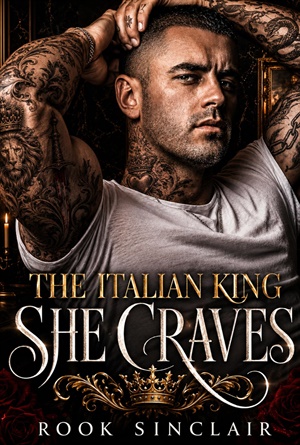
The Italian King She Craves
Prologue
Aurelio
The crown is a length of gold filigree no wider than my mother's wedding band, and they have to bend it to fit my head because the last man who wore it had a skull built for a man twice my age.
I am eighteen years old, and my father is dead in a box six feet from where I'm standing, and the priest is saying words in a Greek so old it isn't really Greek anymore, it's just a sound the mountain has been making since before there was an Italy to put a border around it.
Padre Eustachio is younger then, not yet stooped, and his hands shake anyway when he lifts the crown, because everyone in the sanctuary knows what they're watching.
They are watching a boy become a king with his father's blood still drying under his fingernails, because I'm the one who carried him down from the ridge myself, because I wouldn't let anyone else touch him.
Polsi smells the way it always smells in September — wet stone, candle tallow, the green crush of chestnut leaves underfoot, and beneath all of it, so faint you'd miss it if you hadn't grown up breathing it,
the copper smell of every man who has ever bled on this mountain for the right to stand where I'm standing.
The Madonna watches from her gold frame above the altar, her painted eyes too kind for what's happening in front of her.
I have looked at that icon my whole life and never once wondered what it actually costs to be the kind of family that gets to keep a thing like that.
I am about to start wondering.
"Aurelio Bruzzano." Padre Eustachio's voice carries to the back of the nave, to the men standing shoulder to shoulder in their dark suits, the heads of every 'ndrina in Aspromonte come to watch the changing of a throne they all, in their own private ways, resent and require.
"Do you accept the crown of your house, and with it, the weight of every promise made by those who held it before you?"
I should say yes the way my father would have said yes — like it cost him nothing, like the word was a door he'd been standing in front of his whole life, waiting for someone to finally open it.
Instead I look past the priest, past the altar, to my grandmother standing in the front row in unrelieved black, her spine straighter than any of the armed men flanking her, and I understand — not in words yet,
just in the cold drop of my stomach — that she is the only person in this church who isn't grieving.
She is waiting. She has been waiting for this exact morning for longer than I've been alive, and the understanding of that sits in me like a stone swallowed whole, undigested, something I will carry for eleven years before I learn what it actually weighs.
"I accept," I say.
The crown goes on my head. It is too big after all, despite the bending, and it sits crooked until Costanzo — sixteen, already more my brother than my cousin,
already the only person in the building who looks more frightened for me than impressed by me — reaches up without anyone giving him permission and sets it straight.
The men in the nave do not clap. They never clap.
They lower their heads, all of them at once, like wheat going down in wind, and that is how I learn what power actually sounds like.
It sounds like silence agreeing with you.
Afterward, in the sacristy, while the rest of them eat and drink and tell each other stories about my father designed to make a thirty-four-year-old murder look like an old man's peaceful passing, my grandmother finds me alone.
"There is a ledger," she says, no greeting, no condolence, nothing but the thing she came to say. "In your father's study. Black cover, no markings. You will burn it tonight, before you sleep, and you will never ask me what was in it."
"Why would I burn something without reading it first?"
Adelina Bruzzano has never in my memory raised her voice, and she doesn't now.
She takes my face in both hands, the way she did when I was small and feverish and she was the only one who could get me to swallow medicine, and she looks at me with an expression I will spend eleven years trying to name and will not manage to name correctly until the night I find the ledger has
not, in fact, been burned at all.
"Because some crowns are heavier than the men who wear them," she says, "and your father carried that weight so you wouldn't have to. Honor that. Burn the book."
I am eighteen. My father is dead. I have just been crowned king of a mountain I do not yet understand I will spend the rest of my life either ruling or being ruled by, depending on how well I learn to lie to myself.
I go to his study that night. I find the ledger — black cover, no markings, exactly where she said it would be, locked in the bottom drawer with a key I have to break the lock to use, because no one ever gave me the key, because no one was ever supposed to give me the key.
I sit with it unopened in my lap for eleven minutes.
I remember counting them on the desk clock, watching the hand move, telling myself each minute that I would open it on the next one.
I do not open it.
I do not burn it either.
I put it back in the drawer, and I do not break the lock again for eleven years, and in all that time I tell myself this was discipline, was loyalty, was a king learning when to leave a door closed.
It was cowardice. I understand that now. I understand a great many things now that I did not understand the night they put a crown too big for my head and told me silence was the sound of respect.
I was eighteen years old, and I had just inherited a throne, a mountain, and a lie so old it had calcified into history — and I would not learn its true shape until a woman with steady hands and a restorer's patience walked into my house holding the one object that had always known the truth,
and had simply been waiting, the way my grandmother waited, for someone willing to finally look at it directly.