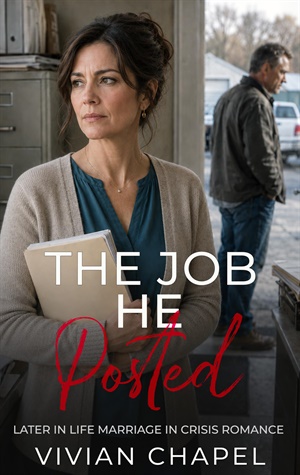
The Job He Posted (Marriage In Crisis #28)
Chapter 1
FERN
The number came out right, the way it always did once I'd had my hands on it.
The coffee maker ticked behind me, cooling.
I'd made a pot at four and forgotten it — I forget most things that are only for me — and the mug at my elbow had gone cold at the bottom.
I drank it anyway. Eleven crews to pay by Friday, the Delgado permit the county had kicked back twice, a stack of lien waivers waiting on two signatures I could've forged better than the men they belonged to.
I didn't. I just knew I could, and some nights that felt like the same thing.
This was the room. Sowder Roofing. Gray metal desk, gray metal chair, and the filing cabinet I'd labeled myself twenty-two years ago with a marker gone brown at the edges.
PAYABLES on the top drawer, in my hand. RECEIVABLES under it.
The one below that said DON'T, and I was the only person alive who knew it held every deal Gil had ever closed on a handshake with no paper behind it.
Somebody had to keep the record of those, and it was always going to be me.
My phone lit up. Weber Dental — Priya, the girl at their front desk. Fern are you still doing our September close? Dr. Weber wants to know if we're okay on the equipment lease before he signs.
You're fine, I typed with one thumb. Lease amortizes clean, I built the schedule. Tell him not to sign the maintenance rider, it's junk. I'll call the rep Monday.
You're a lifesaver, she sent back. Genuinely.
The Webers paid me nine hundred a month.
Statler Feed paid me eleven, because Ron Statler's books always came to me looking like something had nested in them, and I charged for the nest. Two thousand a month, cash, earned at this same desk after I finished the work I did here for free.
I never lined those two facts up next to each other.
If you'd asked, I'd have said I was lucky — a woman my age, fifty-three, with a skill that traveled, in a county where not much did.
I finished Danny's line and moved down to Marcus, then to the two new hires whose W-4s I'd had to chase down myself, because Gil hired men the way he did everything: hand out, heart open, no form anywhere in sight.
The truck pulled in at six. I heard the diesel first, then his boots on the gravel, then the door with the stuck bottom corner I'd been asking him to plane for three summers. He put his shoulder into it out of long habit and it gave.
"Furnace in here," Gil said.
"Furnace out there too."
"Out there I get paid for it." He set a paper sack on the corner of the desk, clear of the keyboard, because he knew what grease did to a keyboard and he knew where I kept mine.
Two tacos from the place past the lumberyard, the good one, the one he went eight minutes out of his way for because I liked the green sauce.
He'd been remembering the green sauce for twenty-four years.
"Delgado permit came back," I said.
"Wanting what?"
"Revised site plan. The surveyor's stamp expired, so the county won't take his drawing." I peeled the taco open. "I already called Renny. He'll re-stamp for a hundred fifty. Comes out of the Delgado contingency — we don't eat it."
Gil sat on the edge of the desk, which he wasn't supposed to do, and the metal complained.
He'd gone a little soft through the middle, gray coming into his temples like frost creeping up a windshield, and he looked at me the way he looked at a roof that had held through a bad storm — satisfied, a little amazed.
"What would I do," he said, around his own taco.
"Pay Renny three hundred and never know why."
He laughed, low and easy, and it filled the ugly little room the way it always had.
I loved him right then, at that desk, cold coffee and green sauce on my thumb, running the numbers that kept the lights on for eleven families and ours.
We were building something together, and it had my fingerprints all over it, because it did.
"Mago says Kessler's got rot in the decking," Gil said. "Whole north face. We didn't bid it."
"Then we do a change order. I'll draft it tonight, you get Kessler's signature before anybody touches another shingle." I wiped my thumb. "Don't let Mago start the tear-off first. You know how he is — he'll be sweet about it and cost us four thousand dollars."
"We'll square it up." Which is what he always said, and what it always meant was that he'd do it his way and I'd make the paper catch up behind him. Twenty-two years of catching up.
We ate. He told me about the new kid, Tyler, who'd nearly stepped off a ridge because nobody'd taught him to trust a harness, and how Gil had walked him back down with a hand on the boy's belt, talking about the Cardinals until the kid's legs came back under him.
That was Gil. Eleven crews of men who'd take a bullet for him, every one of them, because at least once he'd climbed up and gotten them off the ledge himself.
There was no org chart. There was Gil, and the men, and me, and the paper I made so all of them could exist inside the law and get paid on Friday.
Without me it was a guy with a ladder. With me it was a company.
I knew that the way you know your own hands, and I never said it out loud, because why would I. It was ours.
That word did a lot of quiet work. Ours meant I didn't need my name on anything. Ours meant the money landing on his side of the account was as much mine as any paycheck would've been. That Thursday, with green sauce on my thumb, it was the truest word I owned.
He balled up his taco paper and hooked it into the wastebasket by the door — the one I emptied. "You almost done?"
"Payroll Friday. I want to close Statler's quarter tonight, Ron's got something coming up." I nodded at the second laptop, mine, the one that held the clients who actually paid me. "Go home. Shower. You smell like the Kessler job. I'll be an hour."
He kissed the top of my head. His mouth was warm and he tasted like green sauce too. "Don't stay past dark. Bugs get in with that window."
"I know about the window, Gil. I've known about the window since Clinton."
He grinned, shouldered the door, and left. The diesel coughed and pulled out, and the office went quiet the particular way it only did when it was down to me and the fan and the numbers. I liked it. It was the one room in the world that did exactly what I told it to.
I opened Statler's file. Ron had let three months of deposits go uncoded, and I sorted them the way you sort laundry, by feel and by long knowing — feed, feed, feed, that's the Amish account, that's the co-op, that one's wrong, that one's a duplicate the bank ran twice.
In ninety minutes I clawed back four hundred dollars Ron would never have found on his own, and I felt the small clean click of it.
The thing I was good at. The thing that had a price everywhere I carried it but here.
The phone buzzed at eight-forty. The window had gone the last blue it goes before the bugs come. Bess.
My daughter. Twenty-four, three states off, doing something with a nonprofit I couldn't fully explain but was proud of anyway. She texted the way her whole generation did, in bursts, no capitals, a link and then a reaction to the link before you could get it open.
mom.
Then, before I could answer:
mom??
Then the link. A hiring site — blue banner, little bookmark icon.
isn't this literally you
I set the coffee down. The mug met the metal softer than I meant it to. I tapped the link, and the fan turned its face away from me and came back.
The page loaded slow, the way everything loaded slow in that room, the header coming up first in bold black, a font I didn't recognize because I hadn't been the one to choose it.
Office Manager — Sowder Roofing.