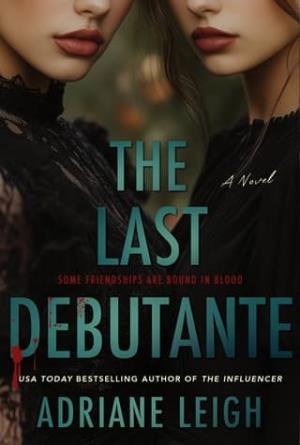
The Last Debutante (The Black Widows #1)
Chapter 1
Chapter One
“Ithink my husband is having an affair.”
My best friend, Whitney, slides into our usual table at La Madeleine—a French café in Tigertail Beach Village tucked between designer boutiques and art galleries.
It’s all curated charm and soft lighting, meant to feel like a slice of Paris dropped into Marco Island.
For us, it’s also the backdrop to all of our juiciest secrets and revelations.
“Bloody Mary, please.”
Shock hums through me. “Come again?”
“Here—take this, just in case anything happens to me.” She drops a stack of black journals onto the white tablecloth between us.
“Anything like what?” I pick one up, flipping through it. Every page is filled with Whitney’s tight, looping handwriting.
“You know… death, divorce, an accident that leaves me comatose. The usual.” The waiter sets her drink down. She smiles, takes a long sip, then adds, “I found something.”
Whitney finding something isn’t unusual. Skeptical doesn’t even begin to cover it. After everything she’s been through, who wouldn’t be?
“What did you find this time?”
She sighs, fingers brushing the pearls at her throat before she catches herself and laces her hands together instead.
“My credit card expired, so I logged into our phone account to update it. That’s when I saw it—hundreds of messages between his number and another one.
At first, I didn’t think anything of it, but they go back months. So I did some digging.”
“This isn’t going to end well,” I say.
“It never does.” She gives a soft, humorless laugh. “Anyway, I found out everything about her. Chrissy Thatcher. Pensacola. I even found her LinkedIn.” She rolls her ocean-blue eyes. “Can you believe how easy it is to know everything about someone you’ve never met?”
I don’t answer.
“Twenty-two. Barista. Probably making twelve bucks an hour while my husband wines and dines her at the best restaurants in Naples.” Her voice wavers—just slightly—but I see it.
The crack in the facade. Her brows pull tight, her teeth pressing into her lower lip.
“It’s been going on for months. The further back I scroll, the worse it gets. ”
“Did you save it? For evidence?”
“Evidence?” The word trembles.
“For a divorce.”
She shakes her head.
My instinct is to reach across the table, take her hand, offer comfort.
But Whitney and I aren’t built like that.
We don’t do soft. We don’t do fragile. We met in college because we both existed just outside the polished illusion our families insisted on maintaining.
We’re outspoken, abrasive, maybe even cynical—but always funny. Laughter is how we survive things.
Whitney and I aren’t comforting.
We’re dangerous.
We buy houses next to each other in Tigertail Beach Estates. Stand beside each other at our weddings. Our husbands call us the Dangerous Duo, half-joking, half-not.
When we’re together, something always happens.
“God, can you imagine what Veronica would say if I told her Phillip and I were getting divorced?” Whitney says. “She’d write me out of the will before I finished the sentence.”
Her mother.
We’ve always done this—first names instead of titles.
It makes sense for me. I’m adopted. But Whitney is born and bred royalty around here.
Her mother sits on the board of every major charity from Naples to Palm Beach, and her father…
well, no one really knows what he does, but he brings in enough money that no one asks.
“You don’t need her money,” I say with a shrug.
“Well, I’d still like to avoid pissing her off if I can.
” Whitney swirls her Bloody Mary. The pickle spear sinks deeper into the red.
“Divorce isn’t lucrative—that’s what she’d say.
You know my parents’ only priority is protecting their bank account.
A divorced daughter brings shame on the whole family. ”
“Veronica could use a little humility.”
“That’s true. Maybe I’ll tell her I’m leaving Phillip for another woman. See if I can make her stroke out.”
We both laugh.
It’s always been like this between us—easy, effortless.
Finding Whitney in a place like this, where people care more about their yachts than their families, feels like a gift.
A blonde, blue-eyed socialite who doesn’t quite fit the mold.
Neither of us does. We may have grown up with silver spoons, but ours were tarnished from the start.
When I arrived at Miami University as a freshman, I didn’t know anyone. But I learned quickly how to sound like I belong somewhere I don’t. By the end of my first semester, I still didn’t have a group—but I had Whitney.
And that’s enough.
I’m used to being an outsider. Being the token Native girl adopted into one of Collier County’s wealthiest families is both a blessing and a curse. I can’t imagine what my life would have been like if Jon and Kathy Williams hadn’t taken me in.
I’ve never met my mother—a white woman with addiction issues my father dated one summer before she got pregnant. They tried to stay together for me, but she left when I was a year old, dropping me on the reservation with him.
He did his best.
It wasn’t enough.
By the time I was two, he put me into foster care. A twenty-year-old man can’t raise a child when he can barely support himself. The tribe didn’t like that I was sent off to outsiders, but there wasn’t another option.
I think about it sometimes—what my life would have looked like if I’d stayed. Tradition. Culture. Poverty.
When I was twelve, my adoptive parents took me back once. They donated to the new Seminole school, watched me learn beadwork and pottery, clap along to dances I didn’t know the rhythm to.
We didn’t go back again.
Not because they didn’t want to.
Because I didn’t.
I don’t remember my life there before I was adopted. And when I met my father’s family at twelve, they were kind enough—but even I can tell we didn’t fit. I never fit.
Too white for the reservation.
Too Native for Collier County.
Dropped into the middle of the reservation after ten years as a country club kid, I felt like a fraud in both directions. I expected the teepee jokes from the rich kids at school. I was prepared for that kind of ignorance.
I was not prepared for the quiet judgment from my own blood.
That’s what lingers.
That, and the name—McCullough. Strange on my tongue, a legacy I don’t quite know how to carry.
“So what’s your plan?” I ask.
“I don’t have one,” Whitney says. “Other than finishing this Bloody Mary before I have to go home and look at Phillip’s face.”
We laugh again. I like that we can still do that—even now.
“At least you don’t have kids,” I say. “Can you imagine doing this as a single parent?”
“If we had kids, I already would be,” she says. “He works enough as it is. He’d disappear completely and leave me with them.” She takes another sip, then sets the glass down. “There’s something else.”
“Oh?”
“He increased the coverage on my life insurance policy.”
“What?” I nearly choke on my drink.
She shrugs. “I’m sure it’s nothing. He increased his own too. Maybe he’s compensating for inflation.” A weak joke.
“Maybe,” I say. “Or maybe…”
My eyes flick up to hers.
“Stop.” She holds up a hand, laughing—but not really. “I’m sure I’m just being paranoid.”
I glance down at the journals between us.
“Right,” I say, flipping a page. “Paranoid.”
I look back at her.
“With good reason.”
Whitney meets my gaze. Something settles between us—quiet, immediate, understood.
We don’t say it.
We don’t have to.
We’re thinking about the same thing.
The last time death came looking for us.