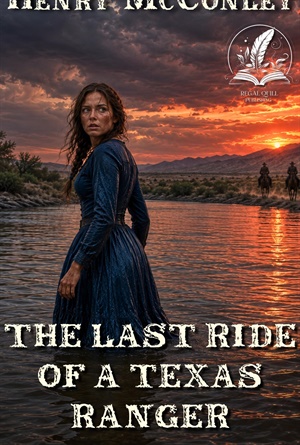
The Last Ride of a Texas Ranger (Brave Hearts of the Frontier #10)
Chapter 1
The wind came off the ridge in long, steady pulls and flattened the grass on the slope below them.
Emmett Vaughn had his hat pressed to the ground beside his right elbow and he studied the two men at the fire through eyes that had been doing this kind of work since before the younger man next to him had learned to shave.
The Towns brothers were down there eating. One of them had his boots off. The other sat with his back against a scrub oak and worked his supper around his mouth without much enthusiasm.
“Wind’s running about fourteen miles,” Emmett said. “Maybe fifteen.”
Samson Jennings had his cheek pressed to the stock of the Winchester. He didn’t answer.
“You’ll want to pull about four inches left of where you’re thinking,” Emmett said. “Maybe five.”
“I know how wind works.”
“Four to five. You use your judgment.”
Samson said nothing.
The wind pushed through again. Emmett felt it on the back of his neck and watched it move the tops of the brush below.
There wasn’t much cover between the ridge and the camp, just scrub and rock and a long, dry channel where water ran in spring and sat baked and cracked the rest of the year.
The brothers had set up in a wide flat spot past the channel, good ground for horses, and their string was picketed back behind the house.
Eleven horses. The Rangers had counted them on the way in. Only two belonged to the brothers.
A hanging offense, horse stealing. People got very particular about their horses out here. A man on foot in this country was a man in a slow emergency, and everyone knew it, and everyone took the theft of a horse as a kind of attempted murder at a distance.
The men who’d put up the bounty on the Towns boys hadn’t specified the condition of delivery. In Emmett’s experience that was a choice, not an oversight.
He looked at the brother with the sock. The man had put it back on and was now pulling his boot on, working his heel down into it with short, frustrated shoves. He’d be standing up directly.
“You need to go ahead and fire,” Emmett said.
“I’m waiting for them to settle.”
“The one on the left is about to stand up.”
“Then I’ll take the one on the right first.”
Emmett considered that. “Alright. Fire when you’re ready.”
The crack of the rifle split the night open. Emmett watched the shot kick up a puff of dirt six inches to the right of the seated man, who launched himself sideways off the log he’d been sitting on and scrambled on all fours toward the far side of the house.
The brother with the boot had gotten it on at the worst possible moment and was now up and running, no idea which direction to run in, darting toward the horse string and then cutting back toward the house, yelling something that didn’t carry up the ridge clean.
“Hell,” Samson said.
Emmett already had his hand out. Samson passed him the rifle without being asked twice.
The running brother made it around the corner of the house. Emmett tracked him, held his breath, and put the shot through the corner boards just as the man came around the far side thinking he was clear. He dropped and didn’t move.
Emmett worked the lever without hurrying and picked up the second brother, who had come up from behind the water trough with something in his hand, couldn’t tell what from here, and was looking at his brother on the ground with his mouth open.
Emmett shot him and he sat down against the trough and then tipped over sideways.
The horses were pulling at the picket line, bunched and nervous. Down at the camp the fire kept burning like it didn’t have an opinion about any of it.
Emmett got to his feet and set the rifle against his shoulder and started down the slope, hat in hand.
Samson came up beside him, moving fast to match his pace.
“I had the wind figured,” Samson said.
“You were six inches off. And your trigger pull dragged left. You do that when you’re nervous.”
“I wasn’t nervous.”
“Your trigger finger was.”
They came down off the rock and onto the flat ground, dry grass crunching underfoot. The horses had settled some but the nearest one watched them come with its ears laid back. Emmett gave it room.
“I’m sorry,” Samson said.
“Both of them are dead. That’s the job.” He paused and looked at Samson. The younger man’s jaw was set and he was staring at the ground ahead of him. “You’ve got good instincts. You read the camp right. You picked the correct target to take first. You’ll get the rest of it sorted.”
“That’s not a compliment.”
“It wasn’t meant to be one. But it’s the truth, and the truth’s more useful.”
They crossed to the camp. Emmett crouched next to the man by the trough, checked him, then walked around the house to the one at the corner. He checked him, too. He stood up and looked around the place. A single-room house, badly built, with gaps in the boards and the roof pitched wrong.
He went inside. There wasn’t much. A cot with a wool blanket, a small table with a deck of cards fanned out on it like someone had been playing solitaire, a saddlebag hung on a nail by the door.
He went through the saddlebag. Some paper currency, a “wanted” circular with someone else’s name on it, a folding knife, and a woman’s locket that he set on the table. He’d turn that in separately and see if anyone could trace it back.
“Help me get them loaded,” Emmett said.
They brought two horses around from the string and got the brothers draped and tied across the saddles, which neither horse appreciated. Samson had to work to get his animal calmed down enough to take the weight.
The horse sidestepped and blew and Samson talked to it low until it quit moving. When it was done they stood in the firelight and Emmett looked at the remaining nine horses on the picket line.
“We’ll string them behind. Return them on the way back through.” He walked the line, checking the animals by the firelight. Most were in decent shape. The brothers hadn’t mistreated them, which was more than he could say for some. “We’ll take them to Aldecoa. He’ll sort out the claims.”
They got the lead ropes sorted and Emmett put out the fire with the pan of burnt supper. He stood and looked at the camp one more time. Just a circle of dark ash now and the smell of smoke and the sound of horses blowing.
They rode north, the spare horses moving tolerably well behind them once they got clear of the camp. The sky was open and black and thick with stars. No moon yet.
“Are you really going to leave?” Samson asked.
“Nash wants me out. He’s been wanting it for a while.”
“Nash is the mayor. You’re a Ranger. He doesn’t have jurisdiction over what you do.”
“He has jurisdiction over the things that make my life easier. The things that make Irine’s life easier.
” Emmett moved his horse forward at a walk, the string following behind with some reluctance.
“A man like Nash, he’ll work the edges of what he can actually do.
Take things away a little bit at a time. It’s how they operate.”
“And you’re just going to let him.”
“I’ve been a Ranger going on twenty-eight years. My knees hurt every morning until about ten o’clock. My left eye isn’t what it was.”
“Your left eye’s fine.”
“My left eye is adequate. Adequate and fine are two different things, and in this job they’re a long way apart.”
They rode. The land around them was silent except for the horses and the wind moving through the grass. Out to the east a coyote started up and then quit after two calls, like it had thought better of the conversation.
“Dry fire that rifle every night before you sleep,” Emmett said. “Fifty pulls at a minimum. You’ll feel where it’s going wrong.”
“And the wind?”
“The wind you already know. You just let yourself think about it too long.” He shifted in the saddle and looked out ahead of them.
“First calculation’s usually right. You start second-guessing yourself in the middle of a shot, the shot goes bad.
Make a decision. If it’s wrong, make another one. Don’t sit in between them.”
The lights of a ranch came up a long way out to the west. Emmett tracked them briefly and then looked away. Old man Trevino, running sheep now where he used to run cattle. People adapted. That was the thing about this country. The ones who made it adapted.
They dropped into a shallow valley and the wind cut off and the horses relaxed behind them, the hoofbeats going quieter on the softer ground. The two dead brothers rocked gently on their saddles.
In the morning, someone in Colinas Rojas would verify who they were and the bounty would get processed and Emmett would ride on to the next thing. There was always a next thing. Had been for twenty-eight years.
Emmett didn’t know what to do with that. So he rode.
***
The red hills came up about four miles out from town and the trail cut through them the way water would, following the low ground between the clay formations that gave Colinas Rojas its name.
In daylight, the hills ran the color of old brick, deep and mineral, and at dawn or dusk they went almost purple.
At this hour, with the stars still out and the sky beginning to gray at the eastern edge, they were the color of dried blood. Emmett had ridden through them more times than he could reckon and he’d stopped noticing them years ago, the way you stop noticing the furniture in your own house.
Samson pulled his string of horses to a stop where the trail forked.
“I’ll take them on up to Briggs,” he said. “Get the bodies logged and the bounty processed.”
“Make sure he checks the date on those papers. Last time there was a dispute about when the warrant was issued.” Emmett adjusted the lead rope in his hand and passed it to Samson. “And the horses go to Aldecoa’s livery, not Briggs’s. Every time without exception.”
Samson looked at him.
“Briggs skims the board fees. He knows I know, and that’s the arrangement we have. Don’t complicate it by going to him.”
Samson took the rope. He looked tired, which was appropriate. “You heading home?”
“That’s where I’m headed.”
“Give my regards to Mrs. Vaughn.”