The Lion and the Deathless Dark (Crowns of Nyaxia #5)
Prologue
The night that she became a divine hero, the girl was covered in blood. Some of it was hers. Most of it was not.
The goddess had already left. Her world had already changed.
Now, she kneeled on the ground, holding a blessed sword.
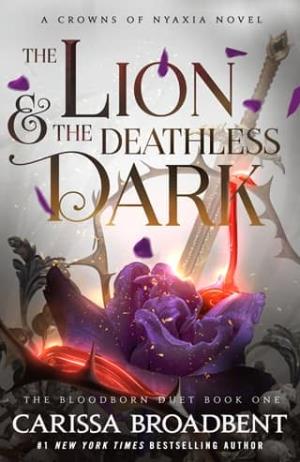
It was magnificent—the Blade of Retribution, once held by the Goddess of Justice herself, and the weapon lived up to her name in every way.
She was crafted of pure gold, the strength of her light so bright it almost hurt against a world that was now so ceaselessly dark.
And yet, the girl could not tear her eyes away, no matter how much it ached to witness.
The girl was just seventeen years old. The world was freshly dark. It had been only weeks since the sun had fallen and the vampires invaded. She did not yet know how much darker it could get.
{We must leave, and quickly,} the blade told her. Her voice was soothing, sliding into the girl’s mind like a caress over skin. It was less disorienting than the girl might have expected. {The fallen ones will come soon. They will smell you.}
The girl dimly recognized this as fact. There was so much blood, and blood had become so very dangerous. She had been in such terrible pain only minutes ago, but now, it had ebbed, nearly disappeared. As if the blade in her hands had washed it away like an incoming tide.
Still, the girl did not rise. Her vision was blurry. She blinked, and two tears fell like dying blossoms onto the sword’s engraved blade, pooling in ancient scripture.
{There is no need to cry, child,} the blade said. Her voice was so tender. It was how the girl imagined a mother might sound.
“What do we do next?” the girl asked. The question was hoarse and small. She had never felt more mortal.
{You shall wield me. And together, we shall enforce justice, as our goddess commands us.}
The girl looked at the scene around her, the silent aftermath of grotesque violence. None of it seemed like justice.
She wrapped her arms around herself, cradling her stomach.
“I’m nobody,” she said. “I don’t even know how to wield a sword.”
{I shall teach you.} A note of wry, warm amusement. {But it seems to me, Kyrene, that you already did wield me, and wield me well.}
The girl looked at all the blood—on her, surrounding her. Perhaps this was true.
“I can’t walk,” she said. “I’m—I—”
Words failed her. The girl did not know how to describe the nature of her injuries.
{I know,} the blade said softly. {But you can walk. You shall be healed. That is, you understand, the nature of my vow to you.}
The girl watched the golden light shuddering up the blade’s beautiful form.
“Vow?” she repeated.
{You are now my bearer, Kyrene. And thus, I vow that I shall provide you my divine strength; that you may use me to enforce what is Just in this world. Death shall not touch you while you are my wielder, until the day I offer it to you by my blade.}
The girl was silent. Then she began to laugh. The sound was unpracticed and pained, spurting up from inside her like blood from a freshly torn wound. Another tear plunked into the sword’s carvings.
{What is so funny?} the sword asked.
The girl gestured to the macabre scene that surrounded them. “This is justice?”
And the blade was utterly serious as she replied, {Yes, child. It is.}
The girl did not believe her, but she did not argue.
{Now come,} the blade said. {This night will be behind us soon, and there will never be a need to return to it. Wipe your tears.}
But the girl could not stop them. They just came and came, rolling down her cheeks with every blink.
“I’m not sad,” she said, suddenly self-conscious. “I’m angry.”
The blade glowed gently. The girl felt it in her heart. Light, in freshly eternal darkness. Warmth, in an endless cold night.
{I know,} the blade said. {Leave the tears. Bring the anger. Only one is useful to you now.}
The girl nodded. She rubbed her tears with a dirty sleeve, leaving more smears of red on her cheeks. She did not know if the blood belonged to her or not, but in this moment, she realized it didn’t matter. The blood would always spill, and perhaps it was irrelevant to whom it belonged.
She staggered to her feet. The blade had been right; she was stronger, now. The pain drained away. The weapon had to have weighed nearly as much as she did, but she hardly struggled to pick it up.
She heeded the blade’s words. She began walking and did not look back, not even once, as she left that night behind her. Her tears remained there in the bloody dirt, but she would carry the rage with her for the rest of her life.
She was no longer a faceless child. She was a divine warrior.
It would be more than ten years before she would at last allow herself to think deeply about this night. She would think of it and tell herself: I should have died that night.
And she would be right.
But of course, fate is never so simple.