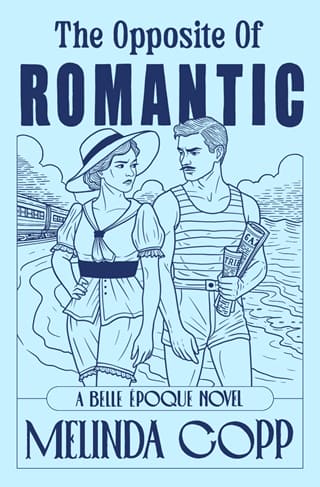
The Opposite of Romantic (Belle Époque #3)
Chapter One
They say Paris is a romantic city, but I wouldn’t have noticed.
I was determined to make something of myself.
Not a wife. Not a mistress. But a professional, serious woman.
A respected journalist. That’s all I thought about.
Work. Getting better at it. Achieving more as a result.
I must have been born this way. Even as a child, I was always keeping a journal filled with notes and observations.
A record of days passed in our house. Commentaries.
Stories I’d heard at school or from friends.
Gossip. Then, not long after I arrived at the Saint Genevieve Maison des Filles Immaculeés, I unearthed that dusty printing machine from the storage room.
A tabletop hand press; fully functional, it turned out, and capable of printing ten lines of text on a quarter of a sheet of letter paper.
Someone had donated it to the orphanage, and even though I was supposed to be cleaning the store room as punishment for slapping one of the other girls, Sister Clothilde said I was welcome to the machine.
Perhaps that was when my fate was sealed.
I was founding editor and lead reporter of the orphanage’s premier news pamphlet in less than a week.
Most of the other girls were more interested in mending and baking, but they enjoyed reading my publication.
When I left years later, Sister Clothilde said I could take the printing press with me.
But I declined; it could spark something in another girl someday.
Sister Clothilde, working some connection or other within the world of Catholicism, secured me a job in the administrative pool at L'Entreprise newspaper.
My career in the booming field of French journalism had been on an upward trajectory ever since.
Romance—especially the kind that involved men—was the furthest thing from my mind.
The day everything changed began like any other.
I was living at a women’s pension on Rue de Fortuny owned by a stern but fair widow named Madame Tremblay.
After waking at six, some reading in bed and my morning toilette, I ate a breakfast of berries and baguette with my housemates and Madame, and then headed out for work.
My blue bicycle—my transportation, my freedom—stood waiting in the little yard behind the house like a trusty steed, only better because I didn’t have to clean up after it.
Granted, horses, I’m told, have personalities that make them fun.
I was more of a cat person. But that bicycle, purchased with my first paycheck, was my most cherished possession.
I tucked my skirt in the elaborate way necessary to ride, took off pedaling, and felt, for those few minutes it took to get to the newspaper, like I could do anything. Anything!
The offices of L’Entreprise resided in an old bank building on Boulevard Haussman.
It had an imposing facade and dominant half pillars, like an institution.
There was a sense of mission and duty, particularly in the departments that covered the government and financial news.
Our culture and lifestyle section took great pride in our rigorous critique and wise commentary.
I rode past the front entrance, down the side street, and parked my bike next to the delivery bay, concerned only with the story I’d been working through in my head all morning.
I entered the building through the staff entrance in the back, greeting the doorman as I passed.
My heels clicked with each step across the polished lobby floor, past the stately reception desk, and up the curved green marble staircase to the newsroom.
The outer edges of the vast upstairs were lined with offices, and the center of the room, where I and the other reporters and assistants worked, was the pen—not the kind that’s mightier than the sword, but the kind where animals are kept.
Most of us preferred to think of our collective efforts as the former. I, for one, behaved that way.
My career was my life raft out of the precarity that had characterized most of my twenty-four years.
Losing both parents made me acutely aware of the need to be my own stability; career was a huge part of that.
Security, but also respect. I was on a mission to prove myself with my compelling words and stellar reporting. I wanted to be taken seriously.
I nodded and greeted my coworkers as I passed them, smiling with pride.
I had been here four years already. I spent six months as an assistant to the culture editor, but after proving my worth as a writer, he agreed to let me work as a reporter.
The only woman reporter at the paper. I wasn’t just making my way to the desk I’d use to type my story, I was taking my place within the institution.
I removed my jacket, hung it from the back of my chair, and sat down to work.
I had been pulling together the threads of a trend piece on summer theater and planned to spend a few hours drafting up everything I had.
The typewriter in front of me sat quiet on the scuffed wooden desk.
I breathed in deep. The louvered windows along the top of the exterior walls had been tilted open to keep the warm, summer air moving through the massive room.
The faint, sour aroma of the city and the commotion of carriage traffic on the street below carried with it.
I removed a stack of pocket notebooks from my black leather work bag.
I untied the grosgrain ribbon I’d fastened them with that morning, and spread them out of the desk in a satisfying row.
Five little notebooks, bound in thread and covered with kraft cardstock, all filled with my careful notes.
I delighted in the tactile pleasure of my work for a quick moment before restacking the notebooks into a neat pile save for one, which I opened to the first page and propped open with the stapler.
Then I settled my hands over the typewriter keys and began.
But before I could finish my first sentence, the doors to the large conference room on the other side of the pen opened and all the important newspaper people—the editors and managers and board members—emerged.
The way they blustered out of the room, clearly this wasn’t an ordinary meeting.
Red faces and glistening, creased brows.
In general, I had little use for men’s bluster.
I tried to continue working, but the flutter of discontent spread through the newsroom.
The murmured stirrings of drama moved from desk to desk.
Someone gasped. What had they been meeting about?
My editor, Monsieur Olivier Paquin, his face drawn and grave, came stalking out of the conference room and crossed the pen, heading for his office.
He wouldn’t meet my eye, not even as he passed right by my desk.
Without slowing his determined pace, he opened the door to his office, stepped through it, and closed it tight behind him.
Then a bang came from behind Paquin’s door.
Followed shortly by a shattering crash that immediately brought to mind the gorgeous blue glass vase that sat on his bookshelf.
His assistant, Marie, always made sure it was filled with flowers.
Daffodils in spring and evergreen branches in winter.
Just yesterday she’d come in with a lush bundle of white irises.
If Paquin had broken that vase, those flowers would be scattered all over the floor.
Poor Marie would probably have to clean them up.
Then the managing editor—Monsieur Lapin, my boss’s boss—called for attention from the far side of the pen. I turned in my swivel chair. A few of the other reporters got up and moved closer. Monsieur Lapin cleared his throat and swept the crowd with his gaze.
“There’s no easy way to say it.” As he spoke, his brow furrowed. Whatever news he had to deliver was clearly troubling him. “The paper has been purchased by L'Etoile . Effective immediately, we are merging L’Entreprise and L'Etoile into one publication.”
Swears erupted, followed by utterances about them eating us alive and the ridiculousness of the notion.
“Their newsroom is smaller than ours, and so they’re moving in with us. They’ve got movers starting today on the other office.” Lapin shrugged, the words as baffling to him as they were to us. “But the full transition will likely take weeks to sort out.”
Several of my coworkers shouted questions. What did this mean for our paper? What about our jobs? Lapin repeated several times that he knew little, only having just learned himself. There would be more information to come, but changes were imminent.
Paquin considered L'Etoile our direct competitor, and so I read it every day. It was one of those papers that some rich financier started to serve as a mouthpiece for touting his own interests. But it had grown from that into something credible enough. They had admirable writers. Unfortunately, they also had a culture and lifestyle section made up of my professional foes. They were the ones I’d been implored day after day to beat, to scoop, to outsell.
There was no way I could work with those people. Never.
“They have a sports reporter,” the sports and leisure writer said, echoing my thoughts.
“Yes. A real star,” Lapin said without malice or appreciation. “They have a managing editor too. They already have a full staff.”
“So everyone’s on the chopping block is what you’re saying?” Someone shouted from the other side of the pen.
Lapin raised his hands in surrender. “This isn’t the best of news for any of us. But yes. I’m not exactly sure what will happen. The plan is to combine the two publications so that the paper will be bigger. We will have a bigger readership. But perhaps not big enough that everyone keeps his job.”