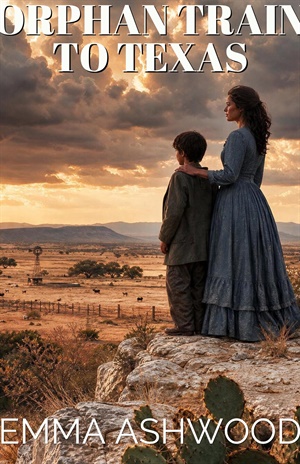
The Orphan Train to Texas (Orphan Trains Out West #5)
Chapter 1
The paper tag was pinned to her coat with a bent brass pin, and Samantha Bree had been told not to touch it.
The train had been slowing for some time.
Iowa slid past the window, brown and flat, endless under a wide October sky.
There were fields with the corn cut down to stubble.
There were fences that ran on farther than she could follow with her eyes.
Once there was a red barn with a dog beside it. Then nothing again for miles.
She was eight years old, and she was scrubbed.
That was what she knew about herself this morning.
The lady from the Society had scrubbed her face until it stung.
She had wetted her dark hair flat and buttoned her into a coat that had belonged to some other child first. It smelled of camphor.
Her own dress was underneath it, with her own two thin legs, her own two boots that pinched.
None of that was hers, not really. The coat was the Society’s. The boots had come out of a barrel. Even the scrubbing had been done to her, not by her.
One thing was hers.
Bree. Her name. Nobody on the whole long journey west had taken it from her, though they had taken most else. She had said it to the lady on the first day, clearly, the way she had been taught to say it. Bree, with the two e’s. And the lady had written it down without asking whether it was true.
Samantha said it now, under her breath, against the cold glass. Bree. It was little enough to own. But she had learned already that a small thing held tight was worth more than a large one let go.
“Faces to the front,” the Society lady said. “Hands in your laps. Sit up, all of you.”
Along the car, children straightened. There were eleven of them left.
There had been thirty when they started.
At every stop, the lady read names from her book.
Children climbed down onto a platform, and the train went on without them.
Samantha had watched it happen so many times that she had stopped wondering where they went.
They went into wagons. That was all she knew.
They went into wagons, and the wagons went away.
Nobody had read Bree yet.
The whistle blew, long and hoarse. Beyond the glass, a water tower came up, then a grain elevator, then a platform of gray boards with people standing on it. Farmers, mostly. Men in heavy coats, women in bonnets. All of them looked at the train as if it were a wagon of goods come to market.
Samantha’s stomach turned over. She folded her hands the way she had been told. She kept her eyes on the seat back, and she waited.
The platform was colder than the car had been.
They were lined up along the boards, oldest to youngest, and Samantha was near the middle.
Wind came across the flat land with nothing to stop it.
It got under the borrowed coat and found her through the dress.
Somewhere a horse stamped and blew. The Society lady stood at the end of the row with her book open, saying what she always said.
Good Christian homes. Schooling. Treated as one of the family.
Samantha had heard it in four towns now.
The words came out the same whether the people listening were kind or not.
The farmers walked the row.
That was how it was done. They walked along slowly, looking.
Sometimes they stopped. Sometimes they did not.
A woman in a blue bonnet stopped before a little yellow-haired girl of five and knelt down to her.
A big man with a red beard stopped before the tallest boy and asked him a question.
The boy nodded. The man laughed. Two of the children were gone before Samantha had finished counting the buttons on her coat.
Then a shadow fell across her boots.
She looked up. A man and a woman stood there. The man was tall and lean, with a long jaw, his hat pulled low. The woman beside him was nearly as tall, with a hard, plain face. Her eyes were the color of a slate roof. Neither one smiled. Neither one knelt down.
“How old?” the woman said. She said it over Samantha’s head, to the Society lady.
“Eight, ma’am. Samantha. A good, quiet girl.”
“Small for eight.”
“They grow, ma’am, with feeding.”
The woman’s mouth pressed thin, as if feeding were a matter she had opinions about. Then, without a word to Samantha, she reached down and took hold of the child’s arm through the coat sleeve.
Samantha stood very still. The woman’s fingers were strong. They pressed along the arm from shoulder to wrist the way a person presses a loaf to see if it is done. Then the woman took the other arm and did the same. She turned Samantha’s hands over and looked at the palms. She looked at her teeth.
“Strong enough,” the woman said at last, and let go. “She’ll earn her keep.”
The man had said nothing. He looked down at Samantha now with no more interest than he might have given a fence post. Then he looked away up the platform, where the wind worried at a torn bill on the depot wall.
“That one, then,” the woman said to the Society lady, and turned toward the table where the papers were signed.
The Society lady wrote in her book. She said the name West. The man grunted, and a pen scratched. Samantha stood where she had been left, the cold on her face, the marks of the woman’s fingers still warm on her arms. She understood that she had been chosen.
Not the way the yellow-haired girl had been chosen. Nobody had knelt down. Nobody had asked her name.
She had been chosen the way a person chooses a hoe.
The wagon was a farm wagon, high-sided, with straw in the bed and a smell of pigs.
Mr. West drove. Mrs. West sat beside him on the board, straight as a post, and neither of them looked back.
Samantha rode in the bed among the straw with her small bundle on her knees.
The Society lady had said goodbye and God bless in the same voice she used for the rest. Then the wagon had rolled.
The platform had gone, and the town had gone after it.
For a long time there was only road.
The land ran flat and brown to the edge of the sky.
Here and there a farmhouse stood up out of it, small, far off, a windmill turning beside it.
Crows walked in the stubble. The wheels found every rut.
Samantha held the sideboard with one hand and her bundle with the other.
She watched the ruts unroll behind them, trying to remember which way the depot lay.
North, she thought. Then the road bent, and she was no longer sure.
Nobody spoke to her. Once Mrs. West said a word to her husband about the price of a hog, and once he said a word back about rain.
That was all. The straw pricked through Samantha’s stockings.
The wind came over the sideboards. She thought about asking how far it was.
Then she thought about the woman’s fingers on her arm, and did not.
The West farm came up out of the flat land at the end of the afternoon.
There was a house, gray and square, with a porch that sagged at one end.
There was a barn much bigger than the house, a corncrib, and a low glasshouse with half its panes gone milky.
A dog came out from under the porch and barked once, then thought better of it.
Chickens scattered. Somewhere behind the barn a cow was complaining.
Mr. West drew up in the yard, climbed down, and went off toward the barn without a word.
Mrs. West got down more slowly. She stood at the tailboard and looked at Samantha in the straw.
“Down,” she said.
Samantha climbed down.
“Bundle in the house. There’s a loft over the kitchen. You’ll sleep there.” Mrs. West was already walking toward the porch. She spoke without turning. “Supper’s at dark. There’s kindling wants splitting before then, and the hens want shutting in. The ax is by the block. You’ll find it.”
Samantha stood in the yard with the wind pulling at the borrowed coat, and understood that this was how it was going to be.
She found the ax.
When dark came, she found the loft, too.
It was a plank floor under the roof slope, with a straw tick on it and one blanket.
There was a square of window no bigger than a Bible.
There was room to stand up in the middle of it and nowhere else.
It was warmer than the barn would have been.
She told herself that, lying under the one blanket with the roof an arm’s length above her face. It was warmer than the barn.
Supper had been at the corner of the table.
Not at the table. At the corner of it, on a stool, where the leaf did not quite reach. Mr. and Mrs. West had eaten at the head and the foot, in silence. Their grown son, Nathan, sat at his father’s right hand. He looked at her once, as if she were a new tool, and did not look again.
Samantha had been given a plate with less on it than theirs, and told to eat what she was given. She had eaten it. She had washed the plates after, standing on a box to reach the basin. Mrs. West sat by the stove and watched her do it, saying nothing.
She was up before light the next morning, because Mrs. West’s voice came up through the loft boards telling her to be. She was up before light the morning after that, and the one after that, until she no longer needed the voice.
That was how the days went. Fire lit, water drawn, hens fed, cow milked when her hands grew strong enough.
Wash on Mondays, the flatirons on Tuesdays, and the endless floors between.
There was schooling in the winter, because the Society required it and Mrs. West did not care to have a Society man come poking.
But it was three months of it and no more.
Samantha walked the two miles there and back, with the milking at both ends of the walk.
She learned that she was not the daughter of the house. She had never truly thought she would be. But she had thought, on the train, that she might be something. A helper, maybe. Somebody’s girl.
The girl, that was the whole of it. Not their girl. The girl.
And she had another name besides. She learned that in the second week, at the church in town, standing at the back with Mrs. West’s hand hard on her shoulder. A woman in a feathered hat leaned toward another woman and said, not quietly enough, “Is that the one off the train?”
The other woman looked. Samantha felt the look go over her, top to bottom, as Mrs. West’s fingers had.
“Poor West,” the woman said. “You never know what you’ll get with that sort. Gutter-bred, most of them.”
Off the train.
The county learned to say it as it said the weather. The girl off the train, at the West place. It was said at church, at the store, and by the boys who threw clods at her on the school road. It was said in a particular tone, sidelong, that Samantha came to know as well as she knew her own name.
Nobody had to explain what it meant. It meant she was not to be trusted with the good spoons. If a spoon went missing, the eyes went to her first. Whatever her mother had been, whatever her father, the county already knew. It was nothing good.
She was eight, and then she was nine. She kept her head down. When the words came, she learned to make her face still, so still that nothing showed on it. A bright, watchful girl can learn that in a season, if she has to.
One season was all it took.
The hopes she kept somewhere else, farther down, where the county’s eyes did not reach.
Only one hope did she ever say out loud, and she said it to the dark.
It was a night in her first winter. Snow ticked on the roof slope, and the loft was so cold, her breath hung over her face. She lay under the one blanket and the borrowed coat both. Her fingers pressed against her chest, where the tag had been pinned once, where it was not pinned now.
Bree, she said, without any sound. Samantha Bree.
Then, because there was no one to hear it, she said the other thing.
Whatever they called her here, she would not always be here.
Someday, she would stand in some place, some far place, where nobody knew about the train or the tag or the corner of the table.
Nobody would say off the train, because nobody would know.
She would be only herself. She would be a person, and not a thing that had come in a wagon.
It was a small vow. She was a small girl.
But she made it in the dark of the loft, with the snow coming down over Iowa. She held it tight, the way she held her name.