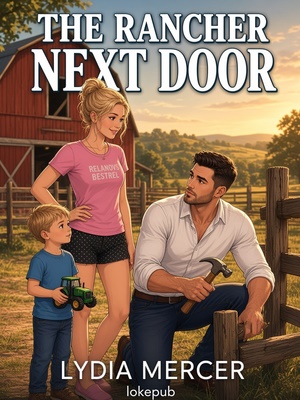
The Rancher Next Door
1. My Rock Bottom has a Hot Cowboy
MY ROCK BOTTOM HAS A HOT COWBOY
Felicity
The last time I made a life-altering decision on forty-eight hours of no sleep and a broken heart, I ended up with a tattoo of a rose on my hip and pregnant with my now four-year-old, Maverick.
So really, quitting my job, packing up my entire life to fit in the back of my SUV, and relocating to a home I’d never seen in a town I’d never visited was practically responsible by comparison.
At least that’s what I was telling myself.
“Look, Mama!” Mav’s booster seat squeaked as he craned to watch the bay reveal itself on our left, its horseshoe curve dotted with boats and the bobbing shapes of paddleboarders. “That’s a pirate flag, that means there are pirates here!”
I checked the rearview, and my heart swelled. Cartoon-wide amber eyes. Chocolate on his chin that I had not given him. A grin that could disarm a small government.
“If you see any pirates,” I told him, “ask them to please save their best treasure for us.”
He considered this with the gravity of a four-year-old who takes both pirates and requests extremely seriously. After a few moments, he did his adorable nose scrunch. “Pirates steal treasure, I don’t think even saying please so they know I’m polite would make them give it to me.”
“That’s a good point,” I agreed. “Never mind.”
And that was the sort of critical thinking that came from raising a gifted child.
At Maverick’s two-year checkup, his pediatrician, Dr. Novesteras, gave me a book titled A Parent’s Guide to Gifted Children.
When I thanked her, she told me it was the least she could do, I was going to need all the help I could get.
I hadn’t fully grasped what she meant, but with each passing year, I understood more and more.
I glanced out the window and my entire body thrummed with a kind of caffeinated panic—equal parts terror, hope, and a sprinkle of relief that we weren’t, at that exact moment, being pursued by the ghosts of my own bad decisions in the form of debt collectors and unreliable, narcissistic exes. This was our new beginning.
Following the sat nav, I took the first exit, which dropped us off in downtown Valentine Bay.
I didn’t know that much about the town, other than its unique name and picturesque location on the Oregon coast, which drew a large tourist crowd.
From what I saw, the pier and businesses were overflowing with visitors, and locals who were, if my uncle was to be believed, putting up with them.
The quaint downtown district sloped gently toward the waterfront, each block stacked with two-story Victorians painted in popsicle colors: creamsicle orange, mint blue, banana split yellow.
Banners strung across Main Street promised: The Cookie War Returns!
The sidewalks buzzed with kids on bikes, retirees walking golden retrievers, couples and families.
We passed the boardwalk, fifty yards of sun-bleached planks lined with souvenir shops, a fish-and-chips shack, and an arcade that, from the outside, looked like it had updated its games when my late Uncle Walter was still in diapers.
With each block, the quaintness out-quainted itself.
Be Mine bakery boasted, “Famous Oatmeal Cookies!” hand-painted in the window, and Ever After Florist advertised, Free Delivery for All Heartbreaks and Anniversaries (No Judgement).
I didn’t even let myself calculate how many heartbreaks or anniversaries I’d racked up that qualified for that discount.
In the backseat, Maverick pressed his face to the glass so hard his breath fogged a circle. “Mama, there’s a playground and a statue of a dog by the water. And there’s a real cowboy. Do you see the cowboy?”
I saw him. A man in a worn hat, jeans, and boots, straddling a rusted bike outfitted with a saddle in place of a seat.
He smiled widely and waved at us. I waved back.
Either he mistook me for someone he knew, or this town was a lot friendlier than Seattle.
Either way, seeing a friendly face helped to calm my overactive nerves.
When I’d gotten the email from a lawyer saying that Uncle Walter passed away and he left me his house—a sentence I had to read four times to believe—I thought it was a prank.
Why would a great uncle I barely knew leave his home to a niece he’d only met a few times? It had to be some sort of mistake.
I called the attorney, Raymond Blackburn, and lo and behold, I wasn’t being punked.
He explained that this was my uncle’s wishes and emailed me photos.
I clicked on the attachments and saw a smallish craftsman perched on a rise above the water, white paint peeling in long strips, the porch railing patched with mismatched balusters, and a single rhododendron bush blooming.
It looked like a Hallmark movie location.
I told myself the house was our escape hatch. The house was mine outright. No more stressing about making rent or keeping the lights on. No boyfriend or baby daddy making promises he doesn’t keep. No more moving every year because of breakups, rent hikes, or owners selling the building.
Our new life consisted of a small town where I’d hopefully be able to ingratiate myself into the community and find support.
No more boyfriends/situationships who “didn’t want to put labels on things” or “needed to put themselves first,” only to string me along until their next conquest, or sometimes during.
No more baby daddy who only remembered Maverick’s birthday if Facebook sent him an alert.
After a life spent growing up in foster care, being “raised” by the system, I would finally be able to give Maverick the childhood I’d craved so desperately. We’d have a permanent address, something I’d never experienced in my entire life. And three lush acres for him to roam on.
As his mother, I hoped to provide a home, a yard, a safe community, stability, and a childhood that didn’t depend on whether his father remembered he existed.
Leaving Seattle, and inheriting this farmhouse, felt like my golden ticket to accomplish those things. But I had to be intentional in every action. It was too easy to get swept up by the dramas and demands of the day and lose focus.
I made three promises to myself on that drive into Valentine Bay:
1. Give Maverick the idyllic childhood.
2. Rebuild my event-planning career, which I’d put on hold because Maverick’s dad didn’t like me being gone on the weekends or evenings.
He was a traditionalist, in the sense that he wanted me home making him dinner every night, but not in the sense of financially supporting his child or the woman who gave birth to said child.
3. Stay away from men, at least until Maverick graduated from college, or med school, or possibly until I died.
I didn’t have the best track record with men, which is exactly why I’d decided part of our fresh start was the perfect palate cleanser to make big changes and focus on myself, my son, and building a life for him that I could look back and be proud of the childhood I’d provided.
Mav’s voice snapped me out of my mental vision-boarding. “Mama, are we there yet? ’Cause my foot’s asleep and it’s making my brain do jumpy things.”
“Almost, bud.”
A left at the church, a right at the public library, and the Downtown district was in the rearview. As I followed the GPS directions, I noticed there were houses tucked into the hillside like secrets.
“Your destination is in point five miles on your left,” the automated voice announced.
My heart pounded as the finality of arrival was upon us. A tiny part of me still expected the house to vanish in a puff of smoke, or to wake up in our old apartment, sunlight slicing through the crooked blinds, everything the same as it ever was.
But as I continued driving, there it was.
17 Driftwood Lane, weathered gray and abandoned at the end of a short driveway with a faded red mailbox barely clinging to the post at the road.
I tried not to panic that it looked like the haunted house version of the charming cottage the lawyer had forwarded to me.
I’d never been catfished by property before, only men, and this was a lot scarier.
My throat pinched. I parked and sat for a moment, hands white-knuckling the wheel. Maverick unbuckled himself and clambered into the front seat to peer through the windshield and point excitedly.
“That’s our house?” he asked with breathless enthusiasm, clearly not seeing what I was seeing. I wished I had his same optimistic outlook on our new dwelling.
I nodded, swallowing the lump in my throat. “Yep, it sure is.”
He grinned, exposing his gapped front teeth. “Race you to the door!”
Before I could respond, he shot out of the passenger side like a bullet.
He made it to the porch first, of course, and waited with exaggerated patience for me to catch up.
I fished out the key the lawyer had sent and braced myself for whatever “vintage charm” looked like when left unsupervised for half a decade.
Uncle Walter spent his last five years in a senior care facility.
The door stuck, but a hard shove got us inside where we were met with the unmistakable aroma of dust, old books, and something else—wet dog, maybe, or unwashed dishes.
From the doorway, I could see the front room was compact, a combination of dark wood and faded flowered wallpaper.
Someone, I would assume my uncle, had attempted to install recessed lighting but abandoned the project halfway, so the ceiling was a polka dot of empty sockets.
Uncle Walter’s lawyer had described the home as “charming coastal cottage with vintage flair” and “rustic, but with good bones, and a killer view of the Pacific.” My very optimistic—or possibly willfully delusional—imagination had filled in the gaps with window boxes overflowing with geraniums, a porch swing, and maybe a pie cooling on a windowsill.