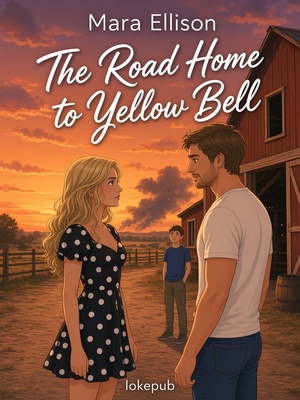
The Road Home to Yellow Bell
Chapter 1
Chapter One
Emily
Why is it so freaking hot today of all days?
The black cotton of my pencil dress is practically fused to my back.
I can feel beads of sweat tracking a slow, itchy path down to my ass.
The color choice wasn’t exactly ideal for a triple-digit forecast in the height of Oregon summer, I admit, though it’s not like there are a multitude of options when attending your father’s funeral.
Ironically, the last time I squeezed into this thing was for the job interview that started this whole downward spiral.
I stand unevenly next to the pastor, my black patent stilettos sinking into the parched grass like tent stakes. I feel as though I’ve exchanged far too many hollow pleasantries with a trickle of well-wishers who have come out to say their final farewell to my father.
Most of them are strangers, some old acquaintances—elderly distant relatives, old friends of my father’s, people who went to school with him back before we left for Oregon.
There aren’t many, only a scattering of people who truly appreciated Dad.
It was hard not to; he was the kind of man who had all the time in the world for everyone, a warm, steady fixture of the community who could fix a neighbor’s tractor as easily as he could tell a joke.
Just when I think I’ve smiled my final forced smile and listened to the last anecdote about Dad’s golden hands, I look to the sky.
I wonder if he’s looking down right now and laughing at us.
I know for a fact he thought Gus from the hardware store was an idiot, and yet here Gus is, dabbing his eyes with a greasy handkerchief.
I turn to Father Graham to relieve him of his duty. “Thank you so much for today, Father. Dad would have really appreciated it.”
His snow-white hair is almost illuminated by the sunlight, and the lenses of his bifocals are so thick they make his eyes look tiny. “Bless your heart, Emily. Your father was well-loved by everyone in the community,” he replies, encasing my hand between both of his frail palms.
Dad and I were never religious—we didn’t exactly spend our Sundays in a pew—but my dad used to fix Father Graham’s car for a reasonable price, so the man owed us a favor.
“If you need anything at all, Emily, you know where I am.” His words are a mirror of every well-wisher’s surface sincerity today.
“Thank you, Father. I’ll keep that in mind.”
He nods warmly before turning to make his way back to the parking lot, leaving the graveside virtually empty. I inhale deeply, catching the sharp, resinous scent of pine and sunbaked grass, closing my eyes for a moment of calm amongst the chaos of the past few months.
I let a welcome cool breeze float over my face, and suddenly, beside me, I feel a presence.
A warm scent of musk and expensive leather fills my senses just before the sound of someone clearing their throat.
My eyes open, and standing hesitantly in front of me is a man I haven’t seen since I was seven years old.
Owen Miller.
His features are exactly as I remember, only thrown two decades into the future.
The same steady brown eyes are now framed by deep-set weather lines, and his once darkened blonde hair is a slightly more silvered shade.
He wears a perfectly tailored black three-piece suit and a matching black felt Stetson that looks like it cost more than my last three mortgage payments combined.
He’s been hanging back, I realize, waiting for the crowd to thin.
“Emily,” he says, his voice a warm, gravelly rumble. He removes his hat, holding it against his chest.
“Mr. Miller,” I breathe, surprised my voice holds steady. “I wasn’t sure if you’d get my email. I found the ranch address online. It would have meant everything to Dad that you’re here.”
“I got it. And please, it’s Owen. Always was.
” He looks toward the casket, and a flash of genuine pain crosses his face.
“I’m sorry it took me so long to get over to you.
I wanted to give you a moment. Your dad…
he was the best man I knew. We were both dinosaurs when it came to modern technology—neither of us could text to save our lives—but we spoke on the phone whenever we could.
I’m glad we had that at least, but I fear we left it too long. ”
He looks back at me, his gaze assessing. I wonder if he can see the strain of the last few months hanging around my neck, or if he only sees the ghost of the little girl who used to run wild on his ranch.
“I know it’s just you now, Emily,” he says softly. “And I know your dad would haunt me to the end of my days if I didn’t make sure you were looked after.”
He reaches into his vest pocket and pulls out a thick, cream-colored card. On it is a cell number line and the Yellow Bell Ranch’s unmistakable logo embossed onto it.
“I’m heading back to Montana this evening. If you find yourself needing a change of scenery—or needing anything at all—you call that number. You don’t even have to say hello. Just tell me where you are, and I’ll come get you. Do you understand?”
I take the card, the sensation of it feeling more solid than anything else I’ve held lately. “Thank you, Owen.”
“Don’t thank me,” he says, replacing his hat and adjusting the brim. “We’re family, Emily. Whether it’s been twenty years or fifty. Don’t you forget that.”
My lips press into a thin line, a small smile of appreciation finally breaking through for his kind words. “Thank you, Owen,” I say, nodding as I find my voice. “I’ll keep it in mind. I really will.”
He nods in return, touching my arm with a steady, paternal kindness. “Well, I’ll let you go now. It’s been a long, rough day for you, sweetheart. But please—remember my offer stands.”
He turns toward the gravel path, and I stand there, feeling the heat radiate off the ground as I watch him climb into a massive, jet-black Ford branded with that same silver Stallion logo of the Yellow Bell Ranch.
It’s a powerhouse of a truck, sleek and intimidating, and it kicks up a cloud of dust as it pulls away.
I twirl the thick business card between my fingers, feeling the embossed letters before I finally slip it into my purse.
Turning back, I take one last glance at the six-foot hole my father has been reduced to. The tears I’ve been fighting back all day finally feel safe enough to escape.
“Bye, Daddy,” I choke out, my lip trembling violently.
I reach into my pocket and pull out a small, wilted daisy chain.
I lean over and toss it onto the casket—a fragile, white-and-yellow splash against the dark wood.
It’s a relic of the summer days we used to spend in the Montana fields.
The hours he’d sit with me while I looped the stems together.
It was the mark of the unbreakable bond we once shared.
Now, I’m alone. Technically an orphan, blacklisted from the only career I’ve ever wanted, and standing in the dirt with sixty-four dollars to my name.
I honestly don’t know what I’m going to do next.
* * *
The silence in the house is heavier than ever as I make it over the threshold.
I kick a pile of letters to the side—knowing full well that there are more bills and notices in there—before I instinctively look to the old leather armchair that sits by the window.
I feel a strange, hollow emptiness because when I come home, my father no longer greets me from it.
I’d moved back into Dad’s place six months ago after I lost my job and had the court case hanging over my head, a move that had felt like a defeat at the time, but turned out to be a blessing.
It gave me six months to be his nurse, his cook, and his daughter again after the corporate world in Portland chewed me up and spat me out.
Now, it was just a house full of grease-stained manuals from the 1990s and empty rooms.
I kick off my black stilettos, the relief of my feet hitting the hardwood almost makes me lightheaded. I reach up, pulling the pins from my hair and letting the heavy mass of blonde fall over my shoulders. I feel wrought. Like someone has twisted me in the middle and wrung me out dry.
I make my way to the kitchen, my stomach growling with an empty ache.
I open the fridge. Great: a jar of mustard, half a lemon, and a carton of milk that has definitely turned.
I check the pantry, but it’s just as bleak, so I settle for a stale box of cereal and eat it dry.
My bank account is a desert, and the house—the only asset I have left—would have to be sold just to clear the mountain of medical bills and legal fees Dad had taken on for me.
I sigh heavily, reaching for the bottle of Jameson on the counter. I pour a finger of whiskey into a glass, not bothering with ice, and slump onto the sofa. The burn in my throat is the only thing that feels real right now.
I reach into my purse for my phone, wanting to check the time, but as I pull it out, a thick, cream-colored card flutters onto the cushion.
Yellow Bell Ranch.
I pick it up, the embossed logo catching the dim light of the living room.
I think back to the sleek black Ford, the expensive Stetson, and the way Owen had looked at me, like I was still part of a world I’d forgotten.
I think about my career in ruins and the “Past Due” notices stacked on the coffee table with no idea how I’m going to pay for them all.
Taking a breath that tastes like cheap whiskey and desperation, I dial the number with an unsteady hand. It doesn’t even go to a third ring.
“Miller,” the gravelly voice answers.
“Owen? Hi, it’s Emily. Callahan.” I clear the lump in my throat, my fingers tighten around the glass. “I’m sorry to bother you so late, but…I think I may need to take you up on that favor.”