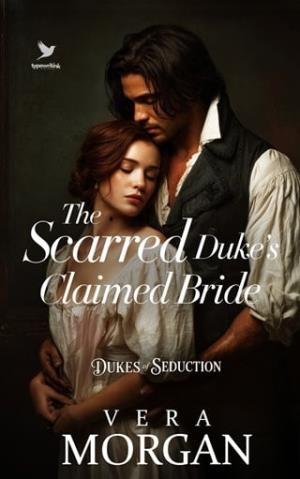
The Scarred Duke’s Claimed Bride (Dukes of Seduction #2)
Chapter One
“If you insist upon reading that Gothic nonsense aloud, Molly, I shall be compelled to throw myself from this carriage.”
Fiona Hart had not the slightest intention of throwing herself anywhere. The rain hammering against the carriage windows had already soaked through one corner of the leather curtain, and she had no desire to add drowned upon the Yorkshire moors to her catalogue of indignities for the day.
Her maid lowered the penny pamphlet with an expression of wounded dignity. “It is a perfectly respectable tale, miss. The Beast of Brantwood Hall. Very educational.”
“Educational.” Fiona arched one brow. “And what, precisely, does it teach? That young ladies ought to wander into crumbling castles and expect to discover handsome, misunderstood lords awaiting reformation by the power of their virtue?”
“Well.” Molly considered this gravely. “Yes, miss. That is exactly what occurs in chapter four.”
Fiona bit back a smile. She had read the pamphlet herself, cover to cover, the previous evening—but Molly had no need to know it. Certain dignities must be preserved, even between mistress and maid who had known one another since girlhood.
The carriage lurched violently.
Fiona’s hand shot out to brace against the wall, her heart vaulting into her throat. Outside, the coachman shouted something swallowed by the wind, and the horses screamed—a terrible, panicked sound that lifted the fine hairs along her arms.
“Miss—” Molly’s pamphlet flew from her grasp as the carriage tilted.
Fiona had precisely one coherent thought: This is what I deserve for mocking Gothic novels.
Then the world turned sideways.
The crash was a symphony of splintering wood and shattering glass, punctuated by her own scream and Molly’s frantic exclamations. Fiona’s shoulder struck something unyielding—the door, perhaps, or the ceiling; direction had lost all meaning—and pain bloomed, bright and immediate, across her vision.
When at last the carriage ceased its violent motion, she found herself crumpled against what had once been the window, rain pouring through a jagged breach in the wood to soak her face and hair. Her ribs throbbed. Her head pounded. Somewhere beneath her, Molly whimpered.
“Molly.” Her voice emerged as a rasp. “Molly, are you—”
“Alive, miss.” A pause. “I believe so. Though I may have left my stomach somewhere upon the road.”
Fiona attempted a laugh and discovered it hurt abominably. She shifted, endeavouring to ease her weight from whatever portion of Molly she had landed upon, and promptly learned that her left ankle had no intention of cooperating with any movement whatsoever.
“The coachman,” she managed. “Mr Briggs—”
“Here, miss!” The reply came from somewhere above and to the left, muffled by rain and wreckage. “I’m pinned, but I shall manage. You stay where you are—there’s a drop not three feet from the carriage. We’ve gone off the cliff road.”
A cliff road. Naturally. An ordinary tumble into a ditch would have been far too commonplace for this particular journey.
Fiona closed her eyes and allowed herself precisely five seconds of despair.
She had been meant to reach Whitby by nightfall, to secure an introduction between her cousin Adelaide and the eligible—if reportedly insipid—third son of a viscount.
She was meant to be useful. Practical. The sensible Hart daughter who managed things while her prettier, more frivolous relations secured advantageous matches.
She was not meant to be lying in a shattered carriage upon a Yorkshire cliff in a storm intent upon washing the entire county into the sea.
“Miss Fiona.” Molly’s voice had gone thin. “Miss… someone is coming.”
Fiona opened her eyes.
Through the rain and the broken frame of the carriage window, she saw a figure approaching.
Not merely walking—striding, with a purpose that suggested the storm was no more than an inconvenience rather than the apocalyptic deluge it appeared.
The figure was enormous. Tall and broad-shouldered, silhouetted against the iron-grey sky like something torn from the darker pages of Molly's Minerva Press romances.
Dark hair whipped about his face—too long, too untamed—fighting the wind like a living thing. His coat billowed behind him, and even half-blinded by rain and pain, Fiona could discern the sheer scale of him.
The Beast of Brantwood Hall, she thought, and nearly laughed at her own absurdity.
He reached the carriage. A face appeared in the jagged opening—rain-slicked and sharply hewn, with dark eyes that seemed to absorb the storm’s light rather than reflect it.
He was not handsome, she decided. Handsome was too mild a word, too civilised.
His features were stark, severe—the work of an artist who valued impact over elegance.
“Can you move?” His voice was deep enough to rival the thunder, rough as the rocks visible beyond the carriage’s wreckage.
Fiona blinked rain from her lashes. “I—my ankle. I do not think—”
He did not wait for her to finish. One moment, she was attempting to explain her predicament with the composure befitting a baronet’s daughter; the next, large hands had closed about her arms, and she was lifted from the wreckage as though she weighed no more than Molly’s abandoned pamphlet.
“Sir—” she gasped, but speech proved difficult when one was being cradled against a chest that felt carved from the same stone as the cliffs. His coat was soaked through, yet beneath it she felt the heat of him—the solid, living warmth that cut through the rain’s chill.
He looked down at her. At such proximity, she saw that his eyes were not merely dark, but the deep brown of aged oak, of earth after rain, fringed by lashes any debutante would envy.
His jaw was set, his mouth a firm line that suggested he found the storm, the wreckage—and perhaps Fiona herself—deeply inconvenient.
“Your maid?” he asked.
“Inside. And our coachman—he said he was pinned—”
The stranger turned his head and bellowed an order into the gale. Though Fiona could not distinguish the words, two additional figures soon emerged from the rain—servants, by their appearance. One hastened toward the carriage; the other followed at a run.
“My men will see to them.” He was already moving, carrying her away from the wreckage with long, decisive strides that defied mud and wind alike. “Can you tell me your name?”
“Fiona Hart.” Her teeth had begun to chatter as the cold penetrated the shock. “Miss Fiona Hart, of Suffolk. I was travelling to Whitby, to my aunt—”
“You will not reach Whitby tonight.” The words were delivered without apology. “The road is washed out in three places, and the bridge at Cragmoor has collapsed.”
“Collapsed?” she repeated faintly. “But my aunt is expecting—”
“Your aunt must wait.”
The audacity of it—spoken as though her family’s expectations weighed less than the weather—ought to have offended her. Yet the rain drove harder, her ankle throbbed with each step, and his arms were the only constant in a world that had abruptly lost all sense of order.
Through the veil of rain, a shape emerged.
A house—no, a castle—of dark stone and sharp angles, perched upon the cliff’s edge as though grown from the rock itself. Lightning fractured the sky behind it, and for one absurd moment, Fiona wondered whether she had fallen bodily into Molly’s novel.
“Where are you taking me?” she called over the wind.
He glanced down at her, something flickering in his eyes—surprise, perhaps, that she dared question him. “Thornwick Castle. My home.”
Thornwick Castle.
The name stirred a faint chord in her battered memory—something mentioned in her aunt’s letters, some warning or morsel of gossip she had skimmed in favour of practical details.
But the thought dissolved as another wave of pain surged through her ankle, and she found herself clutching at his coat to suppress a cry.
His hold tightened—not painfully, but with deliberate assurance, as though he had perceived her distress and addressed it in the most efficient manner possible.
“We are nearly there.” His voice softened, if only a degree—from granite to sandstone. “You are safe now, Miss Hart.”
Safe. A simple word. And yet, cradled against this stranger’s chest while a storm raged and a castle loomed ahead, she found she almost believed him.
The world began to blur at the edges—shock, cold, or both. She tried to focus upon his face, to commit its stark planes to memory, but her vision would not obey.
“Sir,” she managed, because even on the brink of insensibility, she was her mother’s daughter, and propriety must be observed. “I do not believe you have given me your name.”
A pause. Rain drummed against his shoulders as the castle gates swung open before them, revealing a courtyard lit by guttering torches.
“Hale,” he said at last. “Christian Hale.”
The name meant nothing to her. Yet the manner in which he spoke it—as though he anticipated recognition, or perhaps braced for it—penetrated even her gathering haze.
“Thank you, Mr Hale,” she whispered. “For saving my life.”
Something shifted in his expression—surprise, perhaps, or something more guardedly tender—but darkness crept in from the edges of her vision, and she could no longer be certain of anything.
The final words she heard before unconsciousness claimed her were spoken low and rough against the storm, a murmur that might have been a warning—or something more intimate still:
“Not ‘Mr Hale’, Miss Hart. The Duke of Thornwick.”
***
Christian Hale, seventh Duke of Thornwick, had not intended to acquire a houseguest today.
He had intended to spend the evening precisely as he spent most evenings: alone in his study, a glass of brandy at his elbow and a stack of estate correspondence before him, listening to the storm assail the windows and finding, in its violence, a temperament suitably matched to his own.