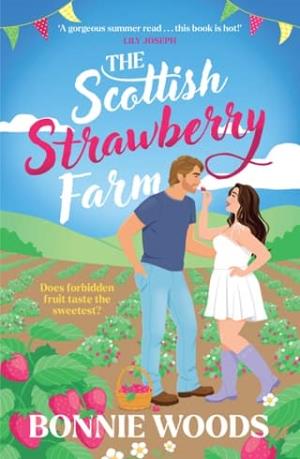
The Scottish Strawberry Farm (Scottish Spice #3)
Chapter 1
As Rae looked out at Sweetbriar Farm’s steadily blooming fruit fields from the kitchen window, she felt herself longing for something she couldn’t quite name.
She’d thought – or, at least, hoped – that coming home would settle the niggle of unease she’d lived with, worked with, travelled with, for the last six years, convincing herself she just needed a taste of the familiar again.
She hadn’t anticipated that change could happen here, too.
Usually, the farm would be bustling by now, but the fat bumblebees buzzing around the fragrant lavender shrubs seemed to be the only keen summer visitors so far.
Gran maintained the backyard well, the flat expanse of grass fringed by an array of colourful flowers: red geraniums, dense verbena, powder-blue and sunset-pink hydrangea, and even the gold, spiky beginnings of dwarf sunflowers.
However, the rows of tart blackcurrants beyond seemed to have wilted in their solitude, dry leaves curling in on themselves as the sun dipped behind the Highlands.
It was too quiet. Not even the thwack of her knife against the chopping board could distract Rae from the half-formed thoughts rattling around her head.
The long purple carrots and wonky salad potatoes had been harvested from the small, mossy greenhouse beside Dad’s tool shed, Rae having missed getting soil between her fingers – only, that didn’t feel the same anymore either.
She wasn’t even hungry. Just bored, antsy, now she wasn’t rushed off her feet for the first time in her adult life.
Her dad, who normally lived and breathed farm work, had disappeared to meet up with his hiking group, leaving Rae with the task of entertaining Gran.
The plump elderly woman currently hovered over the stove with her hands clasped behind her back.
Her nose twitched as she inspected the pan Rae had set down there. ‘It’s burning.’
‘It’s not burning, Gran. I haven’t even turned it on yet,’ Rae replied, fighting a huff. ‘Believe it or not, I learned a little bit about cooking while I was away.’
‘Not enough,’ Gran muttered.
Rae rolled her eyes. Gran always knew best, and she wasn’t taking kindly to having her kitchen invaded, especially not when Rae had ‘wasted her vegetables to cook fancy mush’.
She was trying not to take offence – she was used to critics, but her Gran was in a different league.
No amount of culinary experience in Michelin-starred restaurants could impress her, so Rae opted for what she’d thought was a relatively homely meal tonight: a summer vegetable couscous with a tomato tart and lamb racks.
Though she’d hung up her chef’s jacket after a terrible few months of burnout, she’d found she didn’t know what else to do, and so her feet had taken her right back into the kitchen here at the family farm.
‘Gran…’ Rae slowed her dicing hesitantly. ‘Are you and Dad struggling?’
Gran leaned against the counter, and for the first time, Rae noticed the countless wrinkles on her liver-spotted face, the hunch of her shoulders from a life of labour, the frailty of her thin wrists and ankles.
And then there was the way she always needed to brace herself against furniture and walls for support, and the cloudiness of her blue eyes, just noticeable behind the thick lenses of her glasses.
She was still sprightlier than most eighty-somethings, but no longer fit enough for the hard work that had once come easy.
She and Granddad, who had passed last year at ninety-one, had grown Sweetbriar from a small patch of ‘sacred’ Scottish land, hoping strawberry production would expand with each generation.
So it had, the house now surrounded by a dozen acres of berries, currants, and fruit trees, some of which had won awards for their high quality and rich taste.
Then, Rae had decided to take up another career entirely, likely ruining all of their plans.
She wasn’t the only potential inheritor, but her uncle and cousins had never showed an interest in taking over, her uncle having fled the small town of Belbarrow the minute he’d turned eighteen, only ever returning at Christmas or for hospital visits.
‘We’re surviving, hen, just like always.’ The uncharacteristic softness in Gran’s voice did nothing to quell Rae’s concern.
Rae rubbed the steady ache of guilt at her sternum and set down the knife to face Gran properly. ‘I went into the farm shop this morning and it was half-empty.’
The little cobblestone building at the front of the house had once been filled with all manner of homegrown produce, but it looked like the shelves had emptied a long time ago.
Minus Gran’s famously strong fruit wines, a few punnets and jams were all that was on offer to visitors, and since they only had a part-time worker, Myra, manning the counter, their opening hours were limited to weekday mornings and Sunday afternoons.
Not ideal with the summer holidays, their busiest time, just around the corner.
‘Well, we can’t afford to hire any more staff, and your dad’s been struggling to keep up, what with his troubles.’
Rae’s brows furrowed. ‘He didn’t tell me he was struggling again.’ His Crohn’s disease had been in remission since beginning a new treatment plan two years ago. She’d hoped, after watching him suffer her entire childhood, that the worst was finally over. Why hadn’t he told her?
‘Don’t worry. I forced him back to the doctor.
I’m sure they’ll put him on a new miracle drug.
’ Gran batted her hands dismissively. The definition of a Scottish Stoic, she treated everything like a minor inconvenience, whether it was health problems or the loss of her husband.
Making a fuss was a sin in her eyes. Rae wished she could be half as hardy.
Perhaps then she’d still be working in glamorous kitchens on the opposite side of the world.
‘I just don’t know what we’ll do long-term.
Maybe it’s time to close shop, eh? Sell up.
Might actually enjoy my retirement then. ’
After the sting of surprise – Gran had never suggested slowing down let alone retiring – dread then washed over Rae.
The farm was the only home she’d ever known.
All of her favourite childhood memories, the ones she always returned to when she needed comfort, were out there in those fields.
She couldn’t bear the prospect of losing it.
Was this her fault? Should she never have left? She’d always planned to come back eventually, but what if she’d waited too long?
She chewed her thumbnail, earning a disdainful tut from Gran. ‘Stop that. Terrible habit for a young lass.’
Rae ignored her chiding. ‘Have you talked to Dad about closing?’
‘Hm.’ Gran ushered Rae out of the way so she could wipe down the already spotless counters. When she tried to pick up the knife on the chopping board, Rae prised it from her hands.
She assumed the noncommittal hum meant yes, she had spoken to Dad about it, and Rae could only imagine how it had gone.
He was as stubborn as she was, and had sacrificed everything for the farm, including his marriage.
He and Rae’s mum had divorced when Rae was thirteen because Dad had refused to consider a life where his every day didn’t begin and end here, and Rae had chosen to stay instead of moving to Edinburgh with Mum.
The turmoil must have been written all over her face, because Gran patted her cheek with a cool, papery hand. ‘You don’t need to worry about it now. Let’s just see how summer treats us.’
‘It will be nice to get back to it all,’ Rae admitted.
She returned to her carrots, finding her worries only grew louder as she fell into her effortless rhythm.
Part of her was still trapped in a blindingly white-lit kitchen, orders to get a move on piercing her ears, co-workers colliding, food spilling and searing, until the chaos was all Rae knew.
She only noticed her grip on the sleek black knife tighten when her palm began to smart.
‘Cut those any thinner, and we’ll be eating air for tea,’ Gran complained, pulling up a stool as she examined the bag of couscous. ‘And what’s this? Who looked at rice and thought, “how could we possibly divide grains into something smaller?”?’
‘I’m just glad you’re so supportive of my culinary endeavours.
’ As Rae lifted her head to fix Gran with a deadpan look, movement in the window caught her eye.
Dad must have been back, because his two chocolate-brown Springer Spaniels dashed out of the open patio door and down the garden path, long ears flapping happily.
They, too, were getting older, but the only proof was in the white fur around their eyes and nose.
Her soft smile faltered when she finally caught sight of Dad – not alone, and not completely upright. His arm was draped over the broad shoulders of a taller man to support his painstakingly laboured limps.
Hurt.
‘What on earth’s he done now?’ Gran questioned.
Rae’s knife dropped to the chopping board with a clatter, panic clenching cold fists around her gut as she dashed outside. She almost tripped over the dogs to reach Dad.
‘What happened?’
‘He’s all right,’ assured the man supporting his weight. His honey-blond hair and hulking frame were familiar, but Rae didn’t have time to look at his face, assuming he was one of the few farmhands left. ‘Just decided to take a long walk off a short cliff, didn’t you, Doug?’
Dad’s snort of amusement was fractured by his wince, his face wan under his dark beard. ‘Aye, I clearly need my eyes checked, as well as everything else. It’s just a sprain, kiddo. I’m fine.’
She rushed to prop the patio door open, unable to tear her gaze away from her dad’s pained expression. ‘Are you sure? Maybe we should go to the hospital—’