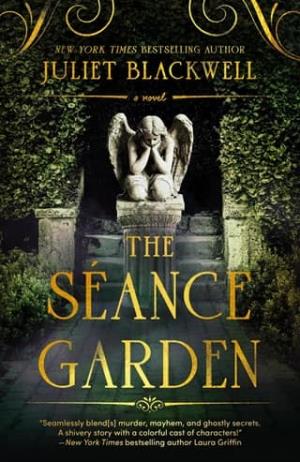
The Séance Garden
Prologue
For as long as she could remember, the girl had been enthralled by the abandoned mansion.
And now, finally, she was big enough. Climbing the thick ivy as she would a ladder, she made it to the top of the high garden wall.
“Give me your hand,” she said, reaching back down to help her brother.
He hesitated. Overhead, the branches of a vast cypress tree swayed and shook, despite the stillness of the day. From its widespread arms hung lichen like silvery-green crepe paper streamers left out in the rain after a party.
“Dooble schafts this,” she said, meaning “You can do it.”
His eyes lit up. He loved it when she spoke to him in the language they had invented, just the two of them. The boy looked over his shoulder nervously before swallowing his fear and starting to climb.
The children landed with a crash in overgrown oleander hedges on the other side of the garden wall.
Brushing themselves off, the girl spied a life-size stone angel kneeling at the base of the tree.
Its graceful wings were furred with moss; elbows resting on its thighs, it cupped its face in its hands.
It gazed down at the ground, mournfully.
The girl stared at it for a long moment. Was it her imagination, or did the angel almost seem to…breathe?
“That’s creepy,” the boy said.
“It’s just old,” said the girl with a shrug. “C’mon, let’s find a way in.”
Built of adobe brick, like all the oldest buildings in Monterey, the Perles Mansion had survived more than a century and a half due to a good roof, temperate weather, and…
something else. Something less obvious. Nanny had sternly warned them away from exploring the building, insisting its very walls were suffused with evil.
The adobe mud had been dredged from a cursed burrow, Nanny whispered, and the bricks laid in place by artisans forced to labor for the wealthy and ruthless Perles family.
“How do you know?” the girl had asked.
“It’s what the old wise women say,” Nanny had replied. “They say that only if the workers sing as they make the bricks will the home be a happy one.”
“And no one sang while building the Perles Mansion?” the girl had asked.
Nanny shook her head, a faraway look in her dark eyes. “They cried.”
The girl liked Nanny, but she was not about to heed her advice. Now that she had made it into the garden, she was determined to find her way into the mansion itself.
All the doors and windows were locked. But then the late-afternoon sun glinted off a piece of glass, and the girl discovered a grimy basement windowpane covered in ivy.
With a surge of triumph, she lifted the green shroud to reveal a slender access point.
Big enough for a child to slip through, she decided.
Just big enough.
The boy protested again, but after a moment, he followed her in.
The large, shadowy basement looked like a set from an old movie.
Grimy vials and beakers and coiled copper piping were piled atop every surface.
Large jars held various bits and pieces floating in a clear liquid—a fetal pig, a snake, something that looked suspiciously like a human finger.
Spiderwebs festooned the dirt-caked bottles lining the shallow shelves that covered one wall; a massive stone mortar and pestle stood in the very center of the room.
The floor was only partially paved in stone, with hard-packed dirt around the edges.
The sepulchral air smelled of mildew, rodents, and stillness.
Neither child said a word as they poked around. Silence felt more natural, as if the laboratory were a cross between a crypt and a library.
The girl was intrigued, yet repelled. She had read Mary Shelley’s Frankenstein last year in her Literature for Gifted Readers class.
She understood that laboratories like these were the realm of dangerous men, men who sought to use science to challenge the rules of the natural world.
Men who imagined themselves to be Prometheus, bringing knowledge to the world at any cost.
“Look what I found,” whispered the boy as he held up a fat, ancient-looking journal that had been lying atop a workbench, its yellowed pages so old they were crumbling at the edges. As he flipped through it, a dried leaf fell from between its pages, fluttering down to the counter.
“It’s a journal,” he said, again in their secret language. “Look, the mad scientist took lab notes, just like we’re supposed to do in science class. And it’s written in some weird hodgepodge language, sort of like ours.”
The girl peered over his shoulder.
The slanted, faded script was hard to read, but she could make out a few words.
Some were in English, Spanish, or Latin, while others were in a language she did not recognize.
The “mad scientist” had filled page after page with what appeared to be recipes and lab notes, accompanied by elaborate sketches of human anatomy.
“He was a good artist,” said the boy. “Like you. I really like that monster you did last week in church. Mom sure was mad, though.”
“Sure was.”
Their mother usually had better things to do than worry about what her children were up to, but she did insist the family look respectable when they went to mass on Sundays: their good clothes pressed, their shoes polished, their hair just so, with the girl’s in ribbons and the boy’s slicked back.
After Nanny smacked her hand for doodling a strange chimera on the back of the church bulletin describing the order of the morning’s worship service, the girl defiantly began drawing vaguely religious figures—Christ on the cross, looking monstrous; John the Baptist washing the feet of an ogre; Saint Theresa holding a demon-like baby.
Her mother, who had been absorbed in the liturgical music, glanced at what her daughter was doing, screeched, and ripped up the bulletin. The priest stumbled over his words, and many in the congregation murmured, craned their necks, and stared.
“Wicked child,” her mother had said in a fierce whisper. “That is the Devil’s work. You are never to draw again, do you hear me? I fear for your soul.”
The girl shivered now, remembering, but remained defiant. Wicked or not, she would draw. She would.
And one day she would draw whatever she wanted.
“Look,” said the boy. “Here’s a recipe for curing chaw…Chole…”
The girl glanced at the journal. “Cholera.”
“Oh,” said the boy. “What’s cholera?”
“I’m not exactly sure, but it used to kill a lot of people,” said the girl, itching to get her hands on the journal but pretending she did not much care.
If her brother knew she wanted it, he would hold on to it.
Better to let him lose interest on his own; then she could nab it, and he would be none the wiser.
“Let’s check out the rest of the house,” the girl said, gesturing toward the wooden stairs.
“I don’t know if we should. Nanny said we shouldn’t even be here.”
“Stay down here if you want. I mean, if you’re a scaredy-cat.”
“I’m not a scaredy-cat!” he protested. “But it’s creepy.”
“I’m going up. Stay here if you want, or come with me. Your choice.”
He made a twisty motion with his mouth. The girl knew the gesture well; he did it when he did not want to follow her lead but would anyway.
Her brother was naturally more cautious than she, but he would never leave her to explore on her own.
As she mounted the wooden stairs leading to a door, she heard, with satisfaction, his footfall on the steps behind her.
At the top of the stairs, she grasped the door’s old brass knob. It turned in her hand, but the door would not open.
“Is it locked?” the boy asked.
“Something’s blocking it, I think. Let’s both try.”
Sister and brother put their shoulders to the door and pushed as hard as they could, but the door would not budge.
After a few moments, they gave up and went back down to the basement.
“Let’s go down to the beach to see the sea lions,” said the boy. “It’s more fun.”
“I’m going to find another way in.”
“But why?”
“Because this will be my house one day,” she said with an air of finality.
“Why do you want an icky old house like this? When we grow up, I’ll buy us a nice new one to live in together, just the two of us.”
“It doesn’t work that way, you know,” she said.
“I don’t see why not. We’re different from everybody else. We have our own language. We have our own everything.”
The girl shook her head and tried to ignore him. He said things like this more and more lately.
As she looked around, imagining what the “mad scientist” had been working on, she repressed a shiver. The basement was fascinating, but also seemed…she searched for the word she had just learned in literature class: “malevolent.”
At that moment the dismal old laboratory seemed to come to glittering life before her eyes.
She could hear the walls whispering to her, imagined flames flickering below the beakers, liquids bubbling through the coiled pipes, and the aroma of freshly crushed leaves wafting up from the huge marble mortar and pestle.
Despite her misgivings, she wanted to linger here, to explore the rest of the home at her leisure, to decipher that journal…
to learn the mysteries of the Perles Mansion.
Beginning with whatever stood behind that locked door at the top of the stairs.
“I will live here one day,” she repeated quietly, her words seeming to echo off the basement walls. “It needs me. It’s like it’s calling to me. Don’t you hear that?”
“I don’t hear anything.”
The door at the top of the stairs swung open a few inches, then slammed shut again with a loud bam!
The boy jumped and cried out in fear, then scrambled on top of the workbench and out the window. When he realized his sister had not followed him, he called back: “Come on! Let’s go!”
But the girl remained stock-still beside the huge mortar and pestle, surrounded by grimy beakers and bowls and jars with their mysterious contents. Slipping the journal into the front of her jacket, she stared up at the basement door. It opened slightly, then closed with a slam, again.
She smiled.