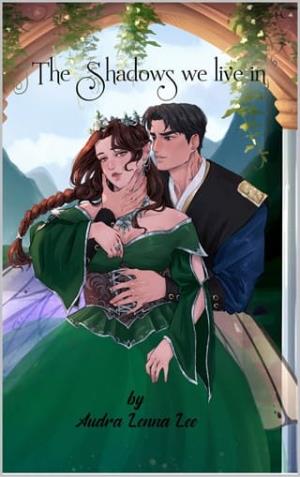
The Shadows we Live In (The Crimson Oath Saga #2)
Prologue – The one I can’t burn
Prologue – The one I can’t burn
Taeyang
I can’t fucking sleep. Fuck.
I close my eyes, and the world just gets louder—steel on bone, breath snagging on old orders, a door in my chest, the bond keeps trying to kick open. When it’s quiet enough to hear myself think, I hear her. When it’s loud enough to drown me, I see her.
Yuna.
I hate that I know her name like it’ll be my salvation.
The bond won’t let me forget. It coils around my ribs like barbed wire dunked in salt, tight when I’m still, tighter when I lie.
Phantom heat flares in the hours after midnight, when the halls are empty and monsters look like men again.
That’s when the mark burns: a crescent scored under my sternum, fate’s little joke, the place where I want, learned my true shape.
I tell myself it’s just magic. A trick. A curse with good taste. The burn doesn’t care what I call it.
When she’s near—even through stone, even through wards I helped build—my pulse stutters like a horse smelling smoke.
Power slips its leash, shadow licking at my wrists, waiting for a command I won’t give.
I press my palm to my chest and feel the heat there like a mouth learning a word it isn’t supposed to say aloud.
I don’t want a mate. I don’t want her.
Because wanting her means setting down the weapon I spent centuries perfecting. Loving her means offering my throat to the future and trusting it not to bite.
And I have been bitten. Once was enough to teach a lifetime. So, I run.
I train until my knuckles split and my breath tastes like iron.
I spar the wooden man and the men who wish they were wood.
I volunteer for patrols along the Veil where the air is thin and mean.
I take missions that end in blood and call it penance because I don’t believe in mercy when it looks at me.
I laugh at the wrong times to prove I can.
I collect silence like trophies and hang them where no one will see.
It doesn’t work.
I still find her in the places I promised myself I would keep her out of, in the way I choose a door over a wall, in the way I hesitate before I cut a throat that isn’t mine to save or punish.
Her voice lives under my scars, soft and stubborn, the sound steel makes when it decides not to pretend it’s anything else.
Her scent—spring rain on stone—sticks in my lungs after battle like the idea of a life that doesn’t hurt to touch.
I see her when I close my eyes. Worse, I see her when I open them.
She’s fae, they remind me. Light, beauty, mercy. All the things my house taught me to despise. I am wrath. I am war. I was built as an answer to problems people didn’t want to name.
But the body doesn’t care about doctrine. It recognizes home when it’s starving.
On the nights when I can’t pretend, I climb.
Roofs are honest. They tell you how badly you patched them the last time the sky tried to tear them off.
I stand above sleeping courts—over lanterns that breathe and vines that gossip—and I do the only math that ever steadied me: count breaths, count exits, count stars until I run out of numbers and have to admit what’s left.
Her.
I think about the first love I lost—the girl with ash in her hair and light under her tongue, the one a king took to prove that kings can take.
I remember the palace burning because I lit it.
I remember promising that my heart would be a locked room after that.
I made good on the promise for a long time.
Long enough to forget what the latch sounded like.
Then Yuna laughed.
Nothing clever. Just a small, disobedient sound that didn’t ask permission from the room. The brand under my sternum flared like it recognized its maker, and I knew like cold water, like a blade in the ribs—that wanting her could kill me.
I ran harder.
I told myself the bond was a trick of proximity. A fae glamour. A hunger with good manners. I told myself I could starve it out by feeding everything else: war, work, wounds I could name. I told myself I was safer as a monster other monsters know.
Fate does not care about a man’s self-story.
So, the brand keeps testing the door. The nights keep lengthening.
I keep bleeding on purpose to prove I get to choose how I hurt.
And she keeps showing up where I can’t keep her out: in the way rookies stand a little wider after I correct them without breaking them; in the way the wind shifts before a storm and I pause because that’s what she would do; in the way my hand refuses to finish a strike when mercy will do more damage to the right thing.
I hate her for that. Not really. I hate the part of me that keeps writing her into me, neat as a signature.
Some mornings I catch myself speaking to the empty room. “It’s nothing,” I say. “A burn fades. A mark is just a story scar tells the skin.”
But scars are a kind of memory, and this one remembers loudly.
When I pass the balcony she favors, the stone feels warm.
When I touch the ribbon at my wrist I haven’t taken off because I can’t admit it was never mine to wear, my hands go steady like a dog finding home by scent alone.
When someone speaks her name—carelessly, like a blessing they did not earn—I flinch.
I have seen wars end. They don’t. They change costumes. I have seen men kneel. Sometimes they get back up different. Sometimes they don’t.
I do not kneel. Not too crowns. Not to curses. Not to the old, ugly voice under my ribs that says heel and means hurt her first so she can’t hurt you.
But there is a different voice now. Quiet. Stubborn. It says stay. It sounds like her.
I don’t know how to be the man that voice deserves. I only know the drills: wrap your hands, square your stance, choose your target, breathe. I can learn new drills. I just don’t trust the field.
So, I keep moving. Keep the fury busy so it doesn’t notice it’s lonely. Keep the blade sharp so it doesn’t notice it wants to be a hand. Keep the brand in a room with no windows and a lock I can break if I need to run.
The truth is a small, hard thing I keep in my mouth until it cuts:
She is the one thing I can’t burn.
The world made me good at turning love into ash. She walks through my fire and does not ask me to be anything I am not. She looks at me like wrath is a tool, not a sentence. She says my name and the room remembers how to open without breaking.
I tell myself I am not ready.
Fate doesn’t care.
So I sharpen my knives and count the routes and pretend I am not already choosing. I tell myself I will not kneel. But when the bond tightens, when the crescent under my skin warms as if it had a say in who I am, when I breathe her in and my power sits instead of pacing—
I know how this ends. She will ruin me. And worse than that—I think I want her to.