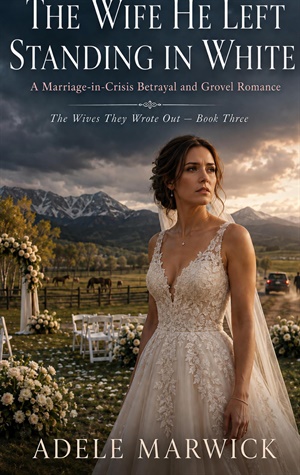
The Wife He Left Standing in White (The Wives They Wrote Out #3)
Chapter 1
The Wedding He Promised
LAUREL
At six that morning, my husband stood barefoot at the foot of our bed and told me I was not allowed to see my wedding dress.
“I have already seen it,” I said.
“Not on you.”
“That is generally how fittings work.”
Thatcher folded the garment bag over one arm as if he had been entrusted with state secrets.
He wore old gray riding pants and nothing else.
A pale scar crossed the left side of his ribs, narrow now but still visible after eleven years.
In the early light, he looked younger than forty and less guarded than the man who could settle a frightened stallion by lowering his voice one degree.
“Deirdre said tradition matters,” he said.
“Your mother also said the ceremony should begin with the Red Lark founders’ hymn. Some traditions deserve a quiet death.”
His mouth moved. Thatcher’s smiles were rarely large. I knew each one anyway.
“You agreed to three hundred guests,” he said.
“Because you promised me twenty and your mother invited the other two hundred eighty.”
“I promised you a wedding.”
He had. Seven years earlier, we had signed our marriage license at the Denver courthouse between his qualifying ride in Wyoming and a clinic I was working in Pueblo.
I had worn navy trousers. He had carried a bunch of grocery-store daisies through security because he had forgotten the courthouse banned glass vases.
We had been happy, impatient, and certain there would be time later.
Later had arrived with white canvas tents across the south pasture, three hundred chairs spaced with Deirdre’s idea of luxury, and my dress locked in the east dressing room.
Thatcher hung the garment bag inside the wardrobe. When he turned, I had risen onto my knees.
“You are bad at guarding things,” I told him.
“I am excellent at guarding things.”
I reached for the drawstring of his riding pants. “Then stop me.”
He caught my wrist. For one suspended second, his expression remained solemn. Then he drew me to the edge of the mattress and kissed me.
Seven years had taught me the weight of his hand at my jaw and the way restraint left him slowly, not in a theatrical break but in layers.
His mouth warmed against mine. My fingers found the hard plane of his stomach.
He set one knee between mine, and the familiar pressure pulled a sound from me that made his breath roughen.
“We have a schedule,” he murmured.
“Deirdre has a schedule.”
“You have hair at seven.”
“Then you have forty minutes.”
“Cruel woman.”
I kissed the scar at his ribs. The skin there had no feeling in one small patch.
Everywhere around it did. His hand slid beneath my nightshirt, warm and certain, finding me already ready for him.
When his fingers pressed inside me, I held his shoulder and watched the concentration gather in his face.
“Laurel.”
“Don’t become polite now.”
His laugh ended against my throat. He stripped the nightshirt over my head and lowered me onto the bed.
We knew how to hurry without making it careless.
His mouth, my hand around him, the quiet question in his eyes before he entered me and my answer in the lift of my hips.
Pleasure came threaded through ordinary knowledge: the old strength of his back under my palms, the sound he made when I tightened around him, the way he kept one hand behind my head so it would not strike the carved headboard.
When I came, I said his name into his shoulder. He followed with his forehead pressed to mine, our breath sharing the same small space.
Afterward, he lay beside me and traced the bare place on my left hand.
“You could wear the ring,” he said.
“I’ve worn it every day for seven years.”
“Today is different.”
“Today is public.”
His fingers stilled. “Yes.”
That was the point of the white dress, the tents, and the absurd towers of flowers. I had not needed a second legal ceremony. I had wanted one day when Thatcher stood before everyone who treated me as the practical woman behind Red Lark and chose me without qualification.
He kissed my knuckles. “I’ll see you at the end of the aisle.”
At ten forty, I was standing in the east dressing room while three women pinned the last half inch of ivory silk at my waist. June grazed in the small bridal paddock outside the window, unimpressed by the string quartet rehearsing below.
My mare had a white star shaped like an untidy thumbprint.
She lifted her head when she heard my voice and went back to grass.
Deirdre had arranged a procession that placed me after twelve members of the Wynn family, two retired champions, and a riderless horse carrying the ranch colors.
I had removed the riderless horse from the schedule after explaining that memorial symbolism did not belong at a wedding.
She restored it twice. Thatcher removed it the third time and took the argument himself.
That small act had mattered. He was not a man who never chose me. He chose me in rooms where the cost remained manageable, then assumed the private choice would survive whatever he conceded in public.
On the dressing table lay the ceremony card he had written by hand.
Laurel Dane Wynn, my wife and my first home.
He had crossed out bride because, as he told the officiant, we had already spent seven years married.
The sentence had made me cry during rehearsal.
This morning it looked like proof that he understood exactly what I had asked the day to mean.
I slid the card into the pocket sewn beneath the skirt. I did not know then that I would still be carrying it when I cut the fabric away.
My own vows waited on the vanity. I had written about the courthouse daisies, the winter we slept in the foaling barn, and the first horse Thatcher let me withdraw from a sponsor event because she was sore. Nothing in them begged to be chosen. They assumed I already was.
At nine, I had turned off the rehabilitation duty phone and transferred it to Pax.
The act took less than a minute and required three written handoffs: June’s medication schedule, a mare due for a post-surgical check, and the number of the veterinarian covering emergencies.
My clients would not lose care because I was getting married.
They also would not reach through an emergency and make me the only person allowed to respond.
Thatcher had watched me set the phone in Pax’s hand.
“You make leaving work look easy,” he said.
“It is not easy. It is planned.”
“Red Lark emergencies rarely respect plans.”
“Then your staff needs authority before the emergency, not a husband sprinting out of his own wedding.”
He had kissed my forehead. “No sprinting.”
We both smiled because the image seemed ridiculous: Thatcher in formal clothes, running from the aisle toward a horse. I had not asked whether the rule included Sabine. I did not know another plan existed beneath ours, one in which an old promise had already named him as her first call.
Pax carried the duty phone all day. When a client did call during hair and makeup, he handled the question, sent me the note for later review, and never interrupted the room.
The system worked because everyone had agreed I was allowed to be absent.
I folded the page and placed it beside his card. The ceremony coordinator asked whether I wanted a copy held at the microphone in case my hands shook. I said no. I knew the words.
Outside, three hundred people took their seats to witness something our legal marriage had never required. Their presence was supposed to make the promise visible, not create it.
Pax Doran leaned against the open door in a suit that fit him as if both parties regretted the arrangement.
“If you pull a syringe from that jacket,” I said, “my mother-in-law will have you removed.”
“It’s an antihistamine pen. The flowers are plotting against me.”
“You’re early.”
“Your husband assigned me to verify that none of the horses involved in the processional were sedated by the floral budget.”
One of the stylists looked alarmed. Pax kept his face straight.
My phone vibrated on the vanity. Not a message for me. The screen showed a Red Lark group alert: RIDER DOWN — WEST PROMOTIONAL LOOP. MEDICAL TEAM RESPONDING.
I took one step toward the window before the location registered. Sabine’s comeback crew had been filming a short sponsor ride on the far western trail, well away from the wedding pasture. She had insisted the schedule could accommodate both.
Pax read the alert over my shoulder. “I’ll call the field vet.”
The hallway filled with rapid footsteps. A young events coordinator appeared, white-faced, followed by one of the emergency medical technicians assigned to the ranch for the day.
“Mrs. Wynn?” the EMT said.
“What happened?”
“Ms. Mercer came off at a shallow crossing. She’s conscious. Vitals are stable. Probable shoulder injury, possible concussion. Ambulance is on site.”
The first clean breath returned to my lungs. “Has her family been called?”
The EMT glanced down the hallway. “We’re trying to reach her primary emergency contact.”
Thatcher rounded the corner in black trousers and a white dress shirt, his tie hanging loose around his neck. Colter followed him. The EMT’s relief was immediate.
“Mr. Wynn. She won’t let us transport until you come. You’re still listed as her primary emergency contact.”
The room changed shape around that word: still.
Thatcher looked at the EMT, then at me. The pause was short enough that no one else would have measured it. I had made a career from pauses.
“She has a medical team,” I said.
“Yes, ma’am,” the EMT answered. “She’s alert and oriented. We’re keeping her still. She’s refusing the ambulance.”
“Then you document refusal and continue care.” My voice remained even. “Unless her condition changes.”
Thatcher buttoned one cuff. “She asked for me.”
The words landed with the dull weight of something used many times.
“Why are you her primary contact?” I asked.
“This isn’t the time.”
“We begin in twenty minutes.”
“I’ll get her into the ambulance and come straight back.”
I looked at his half-tied tie, at the dress shirt I had unbuttoned four hours ago. “Talk to me first.”
Colter turned his head toward the window. Pax stayed where he was.
Thatcher stepped close enough to lower his voice. “She hit the ground. She’s confused and asking for me. I can’t stand here while she refuses treatment.”
“You can call her. You can let her doctor do his job. You can tell me why my husband is still the first person another woman’s hospital calls.”
His jaw tightened. The ranch radio on Colter’s belt crackled: Ms. Mercer attempting to sit up. Request contact now.
Thatcher reached for the tie draped around his neck and abandoned it. “I’ll explain when I’m back.”
“If you walk past me, the explanation won’t put you back here.”
He looked at me then. Fully. There was fear in him, but it was old fear, aimed eleven years behind us. He touched my bare arm as if he could leave reassurance there.
“Laurel, I have to go.”
“No. You feel that you have to go.”
Another burst of radio static. He turned.
The silk at my waist held me perfectly upright as my husband ran down the corridor in his wedding shirt. From the window, I watched Colter’s black utility vehicle cross the service road. Thatcher drove too fast past the barn and out through the western gate.
Below me, the quartet began the processional.
The first notes carried across three hundred waiting guests while the groom’s taillights disappeared beyond the cottonwoods.