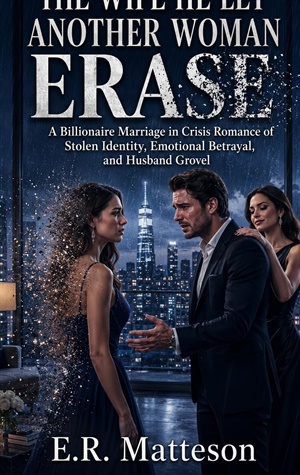
The Wife He Let Another Woman Erase
Chapter 01
LYDIA
The badge said GUEST. They had printed it in the same silver foil as the founder wall, so for half a second it almost looked like an honor.
I turned it over. Smaller type on the back: Visitor Access Only.
"There must be a host list," I said.
The young woman at the check-in table smiled the way you smile at a problem you have already filed. "This is everyone we were given." She slid a clip toward me. "You can fasten it here."
I did not fasten it. I held it in my closed hand, where the foil edge pressed a thin line into my palm.
A small pain. A real one. I kept it.
"Try Hart," I said. "Or Ashford. Either name."
She scrolled, then scrolled again. The stylus tapped the glass the way it taps when it is finding nothing. "It's only guests on here. I'm sorry."
"It's fine." It was not a thing a stranger could fix.
Behind her, the atrium opened up in glass and white light. Seven years of work, lit from the floor. There were waiters with trays of something pale and sparkling. There was a string quartet near the windows, and there were three hundred people who had been invited by name.
I had been invited as a guest to my own life.
I told myself it was the door staff. A temp with a printout. By Monday it would be a story I made small at dinner, the kind Sebastian liked, the kind where I was reasonable and the world was clumsy and everyone could keep eating.
I went in.
I knew the caterer. I had hired the first one, years ago, when the budget was a church hall and a percolator. I knew the font on the program. I had chosen it at a kitchen table. I knew the room. I did not know my place in it.
The founder wall ran the length of the atrium. SEVEN YEARS OF THE SECOND KEY INITIATIVE, in letters tall enough to read from the street. Beneath the title, set into brushed steel, was a single line.
A woman doesn't only need a door out. She needs a second key to a life that belongs to her.
My mother said that. She said it in a kitchen with a window that didn't open, while she counted coins from a jar she kept behind the flour because my father went through her purse.
She said it to me when I was nine. I had written it on the first flyer I ever printed, two hundred copies, because I could not afford three hundred.
Under the line, a small plate gave the attribution.
Camille Wren, Founding Executive Director.
I read it twice. Then I looked for the rest of the sentence, the part that usually lives in small print, the part that says founded as The Second Key Initiative by Lydia Hart. That part holds the truth the way a footnote holds it.
There was no footnote.
There was a brushed-steel wall, and my mother's voice on it, and another woman's name beneath her words.
Founding. Executive. Director. Three words doing the work of one.
Founding made it sound like a beginning.
Executive made it sound like a salary. Director made it sound like a hand on a wheel.
Together they built a woman who had been there at the start and steered it ever since.
None of it was a lie you could point at. That was the craft of it.
The lights dipped. A screen above the wall woke, and a film began.
It opened on a hotel corridor I knew. The Bellwether on Ninth, where the night manager had once let us use a conference room for nothing because his sister had needed us first. The camera moved through it like a memory that belonged to someone else.
A handwritten budget filled the frame next, the columns crooked, the totals in my hand.
Then a woman's face, half-turned from the camera, her story told in voiceover while her name was kept off the screen to protect her.
I had sat with that woman for four hours in a laundromat. I knew the exact gray of her coat.
Her name was Renata. The film called her a survivor.
I had driven her to the courthouse on Adams Street in a borrowed car whose heater only worked at red lights.
I had held her purse while she signed. None of that was on the screen.
What was on the screen was the room, the light, the budget in my hand, and a voice that was not mine telling the world what it had meant.
Camille appeared in soft light, in a chair angled toward the lens.
"It started," she said, "with a belief that every woman deserves more than an exit."
I watched the budget in my own handwriting sit behind her shoulder like set dressing.
Sebastian came on after her. He was filmed against the window of the office he never let me redecorate, and he looked the way he looks for donors, which is warmer than he looks for me before coffee.
"Camille is the public force who made Second Key possible," he said. "She gave the work a voice the city could hear."
I had been the voice the city could hear. I had stood in church basements and shelter hallways and a courtroom on Adams Street, and I had said the sentence on the wall out loud until women wrote it on their hands.
I waited to see myself. A frame. A second.
The back of my head in a doorway. The film was very good.
It had everything except the person who had made it.
My face never came, because someone had sat at a screen and decided, clip by clip, that it would not.
That is not forgetting. Forgetting is an accident. This had taken hours.
On the screen, the budget. In my hand, the badge. Around my neck, under the collar of a dress I had chosen because it would not make trouble, the key.
It was an ordinary key, brass, worn smooth.
Seven years ago Sebastian had given it to me on a chain in that kitchen of ours, the night we agreed to make the thing real.
This is yours, he'd said, closing my fingers over it.
I'll help you make it real. It had opened the first office, a room above a print shop with a radiator that knocked.
The office was gone now. The key opened nothing.
I had kept wearing it anyway, the way you keep a number in your phone after the person stops answering.
I had painted that first office myself, one wall at a time, on Sundays. Renata helped. We used the wrong paint and it never quite dried, and the room smelled of it for a year. It was the first room in my life that had been mine to open and to lock.
My thumb found it through the silk. I pressed the teeth into the pad of my thumb until it hurt, because that was a thing I could feel on purpose.
I took the Guest badge off.
Not in protest. There was no one to protest to. I took it off because I could not wear the word a second longer, and because a small refusal was the only thing in the room that still belonged to me.
"Lydia."
Camille had come from the media wall, unhurried, a flute of something held away from her dress. She wore deep green. She wore competence the way other women wear perfume.
"I didn't know you were coming this early," she said.
"It's a seven-year anniversary," I said. "I was here for year one."
"Of course you were." She said it the way you'd thank a volunteer for folding chairs. Warm. Final. "It's a beautiful crowd. You should let someone get you a drink."
"That's my mother on the wall," I said. "That sentence."
Her smile did not move. It only softened, the way a smile softens when it has decided to be patient with you.
"It belongs to everyone now," she said. "That's what building something does. It stops being one person's." She touched my arm, two fingers, light. "You of all people know that."
Behind her, Eleanor arrived without seeming to move. Ivory, not white. A diamond clasp at the nape of her silver hair. Her eyes touched the badge in my hand, then my face.
"There you are," she said, as if I had been the one who was missing. "Tonight is about the foundation, dear. Try to enjoy it."
It was not a suggestion. It had the polished warmth of the heated towels she kept in every guest bathroom. Pleasant. Cold within the minute.
A man with a press lanyard slowed beside us, hopeful. "Mrs. Ashford—" he started, looking at Eleanor, then at Camille, deciding. He settled on Camille.
"Ms. Wren. Could I steal two minutes about the founding story?"
The founding story. I almost said it then.
I am the founder. Two words. They sat in my mouth and went nowhere.
Seven years, and the sentence still would not come in a room like this one.
That was what they had counted on. Not malice.
My silence, used as a building material.
I had handed it over year after year, every time I let a small wrong stand because setting it right would have made a scene.
"In a moment," Camille told him, and to me, kindly, "We'll talk soon. I'm so glad you came." She turned toward the lights, and the lights were glad to have her.
I stood where they left me. The waiters moved. The quartet found the end of one thing and the start of another. On the wall my mother's sentence held still in steel, and the woman it now belonged to crossed the floor to explain it to a man with a recorder.
A waiter offered me a flute. I took it by the stem and did not drink.
The bubbles climbed in thin strings. My hand left a damp half-moon on the glass.
Somewhere a donor laughed. Somewhere a check was being written with a number large enough to have funded my first three years.
I had built a thing that taught women to put their names on what was theirs.
I stood in the middle of it without mine.
I had thought, walking in, that the worst version of tonight was that no one would mention me.
That was not the worst version.
The screen reached the part of the film where the music goes soft and a face fills the frame to make you feel the cost of things. Camille, lit gold, leaned toward the camera.
"Second Key began," she said, "with a story my mother told me."
My thumb stopped on the key.
That was not Camille's mother's story.