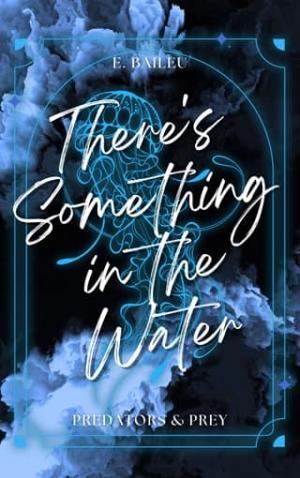
There’s Something in the Water (Predators & Prey #1)
Chapter 1
Tobias
Three Months Earlier
I first noticed him just as the reef tank blossomed into its artificial dawn. A soft cerulean light filtered through forty thousand liters of saltwater, shimmering off living coral and the curved glass in wavering bands. The gallery was hushed except for the excited murmuring between patrons.
Most visitors pressed their foreheads and palms against the glass of the tanks, leaving splotchy, greasy smears as they hunted for a single brilliant hue to satisfy their juvenile attention spans.
He, however, stood a step back—far enough that the glass didn’t mirror him.
His shoulders sloped naturally, his spine a straight column, hands loose at his sides.
He wasn’t merely looking; he was submerged, his dark-green eyes flecked with gold, flowing with the same unhurried grace as a fish weaving through coral arches.
Where others scanned in quick fragments, he traced each drift of color patiently, as if he felt the saltwater’s rhythm more keenly than the air around him.
He stood around five-ten, with long, lithe limbs hinting at both strength and flexibility.
His hair glowed burnished copper, the hue of sun-warmed pennies.
Tiny silver clips—sea stars and seahorses—pinned his braids into a neat crown at the nape of his neck, beautifully expressive of his individuality, but still practical enough to keep every strand off the collar of his employee shirt.
The tank’s pale light made his skin look porcelain-smooth, and a constellation of freckles spilled from the bridge of his nose down the hollow of his throat—an arrangement I honed in on instantly.
I’d always been good at spotting patterns.
Behind me, a child’s cry echoed. Footsteps rattled across the polished floor. An elderly couple bickered quietly over something trivial. Still, the blue glow never wavered, and my subject remained motionless.
When he did move, it was with purpose. He checked his watch, rolled back his shoulders, and swiped his ID card through a staff-only door. Then he disappeared.
I’d never believed in coincidence. I built my fortune predicting human behavior—how desire leads to action, action to habit, and habit unveils the machinery beneath. People are systems, and once you map their variables, they become easily predictable.
I wanted to learn more about this new subject, find out what his variables were. Something in me tugged me towards him, and I needed to know why.
I needed to know him.
So I returned the following Tuesday at exactly the same time. There he stood again, hair freshly restyled with a single clamshell clip anchoring his braids into a bun. That tiny change thrilled me more than it should have.
I began my inquiries that afternoon.
Cove Sinclair was twenty-two, had recently graduated with a Bachelor’s in Marine Science from a respected university in the States, and was here on a six-month internship with the hope of it turning into something long-term.
His visa was temporary, of course.
“Temporary” made me think.
Some creatures aren’t meant to drift without direction.
Some only thrive under permanency.
By the third week, I’d reshaped my entire schedule around his.
My philanthropic commitments could wait; this was far more compelling.
I’d spent years crafting environments where rare specimens could live comfortably under precise conditions—lights calibrated, temperatures locked, variables reduced until survival was simply inevitable.
A remarkable find in the wild had only a matter of time before I collected it. And as luck would have it, I had room for a new specimen.
Shift rotations hung behind the staff desk on laminated sheets with names, initials, and assignments in neat columns. During my next visit, I hovered until I could read them without suspicion.
“Sinclair, C. Tropical Reef—Mondays he did not.
A smaller shark lingered, hesitant to approach. Cove’s smile softened before he lowered the pole a fraction, coaxing rather than commanding, eyes bright when the animal finally accepted its piece of fish.
By my fifth visit, I’d captured his attention. First, a pause in his routine glance, then a second look that settled on me milliseconds too long. I remained perfectly still—hands behind my back, suit uncreased, expression neutral.
He wiped his hands on a terry towel, and I saw his eyes in full color—chlorine-streaked teal, neither purely blue nor green like I’d first thought, almost as if the shade changed in response to his environment.
It was magnificent.
I inclined my head in the faintest nod. He saw, but instead of returning the motion, he looked puzzled, then turned away and returned to his task.
That evening, I reviewed the aquarium’s donor records and quietly increased my contribution. Visibility, when wielded correctly, could be a powerful tool.
At my next visit, the director greeted me by name. “Mr. Kelly, lovely to have you here again!”
Cove froze mid-tilt beside the tide pool exhibit, one sleeve rolled to his elbow as he righted a crooked placard.
His hand stilled, and a tiny crease formed between his brows.
His assistant followed his gaze to me, amusement flickering across her face before she whispered something that sent a faint flush through his freckles.
He glanced at me again—too fast, in my opinion—then turned away with a pinched expression.
Over the next week, his awareness continued to sharpen. He didn’t stare, but he watched every time I entered the gallery.
A typical prey animal might have hidden.
He did not.
That interested me most.
It was time to learn more, and people reveal themselves most freely online. A five-minute search turned up an active social media account. The hair in his profile photo—loose on sun-bleached rock, copper strands lifted by wind—and the freckles across his skin made my confirmation immediate.
His feed was private, sensibly so. To bypass this, I created a fake account for a young marine-photography enthusiast newly relocated to Queensland, posted a handful of reef shots and a dive-boat stock image, then sent him a follow request.
Twelve hours later, I was in.
His posts formed clear patterns with sunrise tide pools, jellyfish drifting in quarantine tanks, macro shots of coral polyps under blue LEDs, and fleeting glimpses of him.
Never posing, always candid. Mid-laugh, looking at something the viewer couldn’t see, brushing hair from his forehead.
He shared meals with earnest commentary—mountains of ramen, iced coffees extravagantly decorated, and an obsession with “the best cinnamon roll in Brisbane.”
I bookmarked the bakery’s address.
His captions brimmed with genuine affection. There were detailed explanations of moray-eel feeding rituals, candid frustration at coral bleaching, and protective irritation when commenters misidentified species.
He cared deeply about the sea, with the intensity of someone who called it home.
Some days, he rose before dawn, jogging the mangrove-lined river path a block from his rented flat, paused at the cinnamon-roll bakery for coffee, then arrived at work with a to-go cup in hand.
He drank iced coffee like water and collected marine-themed hair clips as if they were trophies.
Cove had no idea how much of himself he’d already revealed. Most people never do.
Given enough observation, even the wariest creatures eventually drift close enough to the glass to be understood—and, if desired, captured.