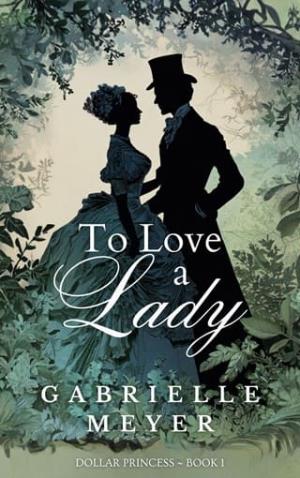
To Love a Lady (Dollar Princess #1)
Chapter 1
Iknew how to blend into the dangerous tenement neighborhood of Five Points to stay safe. But here, just outside the Metropolitan Opera House on opening night, among the city’s wealthiest citizens, I stood out like a thistle among the roses—except no one really saw me.
“Buy a flower?” I asked a fashionable lady as she walked past me in a fine gown. The bustle was draped with yards of purple silk, which trailed along the dusty street behind her, bouncing with each step.
The woman didn’t bother to acknowledge me as she stepped closer to the man escorting her down the street.
A sharp wind sliced along Broadway, and I wrapped my thin shawl a little closer, pretending I was cold, when the truth was, I didn’t want anyone to see the state of my gown. The only one I owned. Stained, worn, and drab.
“Buy a flower?” I asked a distinguished gentleman in a silk top hat, offering the same fabric flower. Though I had scrubbed my hands before leaving Mulberry Street, my fingernails were stained with dirt. I tried to hide them beneath the petals of the flower.
“No, thank you,” the man said, without glancing in my direction.
I tried not to feel discouraged, though I had been outside the opera house for two hours and had only sold two flowers.
Darkness had fallen upon the city, though the streetlamps offered a soft glow for me to see the beautiful people passing by.
Dozens of gleaming carriages lined West 39th and 40th Streets and a trolley drove down Broadway.
Even at this time of night, the streets were busy with traffic.
I should be on Mulberry Street, piecing together shirtwaists, but I could not pass up opening night of the newly built opera house and the opportunity to make a little extra money.
Ushers in black tuxedos opened the doors of the opera house, and people began to stream out onto the sidewalk.
There were hundreds of men in black evening suits and top hats, with capes and walking sticks. And just as many beautiful women in gowns of every imaginable color with jewelry that sparkled under the lamps. My eyes feasted upon the ornate stitchwork and expensive fabrics.
The conversation hummed with excitement, talk of the opera, and the dinner parties being hosted throughout the city that night.
This was the moment I’d been waiting for, though I wasn’t the only hawker on the street. I held up my satin rose, one of dozens I had made in secret these past few months, and competed for attention.
“Buy a flower?” I asked, holding it up from one person to the next. “Buy a flower?”
People pushed and prodded as if I was not there.
“Buy a flower, ma’am?”
“Yes, of course,” a lady finally said, without even looking at me or the flower.
She wore a stunning mauve evening gown with a thick bustle, long train, and a sparkling diamond tiara on her dark hair.
She was easily in her upper forties but carried herself with a youthful elegance.
“Give her a dollar, Alec, and then we must find our carriage. What a crush this is. I can scarcely breathe.”
My lips parted in surprise. A dollar? I had been selling my flowers for a nickel apiece.
“That’s too much, ma’am,” I told her, conscious of my course Irish accent beside her refined American one. “A nickel will do.”
She didn’t seem to hear me as she turned to a woman beside her. “What a stunning rendition of Faust, don’t you think, Mrs. Vanderbilt?” she said. “Signor Italo Campanini was brilliant. And to finally have a box at the opera! What a coup. Mrs. Astor must be steaming mad tonight.”
People bumped into me from all sides, pushing me closer to the gentleman instructed to pay me.
He pulled a wallet from inside his suitcoat, though it wasn’t easy for him to move his arm, as he, too, was being pushed. “A dollar, did she say?”
“’Tis too much,” I said as our gazes met. “I’m askin’ only for a nickel.”
“What did you say?” He half-smiled as he frowned and leaned closer. He was at least twenty years younger than the woman—perhaps her son?
It was loud but surely he heard me. “A nickel, sir.”
His frown disappeared, but his smile remained. There was kindness in his blue eyes—a kindness I didn’t often see from gentlemen of his ilk.
“I don’t have a nickel.” His voice was cultured and sophisticated. “So a dollar will have to do.”
“I’ll make you some change.” I started to dig into my pocket, but he put up his hand to stop me.
“Keep the change.”
“Have you found our carriage, Alec?” The lady turned back to us. She paused as she seemed to see me for the first time. Her gray eyes penetrated mine as she looked at me from head to foot and then back up again. “She’s beautiful. Look at her, Alec, isn’t she beautiful?”
The man glanced away, as if embarrassed by her statement.
“Look, Alec,” the woman insisted as she moved her head to try to get a better view of me. “She’s exactly what I’ve been looking for.”
“Aunt Maude,” the man said to her, “this is neither the time nor the place.”
“But look at her,” she said again as she touched his arm.
He finally returned his gaze to me. His eyes were the bluest I’d ever seen, and his dark brown hair curled out from underneath his silk top hat in a playful manner, though it did nothing to make him appear childish.
Men like him didn’t look at me the way he did—and I felt ashamed of my old dress, my lack of a hat, my unwashed hair, and the dirt smudges on my skin.
I turned my gaze to the ground.
“Isn’t she beautiful?” the lady asked. “Under all that filth, of course. Just think what we could do with her.”
My cheeks burned with humiliation. What did she think she could do with me?
I no longer wanted their money or their attention.
Clutching the satin rose, I tried to turn away, but there was nowhere to go. I was trapped by the crowd.
“Aunt Maude,” he said with admonishment in his voice, “you’ve embarrassed her. And what if someone hears you?”
The lady glanced over her shoulder, as if remembering where she was. “Of course.” She moved a little closer to me.
I tried to back up.
“What is your name?” she asked me, her gaze intent upon my face. She did not look unkind—but she did not look welcoming, either.
I shook my head.
“Don’t worry,” the man said to me, “she means no harm.”
The lady was attractive, though age had begun to erase her youthful complexion. Wrinkles had set in around her eyes, but what she lacked in beauty she made up for in style.
“I don’t mean to scare you,” she said, clearly trying to control her voice. “I have been looking for someone exactly like you for months.”
Again, the man looked away.
“Will you call on me?” the lady asked, handing me a card. “Tomorrow morning at ten?”
Call on her?
I finally found my voice. “For a job, ma’am?”
“Something like that.” She smiled, as if to reassure me. “How old are you?”
I swallowed, hoping my voice worked. “One and twenty in June, ma’am.”
“Twenty-one?” she lifted her sculpted eyebrows. “I would not guess a day over eighteen. You’re so delicate and youthful-looking.”
I had never spoken more than a few words to a lady like her before, except for once, a very long time ago, and that seemed like a dream now.
But I had to tell this lady the truth. “I’m a pieceworker, ma’am, not a maid.”
“I don’t require either one.” She lifted her chin and glanced around to see if anyone was watching us.
Thankfully, everyone seemed preoccupied with finding their carriages.
“You’ll see on the card that I live at 800 Fifth Avenue. Don’t be late.” She nodded at the man—her nephew. “Give her enough fare for a cab tomorrow.”
A cab? I’d never dreamed of riding in a cab.
Someone tore the lady’s attention away again, and the nephew took a step closer to me.
He still had his wallet out, so he removed a five-dollar bill and offered it to me, an apologetic look on his face.
“You don’t need to come, if you don’t like,” he said quietly.
“Though you have nothing to worry about, if you do. Aunt Maude might be a little eccentric, but she’s kind. ”
I swallowed hard as I stared at the money. It would take me almost three weeks, working ten to twelve hours a day, to earn five dollars. Even now, I would have to make an excuse as to why I wasn’t at the kitchen table helping piece together shirtwaists.
“I-I can’t take your money,” I said.
He nudged it closer. “For your trouble.”
I looked up into his blue-eyed gaze and found he was serious.
No one handed out free money. Everyone wanted something. Unless he felt pity for me—something I couldn’t abide.
“If you come,” he said, “use the money for a cab. If you don’t come, consider it payment for the flower.
” He gently plucked the satin rose from my clenched hand and tucked the five-dollar bill in its place.
“Her name is Mrs. Hill, by the way. Maude Hamilton Hill.” He tipped his hat toward me, his white gloves gleaming.
“And I’m Alexander Paxton-Hill, at your service. ”
No gentleman had ever introduced himself to me. I was both breathless and speechless at the weight of money in my hand and his handsome gaze upon me. “Keira O’Day,” I finally managed to say.
“Kee-ra.” He rolled my name slowly, with a smile, trying it out for the first time. “It’s a pleasure to meet you, Miss O’Day.”
I nodded, unsure what to say. I had no experience being introduced to a gentleman.
“If you’ll excuse me,” he said, “I must get Aunt Maude’s carriage before she starts badgering you again. Perhaps you should sneak off while she’s preoccupied with Mrs. Wilson.”
He was teasing, but I sensed there was some truth in his words. What did Mrs. Hill want from me? If she didn’t need a seamstress or a maid, what else did she require?
I moved away from the crowd of people, slipping the five dollars into the hidden pocket in my dress.
What would happen if I went to 800 Fifth Avenue tomorrow? Would I regret it for the rest of my life?
Or worse, would I regret not going?