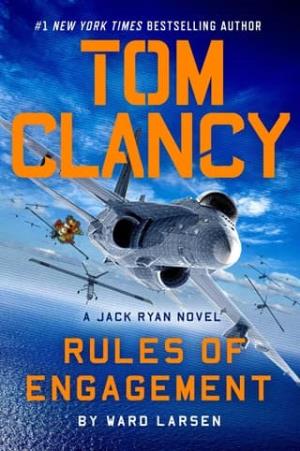
Tom Clancy’s Rules of Engagement (A Jack Ryan Novel #27)
Chapter 1
Standing in the mid-cabin lounge, John Moore calmly gripped the back of the nearest seat to steady himself.
He had lost count of how many of these junkets he’d made in the last three years, but he was beginning to feel like an old hand.
He’d been appointed to the cabinet position by his old friend, President Jack Ryan.
Moore had been a natural fit for Commerce: Georgetown Law, successful businessman, gregarious backslapper.
He was now America’s dealmaker, and he was grateful that in this late stage of life he’d found a way to give back to the country that had blessed him with so much.
He was standing with the dregs of a gin and tonic in hand and chatting with Ari Kouvatsos, the CEO of a Greek shipping company.
Kouvatsos, judging by his wide eyes and clenched jaw, wasn’t a fan of flying.
Things smoothed out and Moore let go of the seat.
It was the first ripple they’d encountered since leaving Tangier three hours earlier.
“As I was saying,” Moore continued, “port fees are determined locally, so I can’t help you there. But the tariff formulas are definitely in my wheelhouse.”
“That is something we hope to address,” replied the shipping magnate with forced composure.
“I can tell you we have a bill pending in Congress that will adjust the weight calculations based on the class of commodity. It’s the administration’s contention that—”
“Mr. Secretary,” interrupted the steward in a polite but firm voice.
“I’m sorry, but we’ll be landing in ten minutes.
I have to ask everyone to return to their seats.
” The young man was wearing his Air Force Class A uniform, the standard for aircrew in the Air Force’s elite 89th Airlift Wing—the same unit that flew Air Force One.
Moore smiled genially, and said to Kouvatsos, “We’ll circle back to this later.”
The Greek sat and Moore moved to the forward cabin.
He settled into a plush seat next to his longtime aide, Monica Smith.
Moore generally enjoyed his work, but after hours spent glad-handing his way across the Mediterranean, he was ready for a few minutes of solitude.
The C-32A was a highly modified version of the Boeing 757 airliner.
There had been extensive upgrades to the interior; a mere forty-five seats were spread around the cabin, most arranged in clusters for small-scale meetings.
“What’s the schedule when we land?” Moore asked. They were about to arrive in Bodrum, Turkey, which was hosting this year’s Southwest Asian Economic Conference. Speeches, panel discussions, and enough spicy food to aggravate his peptic ulcer.
Monica, a staid and level presence who’d been at Moore’s side since his corporate days, checked her phone. “Turkish foreign minister will meet us on the tarmac. Shake hands with the heads of a few regional conglomerates, but no speech. Limo to the hotel and done for the night.”
“Thank God.”
Moore set his empty tumbler in a cupholder, and after a brief internal debate he decided against ordering another. He noticed Monica looking at him over the top of her tortoiseshell readers.
“No,” she said in a practiced low voice.
“I didn’t ask anything.”
“You were about to.”
He grinned. That was how long they had been working together. Moore recalled inquiring an hour earlier if there had been any messages from Foggy Bottom.
He said, “And on the Bodrum end?”
“I initiated a secure link about an hour ago to confirm the security arrangements with the advance team. They’re taking it pretty seriously.”
“As they should. Turkey is an Islamic country, and it’s had its share of unrest.” He looked over his shoulder cautiously. There was no one within earshot. “But nothing about our…last-minute change?”
“Not a word.”
“That was a strange request. Why do you think the Agency chose this flight?”
“We happened to be in Tangier…right place at the right time. I can’t imagine it was anything else.”
“I suppose,” he said pensively. “But the next time I see the President, I’m going to ask him about it.”
Moore looked out the window, hoping for a glimpse of the Turkish countryside. He saw nothing but dense clouds in the wash of the landing lights.
—
The aircraft commander of SAM Flight 719, Air Force Major Tom Spears, looked outside and frowned. They had been in thick weather since beginning their descent. It was a murky night, and the forecast at the airfield gave little hope for improvement.
Captain Evan Goldman, his right-seater, said, “Remember, if we don’t make it in, our alternate is Mykonos.”
Spears grinned. The idea of diverting to an island playground on the Aegean Sea was a pleasant mental image.
But nothing more. The cloud bases at Bodrum were three hundred feet, the visibility half a mile.
Tackling weather like that at their home drome, Andrews Air Force Base, would be a cakewalk.
Here, on a dark night at an unfamiliar foreign airport, it would be…
a challenge. But Spears never really doubted they would get in.
“There’s an updated weather observation,” Goldman announced. “Still showing the ceiling at three hundred feet with half a mile visibility…right at approach minimums.”
“Shouldn’t be a problem,” replied Spears. “Landing checklist.”
The challenge-response began.
“Flaps,” Goldman read from the checklist card.
“Thirty set.”
“Speedbrakes.”
“Armed.”
“Autobrakes.”
“Three set.”
“Landing gear.”
“Down, three green lights.”
“Landing checklist complete,” Goldman announced.
The tower controller’s voice crackled over the radio in thickly accented English. “SAM 719, you are cleared to land Runway 28 Left. Wind three-five-zero at six knots.”
Goldman read back the landing clearance.
Spears was the pilot flying, but for now the autopilot was doing all the work. The big jet nosed over and captured the programmed descent path that would guide them to the runway. In spite of the poor visibility, the air was smooth, and the hum of the big Pratt & Whitney engines remained steady.
Goldman made a standard callout one thousand feet above touchdown. An instant later, he said, “Boss, I’ve got an amber NAV flag.”
Spears was so engrossed in monitoring the instruments, it took a moment for his copilot’s words to register. “A NAV flag? But I show us tracking fine on the—”
His words cut off when the cloud cover broke. It was as if blinders had been suddenly pulled away. Through the forward windscreen the jet’s brilliant LED landing lights illuminated the ground. Only, to both men’s horror, they didn’t see a runway.
Directly in front of them was the side of a mountain.
The pilots of the 89th were among the best in the Air Force, yet no amount of training or discipline could save the situation. Spears’s brain sent an instinctive command to his hands to wrench back on the controls.
It never arrived.
For a plain-text version of this image, go to this page.