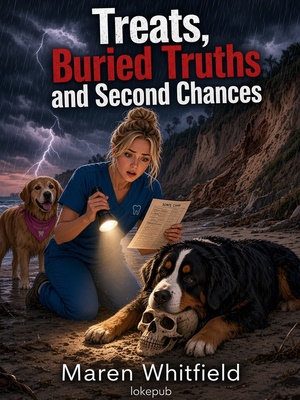
Treats, Buried Truths and Second Chances
1. What the Storm Gave Back
What the Storm Gave Back
It rained for four days, which here is an event and not a season.
"It's Walt's," she said, plugging in the autoclave. "It's been in the basement since 'ninety-five. He bought it after the storm that year and he tested it every January for twenty-two years and I have never once told him I thought it was ridiculous, and you will not either."
We cancelled Friday. Everybody cancelled Friday.
The whole town sat in it — that particular Santa Barbara rain that comes down like it's being poured out of something, straight, no wind, hour after hour — and watched the mountains turn black and the creeks come down brown into a gray ocean with the whole hillside in them.
I liked it, God help me. Tess and I sat in her apartment on the Friday night and watched a bad film with the windows open and the sound of it coming in, and Floss and Bear lay against the door like sandbags, and Nate slept four hours in eighteen because the Bureau, in a storm, becomes a very small emergency-management office with three people in it.
The rain stopped Sunday at dawn. By ten it was the bluest sky you have ever seen in your life, forty-one degrees on the mountaintop and seventy on the sand, the whole coast washed and steaming and absolutely unbearable with light.
And every human being in Santa Barbara did the same thing at the same time, which was go to the beach.
We went to Hendry's, because it was Sunday, and Sunday is dog beach, and by then Sunday at dog beach had been sacred for three and a half years and had survived a homicide, a fraud, a five-week silence, and one mutual decision that we would keep it whatever else happened.
The creek mouth had opened. That's what the storm does — Arroyo Burro comes down hard enough to blow through the sandbar and for a few days there's an actual river cutting the beach in two, brown and fast, and you have to wade it, and dogs lose their minds about it.
Bear stood in it up to his chest with an expression of enormous satisfaction. Floss swam it four times for no reason.
And up at the east end, past the boat trailers, where the bluff runs up toward the Douglas Preserve, about thirty feet of hillside had come down.
You could see it from the parking lot: a raw ochre scar in the face of the bluff, two hundred yards long, with the pale root-ends of things sticking out of it and a fan of mud and rock and iceplant spread across the top of the beach where nobody had been in four days.
There was caution tape at the foot of the Preserve trail and a county truck in the turnout.
Two men in vests were standing at the top looking down at it with that particular municipal stillness.
"That's the trail," said Nate. "That's where the bench is."
"That's where the bench was."
We walked down the other way. We were not being nosy.
I want that on the record, given my history: we walked west, away from it, because the dogs prefer the flats and because a mudslide is not interesting to anyone who lives here — we get four or five of them a winter and they are, ninety-nine times out of a hundred, a matter for the county and an insurance adjuster.
It was on the way back that Bear stopped.
This is the part I have thought about most, and it is the part I put first, because of what it did to Nate.
It was Bear. Not Floss. Floss was forty yards out in the water being an idiot with a piece of kelp.
Bear — who does not fetch, who does not investigate, who has in eight and a half years never once shown initiative about anything except doorways and sitting on people — stopped, halfway up the beach, at the edge of the mud fan where it spread out onto the sand, and put his nose down, and did not move.
"Bear."
He didn't come.
"Bear, buddy—"
And then Bear did something I had seen him do exactly twice before, both times in a boathouse and a dental operatory, which was lie down.
He lay down on the wet sand at the edge of the debris field, with his nose two feet from something, and he put his chin on his paws and he looked up at Nate and he waited.
Nate was there in four strides. I was ten seconds behind him.
It was in the mud at the edge of the fan, half-uncovered, the color of the bluff and almost the same shape as the little rounded stones that come down with a slide.
It was about four inches long. There was a second piece eighteen inches from it, whiter, with an unmistakable articular end, and a third thing further up that I did not look at directly for very long.
And there was, twenty feet away, at the top of the debris where the mud had opened out, something I did look at, for a long time, because it is my entire profession: a fragment of maxilla with three teeth still in it, lying on its side in the ochre mud with the light on it, and on the upper left lateral incisor, even from six feet, even filthy, even after God knows how long, the flat gray gleam of an old composite restoration.
Nobody said anything for a moment. The creek went on making its noise. Two hundred yards down the beach a labradoodle was barking at a boogie board.
"Nate," I said.
"I see it."
"That's a person."
"I know." He had his phone out already, and he was doing the thing he does, which is go absolutely level.
"Don't move. Don't touch anything, don't step anywhere you haven't already stepped, and get your dog out of the water and onto a lead.
" Into the phone: "This is Corrigan. I need Santa Barbara PD and the county coroner at Arroyo Burro Beach, east end, at the bluff failure, and I need them to not send the first two guys who can get here.
Yeah. Human." A pause. "No, I'm not on duty. I'm on a beach with a dog."
I got Floss, who came out of the surf in a spray and an outrage, and put her on the lead, and then I stood eight feet back from a dead person with my hand in my dog's ruff and looked at that old composite filling.
It was a dental restoration. It was small, occlusal-mesial, on a lateral incisor, which is an odd place to need one and usually means trauma rather than decay.
It was gray — which meant amalgam or an old composite gone dark, which meant it was not recent.
It was not a modern material. It had a slight overhang at the margin on the mesial that had been polished back by somebody patient.
I did not say, standing on that beach, I know who did that work. That would be a lie, and I've been careful in three books not to tell you one.
What I thought, standing on that beach, was: *that is somebody's careful work, and it is thirty years old, and there are maybe four people in this county who were doing composites like that in this town at that time, and I bought one of their practices.*
Bear had not moved. Bear was still lying on the wet sand with his chin on his paws, eleven feet from the maxilla, doing the only thing he has ever known how to do, which is stay with the thing until somebody comes.
And Nate Corrigan — who had put his phone away, and who was standing very straight with his hands at his sides looking down at his own dog — said, to nobody in particular, in a voice I had never heard him use in three and a half years:
"Good boy. Good boy, Bear."
And then he turned away and walked eleven steps up the beach and stood with his back to me and his hands on his hips, looking at the water.
I let him have it. I have learned that much.
But I knew, standing there in the wet sand with my ridiculous wet dog and the whole bright washed county steaming around us, exactly what had gone through him — because a man who has spent four years being unable to stop thinking about a body that was never recovered had just watched his own dog find one, and lie down next to it, and wait.