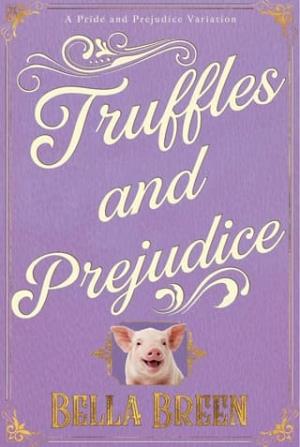
Truffles and Prejudice (Pride and Prejudice Variations)
Chapter 1
ELIZABETH
It is a truth universally acknowledged that a piglet in possession of a good snout must be in want of a gentleman to follow.
Elizabeth Bennet did not have a gentleman. She had a pig.
And at this particular moment, the pig was winning.
"Truffles! Come back here this instant!"
Elizabeth hiked up her skirts and dashed across the Longbourn garden, narrowly avoiding the lavender border her mother prized above all five of her daughters.
The small pink piglet ahead of her was remarkably fast for a creature with legs the length of bread rolls.
Truffles dodged left around the sundial, shot through the gap in the boxwood hedge, and made straight for Mrs. Bennet's rose bed.
No. Not the roses. Anything but the roses.
Elizabeth lunged. Her fingers closed around empty air. Truffles plunged snout-first into the freshly turned soil and began rooting with the joyful abandon of a creature who had never been told no, or had been told no repeatedly and decided the word did not apply to her.
"You wretched animal." Elizabeth scooped up the piglet, who wriggled and squealed in protest, four muddy hooves paddling against Elizabeth's bodice.
A clump of soil fell from the pig's snout and landed on Elizabeth's sleeve.
"You have destroyed three rosebushes this month.
Three. Mama will have you made into bacon. "
Truffles looked up at her with round dark eyes and grunted.
She would not, of course, be made into bacon. Mrs. Bennet had threatened it on at least nine occasions, but Mr. Bennet had observed that the pig had a steadier temperament than most of the household, and that was the end of it.
Elizabeth carried Truffles back toward the kitchen door, holding the pig firmly against her hip.
She could feel the warm weight of the animal through her spencer, the quick flutter of the pig's heartbeat against her ribs.
Truffles had stopped struggling and was now chewing on Elizabeth's bonnet ribbon.
"That is not food."
Truffles disagreed.
Five months ago, Elizabeth had been walking past Mr. Hobbs's farm when she heard the squealing.
A high, thin, desperate sound from inside the barn.
She had gone in without thinking. Elizabeth often did things without thinking, a quality her mother lamented and her father encouraged.
She found Mr. Hobbs standing over a litter of piglets with a bucket of water.
The runt was half the size of its siblings. Pink and wriggling and utterly determined to live, despite being pushed off the teat by every larger piglet in the litter.
"Not worth the feeding," Mr. Hobbs had said, lifting the runt by the scruff. "Too small. Won't survive the week."
Elizabeth had taken the pig out of his hands before she had formed a complete thought about what she intended to do with it.
She wrapped the piglet in her pelisse. Her good pelisse, the green one she had saved three months to buy.
She carried it home with the pig squealing against her chest and never once looked back.
Mrs. Bennet had swooned. Mr. Bennet had peered over his spectacles and said, "Well, Lizzy, at least the pig is unlikely to marry a soldier."
Mary had quoted something from Fordyce about the stewardship of God's creatures. Kitty had sneezed. Lydia had wanted to put a bonnet on it.
Elizabeth named the piglet Truffles, partly because its snout was forever buried in the earth, and partly because she thought it was funny to give a runt from a Hertfordshire farm a name that sounded like it belonged on a Parisian dining table.
Truffles had imprinted on Elizabeth within the first week.
Where Elizabeth went, Truffles followed.
To the garden. To the village. Down the lane for walks.
Up the stairs to Elizabeth's bedroom, where the pig slept on a folded blanket at the foot of the bed.
Mrs. Hill had provided the blanket with the resigned expression of a woman who had long ago stopped being surprised by the Bennet family.
If Elizabeth left without her, Truffles squealed until every window in Longbourn rattled, then escaped whatever enclosure she had been placed in and tracked Elizabeth down.
The kitchen. The cellar. The woodshed. A locked gate was merely a puzzle, and Truffles was uncommonly clever for a pig.
Or perhaps commonly clever, and it was the humans who were uncommonly foolish in their faith in latches.
Elizabeth deposited Truffles in the kitchen and latched the door. She wiped the mud from her bodice with a cloth and surveyed the damage. Her dress was spotted, her bonnet ribbon was chewed, and her left shoe squelched.
It was not yet ten in the morning.
"Lizzy! Lizzy, come here at once!" Mrs. Bennet's voice carried from the sitting room with the penetrating urgency she reserved for three occasions: impending marriage, impending disaster, and the arrival of gossip.
Elizabeth entered the sitting room to find her mother in a state of considerable agitation.
Mrs. Bennet was on the settee, clutching a handkerchief, her cap slightly askew.
Jane sat beside her, embroidering with the serene patience of a woman accustomed to her mother's excitements.
Mary was reading. Kitty was coughing. Lydia was draped over a chair in a posture that would have given their governess palpitations, had they still had one.
"Mamma?"
"Netherfield Park is let at last!" Mrs. Bennet announced, as if informing the room that the French had landed.
"Is it?" Elizabeth sat down and began picking dried mud from under her fingernails. Jane gave her a look. Elizabeth stopped.
"A young man of large fortune from the north of England. A Mr. Bingley. Four or five thousand a year!"
"How fortunate for him," Elizabeth said.
"He is single! And he has taken Netherfield for the whole of Michaelmas! Jane, he will certainly fall in love with you. You are twice as handsome as any other girl in the county."
"Mamma." Jane's cheeks turned pink.
"He is to bring a large party, I am told. Friends from town. Wealthy friends. Oh, what a fine thing for our girls!"
"Is it a fine thing?" Mr. Bennet said from behind his newspaper. He was in his chair by the window, where he spent most of his waking hours, fortified by books and the ability to pretend he could not hear his wife. "I had not noticed."
"Mr. Bennet! You must call on him at once. If you do not call on him, he cannot call on us, and then he will never meet our girls, and we shall all be thrown into the hedgerows when you die."
"I have called on him."
Mrs. Bennet's handkerchief fell to the floor. "You have not."
"Yesterday afternoon." Mr. Bennet turned a page. "He seemed a pleasant enough young man. Rather fond of the sound of his own laughter, but that is no great fault. I believe he will be at the Lucases' dinner on Thursday."
Mrs. Bennet leapt from the settee. "Thursday! But that is only three days away! Jane will need a new ribbon. Lizzy will need — Lizzy, why is there mud on your dress?"
"Truffles got into the roses again."
"That pig!" Mrs. Bennet pressed her handkerchief to her bosom. "That wretched, dreadful pig. It will be the ruin of us. How am I to present five daughters to a wealthy young man when one of them smells of swine?"
"I do not smell of swine, Mamma."
"You have mud on your collar."
Elizabeth glanced down. She did, in fact, have mud on her collar.
"This Mr. Bingley," Jane said, in the gentle tone she used to redirect their mother the way a shepherd redirects a flock. "Is he to come alone, or does he bring companions?"
"A large party!" Mrs. Bennet was diverted instantly.
"His sisters, I am told, and their husbands, and a particular friend.
A Mr. Darcy, from Derbyshire. Very wealthy.
Ten thousand a year, if the reports are to be believed, and I have no reason to doubt them, for Mrs. Long had it from Mrs. Goulding, who had it from the housekeeper at Netherfield herself. "
"Ten thousand a year," Lydia repeated, sitting up. "Is he handsome?"
"That is hardly the point," Mary said, without looking up from her book.
"It is precisely the point," Lydia said.
From the kitchen, a muffled squealing began. Truffles had discovered that the latch on the kitchen door was not, in fact, secured to her satisfaction. A scrabbling of hooves on flagstone. A crash that sounded like the bread basket being knocked from the table.
Hill's voice rose in exasperation: "Miss Lizzy! The pig is out again!"
Elizabeth closed her eyes. When she opened them, her father was watching her over the top of his newspaper, his mouth twitching.
"Perhaps," Mr. Bennet said mildly, "you might introduce the pig to Mr. Bingley's friend. Ten thousand a year could keep a great many pigs in comfort."
"Do not encourage her," Mrs. Bennet said.
Truffles burst through the sitting room door.
Hill had not caught her in time. The pig trotted across the carpet with the self-assured gait of a creature who owned the house and merely permitted the humans to reside in it.
She circled the room once, sniffed Lydia's shoe, rejected Mary's outstretched hand, and settled herself on the rug at Elizabeth's feet with a contented sigh.
Mrs. Bennet stared at the pig. The pig stared at Mrs. Bennet.
"Thursday," Mrs. Bennet said faintly. "He will be at the Lucases' on Thursday. Jane, we must begin preparations immediately. Lizzy, you will leave that creature at home."
Elizabeth reached down and scratched Truffles behind the ear. The pig's eyes closed in bliss, her small body relaxing into a warm pink puddle at Elizabeth's feet. One brown-spotted ear flopped over Elizabeth's shoe.
"Of course, Mamma."
She glanced at the pig. The pig, who had escaped a locked kitchen, a latched gate, and the determined grip of Mrs. Hill, all before breakfast. The pig who would follow Elizabeth into a church, a shop, or the middle of the village green without a moment's hesitation.
She had absolutely no confidence in her ability to make that happen.